

Have you ever stumbled over a sentence filled with S sounds? That’s exactly why S tongue twisters are such a fun and effective way to improve your speaking skills. These clever phrases help you practice the S sound, making your pronunciation, articulation, and speech clarity stronger with regular practice.
Whether you’re an ESL learner, a teacher, a parent, a public speaker, or simply someone who wants to speak English more confidently, tongue twisters starting with S can help. In this guide, you’ll discover easy S tongue twisters, funny S tongue twisters, hard S tongue twisters, and activities designed for kids, adults, and speech therapy.
You’ll also learn practical tips for S pronunciation practice, avoid common mistakes, and build better speaking fluency through simple daily exercises. By the end, you’ll have everything you need to master the letter S with confidence.
Quick Answer
S tongue twisters are fun and effective pronunciation practice exercises that repeat the S sound to improve articulation, speech clarity, and speaking fluency. They are perfect for kids, adults, ESL learners, teachers, and speech therapy practice. From easy S tongue twisters to hard S tongue twisters, regular practice helps strengthen your S pronunciation, build confidence, and make everyday English speaking clearer, smoother, and more natural.
What Are S Tongue Twisters?
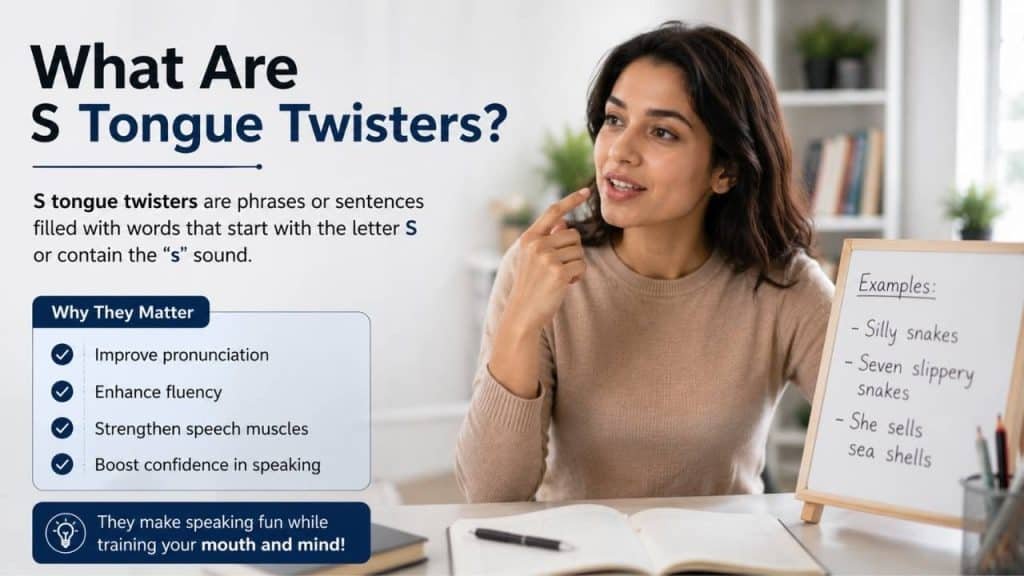
S tongue twisters are short, playful sentences filled with repeated S sounds that help improve pronunciation, articulation, and speaking fluency. They make S pronunciation practice more enjoyable while training your mouth and tongue to produce clear speech.
These tongue twisters with S are useful for kids, adults, ESL learners, teachers, and anyone who wants to speak English with more confidence. You can start with easy S tongue twisters and move on to harder ones as your skills improve. The key is to read slowly at first and then increase your speed without losing accuracy.
Since learning works best when it’s enjoyable, you can also explore our guide on Have Fun or Enjoy to learn the correct expression while making your speaking practice more engaging.
Benefits of Practicing S Tongue Twisters
Practicing S tongue twisters every day can greatly improve your speech clarity, diction, and English pronunciation. Repeating the same S sound helps your tongue learn the correct movement, making it easier to speak clearly in everyday conversations.
These exercises are useful for speech therapy, public speaking, voice training, and classroom learning. They also help ESL learners become more confident by improving speaking fluency and reducing common pronunciation mistakes. Even a few minutes of daily practice can make a noticeable difference over time.
If you’re expanding your English skills, you may also enjoy learning common Home Idioms and Expressions , which pair well with pronunciation practice and help you sound more natural in conversations.
How to Practice S Tongue Twisters Effectively
The best way to master S tongue twisters is to focus on accuracy before speed. Begin by reading each sentence slowly so you pronounce every S sound clearly. After you feel comfortable, repeat it several times and gradually increase your pace.
If you make a mistake, slow down and try again instead of rushing. Recording your voice is another great way to check your pronunciation and articulation. Daily speech practice of just five to ten minutes can improve speaking confidence and make your speech smoother.
Whether you’re using S tongue twisters for beginners, speech therapy, or English pronunciation practice, staying patient and practicing consistently will give you the best results.
Easy S Tongue Twisters for Beginners
If you’re new to S tongue twisters, start with short and simple phrases before trying longer ones. Easy S tongue twisters help you become familiar with the letter S without feeling overwhelmed.
Read each one slowly, then repeat it three to five times while keeping your pronunciation clear. Once you can say them correctly, increase your speed little by little. This method improves S pronunciation, speech clarity, and speaking fluency without creating bad habits.
These beginner-friendly exercises are perfect for kids, ESL learners, and anyone beginning pronunciation practice. As your confidence grows, you’ll find it much easier to move on to hard S tongue twisters and more challenging speaking exercises.
Short S Tongue Twisters
Short S tongue twisters are a great way to build strong S pronunciation skills without feeling stressed. They are quick, easy to remember, and perfect for daily speech practice. Beginners, children, and ESL learners can use these short phrases to improve their articulation and become more comfortable with the S sound. Try repeating each one slowly first, then say it faster while keeping every word clear.
Examples:
- Silly Sally sings soft songs.
- Seven sleepy snakes slide silently.
- Sam sells shiny silver spoons.
- Six small stars shine softly.
- Sara saw seven sunny skies.
Practicing these short tongue twisters with S regularly can improve your speaking confidence, pronunciation accuracy, and overall English communication skills.
Funny S Tongue Twisters
Learning becomes easier when practice feels enjoyable. Funny S tongue twisters add excitement while helping you improve your speech clarity, diction, and speaking fluency. These playful sentences are useful for kids, classrooms, family activities, and anyone who wants a fun way to practice the S sound.
Examples:
- Seven silly squirrels sell sweet strawberries.
- Sammy’s silly sister sings silly songs.
- Six smart snakes sip strawberry smoothies.
- Sophie saw a small snail sliding slowly.
- Sunny sheep shared shiny shoes.
These fun exercises make S pronunciation practice less like a lesson and more like a game. Repeating them often helps your tongue become faster and more accurate while keeping your learning experience enjoyable.
Hard S Tongue Twisters
Once you feel comfortable with simple exercises, try hard S tongue twisters to challenge your pronunciation skills. These advanced phrases contain repeated S sounds that require better control, focus, and timing. They are helpful for advanced ESL learners, public speakers, actors, and anyone who wants to improve their diction and voice control.
Examples:
- Six slippery snakes swiftly slid through the sunny sand.
- Susan’s smart sister sells seven special silver spoons.
- Seven skilled sailors sailed across the silent sea.
- Successful students study simple science subjects.
Do not rush through difficult tongue twisters. Start slowly, focus on each S sound, and increase speed gradually. Regular practice can improve speech accuracy, confidence, and natural English speaking ability.
S Tongue Twisters for Kids
S tongue twisters for kids are a fun way to support early speech development, pronunciation, and language learning. Children can use these simple exercises to practice the S sound while improving their listening and speaking skills. Parents and teachers can turn them into games, challenges, or classroom activities.
Examples:
- Sara sees six small stars.
- Seven silly seals swim smoothly.
- Sammy sings sweet songs.
- Small snakes slide slowly.
Encourage children to say each phrase clearly instead of focusing only on speed. These activities help kids develop better articulation, stronger speaking habits, and confidence when using English. With regular practice, children can enjoy learning while improving their pronunciation naturally.
S Tongue Twisters for ESL Learners
For ESL learners, practicing S tongue twisters can be an effective way to improve English pronunciation and speaking confidence. Many English learners find certain sounds difficult, and repeated practice helps train the mouth to create clearer sounds. These exercises can improve speech fluency, listening skills, and overall communication.
When practicing, focus on the correct S sound instead of speaking quickly. Read each phrase aloud several times and pay attention to how your tongue and mouth move.
Examples:
- Smart students study simple subjects.
- Seven singers sing soft songs.
- Small steps slowly strengthen speaking skills.
With regular practice, these S sound tongue twisters can help ESL learners speak more naturally and confidently in everyday conversations.
S Tongue Twisters for Adults
S tongue twisters for adults are useful for improving pronunciation, diction, and speaking confidence in professional and everyday situations. Adults can use these exercises as a quick vocal warm-up before meetings, presentations, interviews, or public speaking events. They help improve speech clarity by training your mouth to create the S sound smoothly and accurately.
Examples:
- Successful speakers share simple stories.
- Smart scientists study serious subjects.
- Seven skilled singers sing stunning songs.
- Strong students solve simple situations.
Adults can practice these tongue twisters starting with S by repeating them slowly and then increasing speed. Regular practice improves speaking fluency, helps reduce pronunciation mistakes, and makes communication sound more natural. These exercises are also helpful for actors, teachers, and anyone who wants stronger voice control.
S Tongue Twisters for Speech Therapy
S tongue twisters for speech therapy can support articulation practice and help individuals improve their ability to produce clear S sounds. Speech therapists often use simple sentences and repeated sounds to build better speech habits. These exercises can be especially helpful for children who are learning correct tongue placement and airflow.
Examples:
- Seven silly snakes slide slowly.
- Sam sees six small seals.
- Sophie sings sweet songs softly.
- Sunny skies shine over the sea.
When using these exercises, focus on making each S sound clear instead of saying the words quickly. Parents and learners can practice at home along with professional guidance. Consistent speech exercises, patience, and repetition can improve speech skills, pronunciation, and confidence over time.
Common Mistakes When Practicing the S Sound
Many learners make small mistakes when practicing S pronunciation, but these problems can improve with the right approach. One common mistake is speaking too quickly, which can make the S sound unclear. Another mistake is using the wrong tongue position or confusing the S sound with the SH sound.
To improve your articulation, try these tips:
- Keep your teeth close together.
- Place your tongue near the front of your mouth.
- Push air smoothly through the center.
- Focus on clear sounds before speed.
Avoid rushing through S tongue twisters. Slow and careful practice creates better results than fast repetition with incorrect pronunciation. By practicing regularly, you can improve speech clarity, diction, and overall English speaking ability.
S vs SH Tongue Twisters
Many English learners confuse the S sound and the SH sound because they are produced in similar areas of the mouth. However, they are different sounds that require different tongue positions. Practicing S vs SH tongue twisters can help improve pronunciation and make your speech clearer.
S sound examples:
- Sue sells seven silver spoons.
- Seven students study science.
SH sound examples:
- She sells shiny shoes.
- Shelly shares shiny shells.
The key difference is that the S sound uses a sharper airflow, while the SH sound creates a softer sound. Practicing both sounds regularly helps ESL learners, students, and speakers improve their pronunciation skills and avoid common speaking mistakes.
Daily 5-Minute S Pronunciation Routine
A simple daily routine can make S pronunciation practice easier and more effective. Spending only five minutes each day on S tongue twisters can improve your speech clarity, confidence, and speaking control.
Try this routine:
Minute 1: Say simple S sound words slowly.
Minute 2: Practice easy S tongue twisters.
Minute 3: Repeat medium-level phrases.
Minute 4: Try a challenging tongue twister.
Minute 5: Record yourself and check your pronunciation.
This short practice method works well for kids, adults, and ESL learners. The goal is not only speed but also accuracy. With regular effort, these speech drills can strengthen your articulation and help you speak English more naturally.
FAQs
What are S tongue twisters?
S tongue twisters are short phrases that repeat the S sound to help improve pronunciation, articulation, and speaking skills. They are commonly used by students, teachers, ESL learners, and speech professionals.
Do S tongue twisters improve pronunciation?
Yes, regular practice with S pronunciation exercises can improve speech clarity, diction, and confidence. They train your mouth and tongue to produce the S sound more accurately.
Are S tongue twisters good for kids?
Yes, S tongue twisters for kids are a fun way to support language learning and speech development. They help children practice sounds while making learning more enjoyable.
How often should I practice S tongue twisters?
Practicing for 5–10 minutes daily is enough to see improvement. Focus on clear pronunciation first, then slowly increase your speed.
Can ESL learners use S tongue twisters?
Yes, S tongue twisters for ESL learners are helpful for improving English pronunciation, speaking fluency, and confidence in everyday conversations.
Conclusion
S tongue twisters are more than just fun phrases; they are powerful tools for improving pronunciation, speech clarity, and speaking confidence. Whether you are a child learning new sounds, an ESL learner improving English, an adult preparing for public speaking, or someone working on speech therapy exercises, these practice sentences can make a real difference.
Starting with easy S tongue twisters and slowly moving toward hard S tongue twisters helps build stronger articulation and better control of the S sound.
The most important part is consistent practice. Read them aloud, focus on accuracy, and enjoy the process. With regular S pronunciation practice, you can develop clearer speech and communicate more naturally in English.