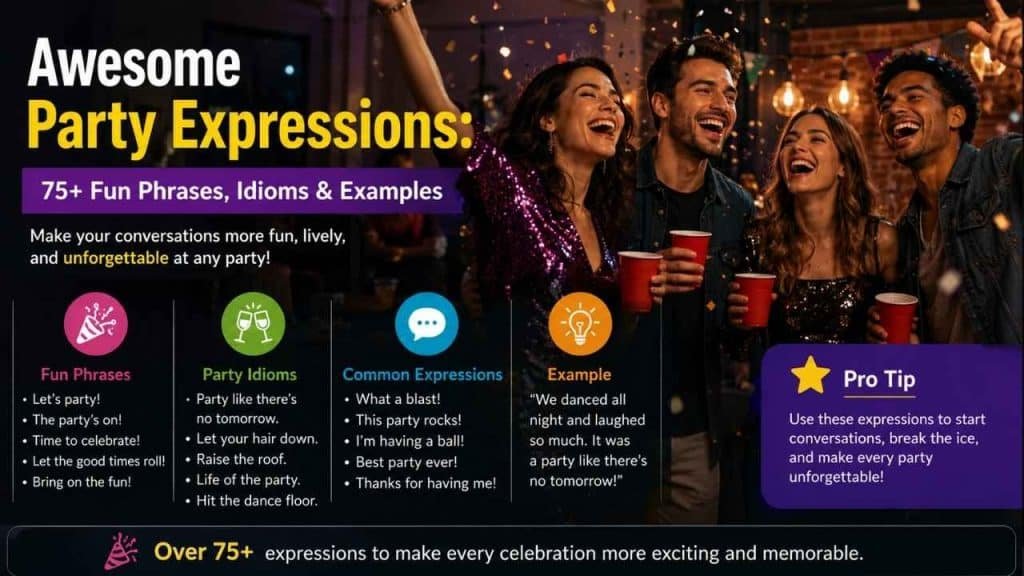

Whether you are attending a birthday, hosting a holiday dinner, or joining a graduation celebration, knowing a few awesome party expressions can make your conversations sound more natural and enjoyable. Native speakers often use party idioms, celebration expressions, and everyday English phrases to welcome guests, compliment the host, or describe an unforgettable event. These expressions add personality to your speech and help you connect with others in social settings.
In this guide, you’ll discover the most common party expressions, learn their meanings, and see how they are used in real conversations. You’ll also explore party vocabulary with examples, practical English celebration idioms, and useful tips for speaking confidently at any gathering. Whether you’re an ESL learner or simply expanding your vocabulary, these expressions will help you communicate with ease while having a blast at every celebration.
Quick Answer
Awesome party expressions are common English expressions, party idioms, and celebration phrases that people use before, during, and after a social gathering. They make conversations sound more natural and help you communicate confidently at birthdays, weddings, office parties, holiday celebrations, and other events. Learning these party expressions with examples also improves your spoken English and helps you understand how native speakers celebrate and socialize.
What Are Awesome Party Expressions?

Awesome party expressions are common English expressions people use to talk about celebrations, fun moments, and social gatherings. These expressions include party idioms, celebration phrases, and everyday words that make conversations sound more natural.
You can use them at birthdays, weddings, graduation parties, office events, or holiday celebrations. Learning these party expressions with examples helps you understand how native speakers communicate in real life. Some expressions describe the mood, while others help you greet guests, compliment a host, or talk about a great event.
If you also enjoy learning expressions related to home and family, check out our guide on Home Idioms and Expressions. Together, these topics improve your spoken English, build your confidence, and make everyday conversations easier.
Party Expressions vs. Party Idioms
Many learners think party expressions and party idioms mean the same thing, but they are slightly different. A party expression is any common phrase people use during a celebration, such as “Have a great time!” or “Let’s get this party started!” A party idiom, however, has a figurative meaning that you cannot understand by reading the words alone.
For example, “paint the town red” means to enjoy a lively night out, not to paint anything. Learning both helps you speak more naturally and understand everyday conversations.
You can also improve your pronunciation by practicing difficult sounds with our S Tongue Twisters guide. Combining vocabulary with pronunciation practice makes your English clearer and more confident.
Common Awesome Party Expressions Everyone Should Know
Learning a few awesome party expressions can help you enjoy conversations at any celebration. Some of the most popular party expressions include “have a blast,” “life of the party,” “party animal,” “let your hair down,” “raise the roof,” and “get the party started.”
Native speakers use these English party expressions to describe fun people, exciting events, or unforgettable moments. For example, you can say, “We had a blast at the birthday party,” or “Sarah was the life of the party.”
These party idioms with meanings and examples make your English sound more natural and friendly. Try using one or two expressions in daily conversations instead of memorizing long lists. Regular practice will help these phrases become a natural part of your vocabulary.
Awesome Party Expressions Before the Party
Before any celebration begins, people often use awesome party expressions to invite guests, make plans, and build excitement. Common English party expressions include “You’re invited!”, “Save the date,” “Don’t miss it,” “See you there,” and “It’s going to be a blast!”
These simple phrases make invitations sound warm and friendly. If someone asks whether you can attend, you can reply with “Count me in!” or “I’ll be there.” If you cannot join, say “Sorry, I can’t make it.” Learning these party expressions with examples helps you communicate politely before any event.
They are useful for birthdays, weddings, graduation parties, office events, and family gatherings. Using these phrases naturally makes your spoken English sound more confident and welcoming.
Awesome Party Expressions During the Party
Once the celebration starts, party expressions help you greet people, enjoy conversations, and create a fun atmosphere. You might hear “Help yourself,” “Make yourself at home,” “Let’s get this party started,” or “Have a great time!” These celebration expressions make guests feel comfortable and included.
If someone is having lots of fun, people may say they are the “life of the party.” If everyone is dancing and enjoying themselves, you could hear “Raise the roof!” or “Let’s dance the night away.”
These party idioms are common in everyday English and help you sound like a native speaker. Practice using them during real conversations instead of only reading them. The more you use them, the more natural they will feel.
Awesome Party Expressions After the Party
The conversation doesn’t end when the party is over. People often use awesome party expressions to thank the host and talk about the event. You can say “Thanks for having me,” “I had a blast,” “It was an amazing party,” or “I really enjoyed myself.”
These English celebration expressions show appreciation and good manners. If you want to compliment the host, say “Everything was perfect,” or “You threw a wonderful party.” Friends may also say “Let’s do it again soon!” after a successful gathering.
These party expressions for conversations help you leave a positive impression and keep friendships strong. Using kind words after a celebration is just as important as using the right expressions before and during the party.
Party Expressions for Different Occasions
Different celebrations call for different party expressions. At a birthday party, you can say “Happy Birthday!” or “Have a fantastic year ahead!” At a wedding, people often say “Congratulations!” or “Wishing you a lifetime of happiness.”
During a graduation party, phrases like “Well done!” and “You earned it!” are common. At an office party, you may hear “Cheers to another successful year!” or “Let’s celebrate our achievements.”
For a housewarming party, people often say “Your new home looks beautiful!” Learning these party expressions with meanings and examples helps you speak naturally in different situations. Choosing the right words for each celebration makes your conversations more thoughtful, friendly, and memorable.
Popular Party Idioms with Meanings and Examples
Party idioms make your English sound more natural and expressive. Unlike regular phrases, these idioms have meanings that are different from the literal words. Here are some of the most common party idioms with meanings and examples:
| Party Idiom | Meaning | Example Sentence |
| Life of the party | The most fun and energetic person | Jake was the life of the party because everyone enjoyed talking to him. |
| Party animal | Someone who loves going to parties | My cousin is a party animal and never misses a celebration. |
| Paint the town red | Go out and have lots of fun | We decided to paint the town red after graduation. |
| Have a blast | Have a wonderful time | Everyone had a blast at the birthday party. |
| Let your hair down | Relax and enjoy yourself | It’s the weekend, so let’s let our hair down and celebrate. |
Learning these English party idioms helps you understand native speakers and use party expressions with confidence in everyday conversations.
American vs. British Party Expressions
Many party expressions have the same meaning in both American English and British English, but people sometimes choose different words or phrases. For example, Americans often say “Have a great time!”, while British speakers may say “Have a brilliant time!” In the U.S., someone who enjoys celebrations is called a party animal, while in the UK you might also hear “up for a good night out.”
Americans commonly say “Awesome party!”, whereas British speakers often say “Brilliant party!” Learning these small differences helps you understand movies, TV shows, and conversations from both countries.
No matter which version you use, these celebration expressions make your spoken English sound more natural and help you communicate confidently at social gatherings.
Formal vs. Informal Party Expressions
Choosing the right party expressions depends on the situation. At a family gathering or a friend’s birthday, informal expressions like “Have a blast,” “Let’s get this party started,” or “See you there!” sound friendly and natural.
At a business event, office celebration, or formal dinner, it is better to use formal expressions such as “Thank you for inviting me,” “Congratulations on this wonderful event,” or “I appreciate your hospitality.” Using the right tone shows respect and helps you communicate clearly.
Before speaking, think about where you are and who you are talking to. Learning both formal and informal party expressions makes your English more flexible and helps you feel comfortable in every type of celebration.
Real Conversations Using Party Expressions
The best way to remember awesome party expressions is to see them in real conversations. Here is a simple example:
Emma: Are you coming to my birthday party this Saturday?
David: Of course! Count me in. I can’t wait.
Emma: Great! We’re going to have a blast.
David: I’m sure Sarah will be the life of the party again.
Emma: She always is! Just remember to let your hair down and enjoy yourself.
David: Thanks! I’ll see you there.
This short dialogue shows how party expressions, party idioms, and celebration phrases fit naturally into everyday English. Reading and practicing conversations like this helps you speak with confidence and remember new expressions more easily.
Common Mistakes When Using Party Expressions
Learning awesome party expressions can make your English more natural, but learners often make a few common mistakes. One mistake is using an expression in the wrong situation. For example, saying “Let’s paint the town red” at a serious business event may sound inappropriate because it suggests having a very exciting time.
Another mistake is taking party idioms too literally. When someone says “let your hair down,” they mean relax and enjoy yourself, not physically change your hairstyle. Some learners also use too many slang expressions, which may confuse listeners.
To avoid these problems, learn the meaning, context, and tone of each phrase. Practicing party expressions with examples helps you choose the right words and communicate more naturally in social situations.
Tips to Remember Party Expressions Easily
Remembering new English party expressions becomes easier when you connect them with real situations. Instead of memorizing a long list, group expressions by topic. For example, learn phrases for inviting guests, enjoying a party, complimenting the host, and saying goodbye.
You can also create your own sentences using party idioms like “have a blast,” “life of the party,” and “call it a night.” Watching English movies, listening to conversations, and practicing with friends can improve your understanding.
Writing down new celebration expressions and reviewing them regularly also helps. Try using one new phrase each day in a conversation. With regular practice, these party expressions for conversations will become easier to remember and use naturally.
FAQs
What are awesome party expressions?
Awesome party expressions are common phrases, idioms, and sayings people use during celebrations. They help speakers describe fun moments, welcome guests, and talk naturally at social events.
What are some popular party idioms?
Some popular party idioms include “life of the party,” “paint the town red,” “have a blast,” “let your hair down,” and “party animal.”
How do party expressions improve English speaking skills?
Learning party expressions with examples helps you understand native speakers and makes your conversations sound more natural, friendly, and confident.
Are party expressions formal or informal?
Most party expressions are informal because people usually use them with friends and family. However, some polite expressions work well at professional events.
What is the difference between party expressions and party idioms?
A party expression is any phrase used at celebrations, while a party idiom has a special meaning that is different from the exact words.
Conclusion
Learning awesome party expressions helps you speak English with more confidence during celebrations and social gatherings. These phrases allow you to welcome guests, share excitement, compliment a party, and connect with others more easily.
From simple expressions like “Have a great time!” to popular party idioms like “paint the town red” and “life of the party,” each phrase adds personality to your conversations. Understanding when and how to use these English celebration expressions is just as important as knowing their meanings.
Practice them in real conversations, listen to native speakers, and use them whenever you get the chance. With regular practice, these party expressions with examples will become a natural part of your everyday English vocabulary.