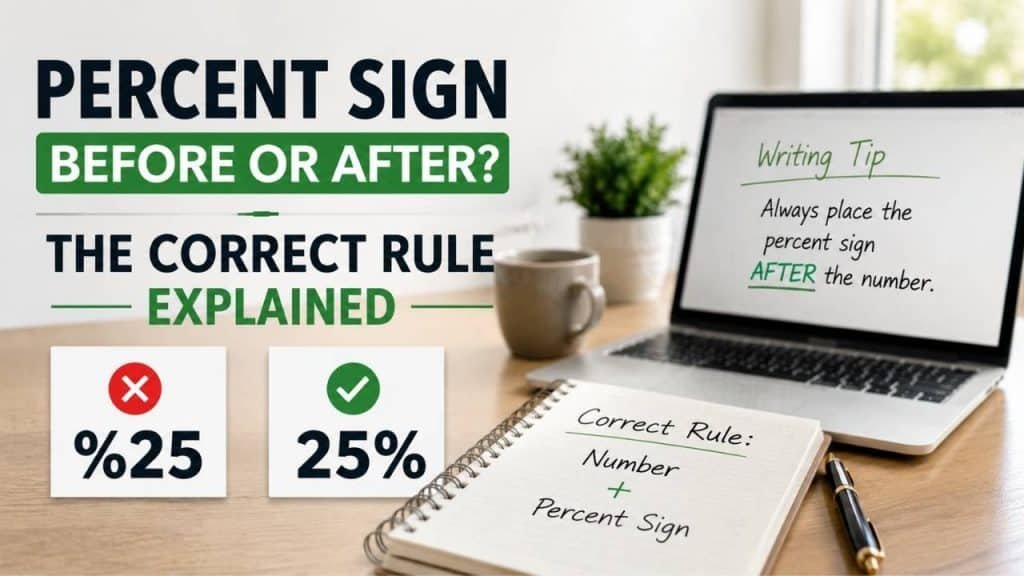

When you write a percentage in English, you may wonder whether the percent sign goes before or after the number. The standard format in American English is simple: put the percent sign after the number, as in 25%, not %25.
You should also write the number and percent sign together without a space in standard US usage. However, writing percentages involves more than symbol placement. You also need to know when to use % instead of the word percent, how to handle decimals and ranges, and how to avoid common formatting mistakes.
This guide explains the percent sign rules in simple terms, with clear examples, so you can write percentages correctly in everyday, academic, business, and professional writing.
Quick Answer
The percent sign goes after the number, not before it. Write 25%, not %25. In standard American English, you should also avoid putting a space between the number and percent sign, so 25% is preferred over 25 %. In some writing contexts, you may spell out percent instead, as in 25 percent. Always follow the style guide required for your writing.
Does the Percent Sign Go Before or After the Number?

The percent sign goes after the number in standard English writing. If you want to show twenty-five percent, write 25%. Do not write %25. The number comes first because the percent sign tells readers what the number represents. You can use the same pattern with whole numbers and decimals. For example, write 10%, 50%, 75%, and 2.5%.
This basic percent sign placement applies to common American English writing. You may see the symbol used in different ways in some technical or international settings, but number + % remains the familiar format for US readers.
If you are learning other common writing rules, you may also find our guide to Awesome Party Expressions useful for building natural English usage.
Correct and Incorrect Percent Sign Placement
Correct percent sign usage becomes easy when you remember one simple pattern: number first, percent sign second. For example, 5%, 15%, 40%, and 90% all follow the correct format. On the other hand, forms such as %5, %15, and %40 place the symbol incorrectly for normal English writing.
You should also avoid changing the order simply because other symbols, such as currency signs, often appear before numbers. For example, we write $25, but we write 25%. These symbols follow different conventions.
When writing a percentage in a sentence, keep the number and symbol together so readers can understand the value quickly. Following this simple rule will make your percentage sign placement clear and consistent.
Should There Be a Space Before the Percent Sign?
In standard American English, you normally do not put a space between a number and the percent sign. Write 25%, not 25 %. The same rule applies to other examples, such as 10%, 45%, and 99.5%.
This format keeps the number and its symbol together and makes percentages easy to scan. You may sometimes see a space before the percent sign in international, technical, or specialized writing because different style systems can use different conventions.
However, if your goal is clear everyday or professional writing for a US audience, no space is the safest choice. When you edit your work, check every percentage for consistent spacing. A small formatting detail like this can make your writing look much more polished and easier to read.
Is 25% or 25 % Correct?
For standard US English, 25% is the preferred form. The number and percent sign should stay together without a space. For example, you can write, “The store offered a 25% discount,” or “About 25% of customers returned.”
The form 25 % may appear in some international or technical standards, but it does not match the usual American English style. This difference can confuse writers who read material from different countries or fields.
The important point is to know your audience and follow the style required for your work. If you write for a general US audience, use 25% consistently. You should also avoid placing the sign before the number. %25 does not follow the normal English format. Keeping these two rules in mind makes percentage formatting simple.
Should You Write “Percent” or Use the % Sign?
Both percent and % can express the same basic idea, but your choice can depend on the writing context. The symbol works well when you present numbers clearly and quickly, such as 25%, 50%, or 75%. In some forms of regular prose, a style guide may prefer the word percent, as in “Twenty-five percent of students passed.”
Technical documents, tables, charts, and other number-heavy content often use % because it saves space. The key is to follow the style guide for your audience and remain consistent.
Do not assume that one form always works in every situation. If you want to improve your everyday English expressions too, check out our guide to Thanks for the Heads Up for another useful writing lesson.
When Should You Spell Out “Percent”?
You may spell out percent when a writing style calls for it, especially in regular sentences. For example, you might write, “Twenty percent of the students completed the survey.” Some style guides also prefer spelling out a percentage when it begins a sentence. This approach can make the sentence flow more naturally.
However, the exact rule can vary by publication, organization, or style guide. That means you should not treat percent as the only correct option. In many contexts, 20% works perfectly well. The most important point is to follow the rules that apply to your document.
If your school, employer, website, or publication has a style guide, check it before making your final choice. Consistency matters just as much as the specific format.
When Is the % Sign Appropriate?
The percent sign works especially well when readers need to understand numerical information quickly. You can commonly see % in tables, charts, graphs, statistics, reports, prices, discounts, and other number-focused content. For example, a sales report might show 35% growth, while a chart might label one section 60%. The symbol keeps the information short and easy to scan.
Many writers also use it in everyday digital content because readers quickly recognize its meaning. Still, some style guides prefer percent in normal body text. Neither choice works as a universal rule for every type of writing. The best approach is to consider your context, audience, and required style. Once you choose a format, use it consistently throughout the same document.
How to Write Percentages in American English
American English usually places the percent sign after the number and does not add a space between them. For example, write 15%, 42%, or 8.5%. You can use these forms in sentences such as, “The company increased sales by 15%,” or “Only 8.5% of the group disagreed.” When you spell out the word, write 15 percent rather than 15 percents.
The word percent usually does not take a plural ending after a number. Keep your formatting consistent throughout the article, report, or assignment. If your workplace, school, or publication follows a particular style guide, use its preferred format. These simple habits will help you write percentages clearly and avoid common percent sign usage problems.
Examples of Percent Sign Usage in Sentences
Seeing real examples makes percent sign rules easier to remember. Here are several natural examples: “The price dropped by 20%.” “About 65% of employees completed the training.” “The battery reached 90%.” “The survey showed a 12.5% increase in sales.” “Only 5% of applicants missed the deadline.” Notice that the percent sign always follows the number and stays directly beside it.
You can also use percentages with decimals, such as 2.5%, when the information requires greater accuracy. In each example, the symbol remains connected to the number. You should avoid forms such as %20 or 20 % in standard US English. These examples show how simple correct formatting can make numerical information easier for readers to understand.
How to Write Decimal Percentages Correctly
You can use the percent sign with decimal numbers just as you use it with whole numbers. The percent sign still comes after the number, with no space in standard US English. Examples include 2.5%, 7.25%, 0.5%, and 12.75%. Make sure you place the decimal point correctly because a small change can alter the value. For example, 2.5% does not mean the same thing as 25%.
When writing a decimal percentage, avoid adding unnecessary spaces or changing the position of the percent sign. You should also check whether your document needs a specific level of precision. A simple article may use 2.5%, while a scientific or financial report may require more decimal places. Always keep your format consistent from beginning to end.
How to Write Percentage Ranges
When you show a percentage range, you have several clear options. You can write 10%–20% when you want a compact range. You can also write between 10% and 20% in a regular sentence. Another option is a 10% to 20% increase, depending on the meaning.
The important thing is to make the range easy to understand. Avoid awkward forms that repeat or mix symbols unnecessarily. For example, 10%–20% clearly shows that the range starts at 10 percent and ends at 20 percent.
You should also avoid changing the placement of the percent sign simply because you are writing a range. Keep the symbol after each number when the context requires clear numerical formatting. Consistent percentage formatting helps readers understand data without stopping to figure out what you mean.
Can You Start a Sentence With a Percent Sign?
Starting a sentence with a percent sign and numeral can create a style issue. For example, “25% of students passed the test” is easy to understand, but some style guides prefer writers to avoid beginning a sentence with a numeral or symbol.
In those cases, you can write, “Twenty-five percent of students passed the test.” This approach makes the sentence feel more natural in formal writing. However, the exact rule depends on the style guide you follow.
Do not assume that every publication uses the same rule. If you write for a website, school, business, or professional publication, check its preferred number style. The main goal is clarity. When a sentence looks awkward because it starts with a percentage symbol, spelling out the number can provide a smoother alternative.
Common Percent Sign Mistakes
Writers often make a few simple mistakes when using the percent sign. The first mistake involves placement: writing %25 instead of 25%. Another common error adds a space, such as 25 %, when standard US English calls for 25%.
Some writers also use percents after a number, but percent usually stays unchanged. Another mistake involves confusing percent with percentage. For example, “20 percent” and “a high percentage” do not serve the same grammatical purpose. Writers can also confuse percentage points with percentage change.
Finally, inconsistent formatting can make an article look careless. If you use % in one section and percent in another, make sure the change has a clear reason. A quick final review can catch most of these errors.
Percent vs. Percentage: What’s the Difference?
Percent and percentage look similar, but they work differently in sentences. Use percent when you give a specific number. For example, “Thirty percent of the class passed,” or “The price increased by 15%.” Use percentage when you talk about a share or amount without giving one exact number.
For example, “A large percentage of customers preferred the new design.” You would not normally say “a large percent of customers” in careful formal writing. Understanding this difference can make your English sound more natural.
The percent sign % represents a specific percentage value, so you normally place it after a number, such as 40%. Once you understand the difference between percent and percentage, you can avoid one of the most common mistakes in percentage writing.
Percent Change vs. Percentage Points
Percent change and percentage points describe different things. Suppose a survey result rises from 20% to 25%. The result increased by 5 percentage points because you subtract 20 from 25. However, the relative increase equals 25%, because the increase of 5 represents one-fourth of the original 20.
These terms matter when you discuss statistics, business results, rates, or survey data. Saying “the rate increased by 5%” can give a different meaning from “the rate increased by 5 percentage points.” When you write about percentages, choose the term that matches your meaning.
This small distinction can prevent confusion and make your writing more accurate. If you regularly explain data, learning the difference between percent change and percentage points can greatly improve your reports and articles.
What Different Style Guides Say About Percent Signs
Different style guides may handle percentages in slightly different ways. Some guides favor the % symbol with numerals, while others prefer the word percent in regular body text and use the symbol in tables, charts, headings, or technical content.
This difference does not mean that one format always works and the other always fails. Instead, it shows why context matters. If you write for an American audience, 25% without a space is a clear and familiar format.
However, always check the specific rules of your school, workplace, publication, or organization when they provide a style guide. Technical and international writing may follow different standards. The best practice is to follow the required guide and remain consistent. Never change between formats randomly within the same piece of writing.
FAQs
Does the percent sign go before or after the number?
The percent sign normally goes after the number, as in 25%.
Should there be a space before the percent sign?
In standard American English, normally no. Write 25%, not 25 %.
Should I write percent or use %?
Your choice depends on the writing context and style guide. Both forms can be correct.
Is percent the same as percentage?
Not always. Use percent with a specific number and percentage for a general share or amount.
Can I start a sentence with a percentage?
Some style guides prefer spelling out the number, such as Twenty-five percent.
What is the difference between percent and percentage points?
Percentage points describe the direct difference between two percentages, while percent change describes the relative change.
Conclusion
The main percent sign rule is easy to remember: put the percent sign after the number, as in 25%, rather than before it as %25. In standard American English, you should also avoid a space between the number and the symbol.
However, good percentage writing involves more than placement. You should know when to use % and when to spell out percent, especially when your style guide has specific rules. You should also understand how to write decimal percentages, percentage ranges, percent change, and percentage points.
Most importantly, keep your formatting clear and consistent. Once you remember number + %, you can avoid the most common mistakes and write percentages with confidence in everyday, academic, business, and professional English.