

Many English learners and even native speakers get confused when choosing between align to and align with. At first glance, both phrases seem similar because they come from the same verb, align, which means to bring something into the correct position, agreement, or arrangement. However, the choice of preposition can change the meaning and usage of the phrase.
If you have ever wondered, “Is it align to or align with?”, you are not alone. This is a common English grammar question that appears in business writing, academic writing, workplace communication, and everyday conversations. While both expressions exist, they are not always interchangeable.
In general, align with is the more common and natural choice when talking about agreement, consistency, compatibility, values, goals, expectations, or strategies. On the other hand, align to often appears in contexts involving targets, standards, requirements, objectives, or positioning.
In this guide, you’ll learn the difference between align to and align with, discover the correct usage of align with and align to, explore real-life examples, and understand when each phrase works best. By the end, you’ll know exactly which expression fits your sentence and why.
Align To vs Align With Comparison Table
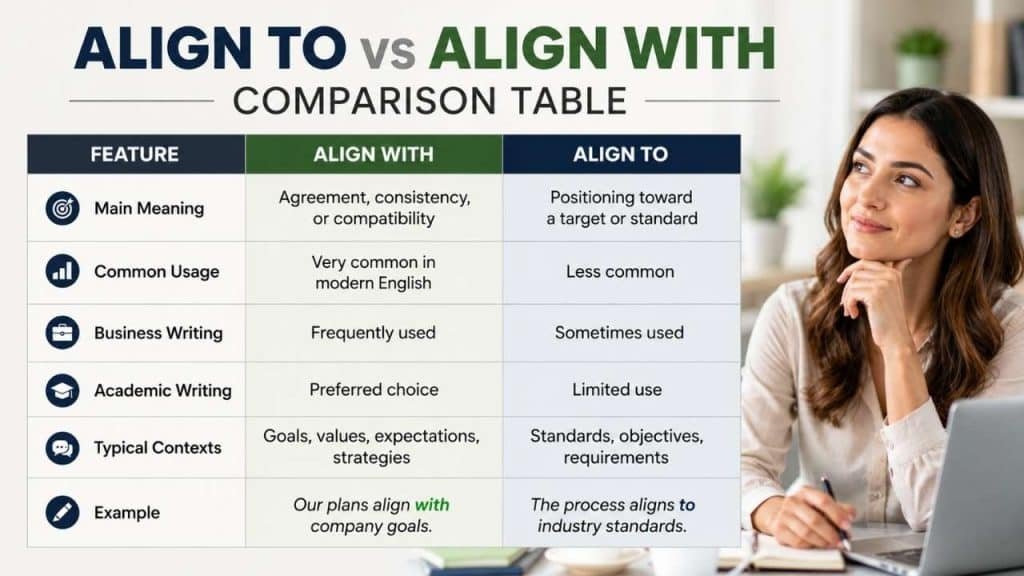
Before diving deeper into the grammar rules, it helps to see the main differences between align with and align to at a glance. Although both phrases come from the same verb, they often serve different purposes in a sentence.
| Feature | Align With | Align To |
| Main Meaning | Agreement, consistency, or compatibility | Positioning toward a target or standard |
| Common Usage | Very common in modern English | Less common |
| Business Writing | Frequently used | Sometimes used |
| Academic Writing | Preferred choice | Limited use |
| Typical Contexts | Goals, values, expectations, strategies | Standards, objectives, requirements |
| Example | Our plans align with company goals. | The process aligns to industry standards. |
As a simple rule, use align with when discussing agreement, coordination, or correspondence between ideas. Use align to when referring to targets, benchmarks, specifications, or requirements. This distinction helps you choose the most natural phrase and avoid common grammar mistakes.
What Does “Align With” Mean?
The phrase align with means to be in agreement, harmony, or consistency with something. It often describes a relationship where two ideas, goals, values, or actions match each other. Because of this meaning, align with appears frequently in business English, academic writing, and everyday communication.
When people ask, “How do you use align with in a sentence?”, the answer is simple: use it whenever something corresponds to or supports another thing.
Examples of Align With
- Our marketing strategy aligns with customer needs.
- Her actions align with her values.
- The project goals align with company objectives.
- These recommendations align with industry best practices.
- The results align with our expectations.
In modern English, align with sounds natural because it emphasizes compatibility, coordination, and agreement. That is why native speakers usually prefer it when discussing plans, missions, strategies, expectations, and professional goals.
What Does “Align To” Mean?
The phrase align to usually means to position, adjust, or direct something toward a specific target, standard, objective, or requirement. Unlike align with, which focuses on agreement, align to often focuses on movement or adjustment toward a desired point.
Although some writers use align to in business communication, it appears more often in technical, engineering, operational, and process-related contexts.
Examples of Align To
- The software must align to security requirements.
- The design should align to industry standards.
- The project timeline aligns to the organization’s objectives.
- Manufacturers align their processes to quality benchmarks.
- The training program aligns to certification requirements.
Many English speakers still prefer align with in some of these examples because it sounds smoother and more natural. However, align to remains acceptable when discussing standards, specifications, requirements, objectives, and measurable targets that guide actions or performance.
Align To vs Align With: Key Differences
Understanding the difference between align to and align with helps you choose the right phrase in different situations. While both expressions relate to alignment, they focus on different ideas.
Difference in Meaning
Align with focuses on agreement, consistency, compatibility, and harmony. It suggests that two things match or support each other.
Align to focuses on positioning, adjustment, or direction toward a specific target, standard, or objective.
Difference in Usage
Writers commonly use align with when discussing goals, values, strategies, policies, and expectations. In contrast, align to often appears when discussing standards, requirements, benchmarks, and specifications.
Difference in Context
- Align with: Ideas, beliefs, goals, missions, and strategies.
- Align to: Targets, standards, objectives, and technical requirements.
Difference in Frequency
Modern English speakers use align with far more often than align to. As a result, it usually sounds more natural in professional and everyday communication.
Understanding these differences will help you improve your word choice and avoid common grammar mistakes.
Is “Align To” Grammatically Correct?
Yes, align to is grammatically correct. However, many people overuse it in situations where align with sounds more natural.
The confusion often comes from business jargon and corporate communication. Some organizations use align to objectives, align to targets, or align to requirements in reports and presentations. While these phrases are not incorrect, native speakers frequently choose align with because it creates a smoother and more conversational tone.
Cases Where Align To Works
- Align to company standards.
- Align to technical specifications.
- Align to compliance requirements.
- Align to performance metrics.
Cases Where Align To Sounds Unnatural
- Align to your values.
- Align to your beliefs.
- Align to our expectations.
- Align to our mission.
In these examples, align with is the better option because the sentence describes agreement rather than movement toward a target. Choosing the correct preposition improves clarity and makes your writing sound more professional.
Why Is “Align With” More Common?
There is a simple reason why align with appears more often in modern English. Most conversations focus on agreement, consistency, and compatibility, not physical positioning.
When people discuss business goals, company values, personal beliefs, project strategies, or customer expectations, they usually want to show a connection between ideas. The preposition with naturally expresses this relationship.
Consider these examples:
- Our strategy aligns with market needs.
- Her actions align with company values.
- The proposal aligns with organizational goals.
These sentences sound natural because they emphasize correspondence and coordination.
Another reason for its popularity is that major style guides, professional writers, and native speakers frequently use align with in reports, presentations, emails, and academic writing. As a result, readers often view it as the safer and more familiar choice.
If you are unsure which phrase to use, align with will usually be the better option.
When Should You Use “Align With”?
You should use align with whenever you want to show that two things are in agreement or support each other. This phrase works especially well in professional, academic, and everyday communication.
Business Writing Examples
- Our objectives align with company strategy.
- The campaign aligns with customer expectations.
- The project aligns with business priorities.
Academic Writing Examples
- The findings align with previous research.
- The study aligns with academic standards.
- The results align with the research objectives.
Workplace Communication Examples
- Your proposal aligns with our goals.
- The new policy aligns with company values.
- The recommendations align with stakeholder expectations.
Personal Communication Examples
- My career goals align with my interests.
- His actions align with his beliefs.
- Their decisions align with their long-term plans.
Whenever you talk about values, goals, expectations, missions, visions, strategies, or beliefs, align with is usually the most natural and professional choice.
When Should You Use “Align To”?
Use align to when discussing adjustment toward a specific target, benchmark, requirement, or standard. In these situations, the focus is on direction and positioning rather than agreement.
Technical Writing Examples
- The software aligns to security standards.
- The system aligns to compliance requirements.
- The process aligns to industry specifications.
Engineering Examples
- Engineers align components to precise measurements.
- Technicians align equipment to performance standards.
Strategic Planning Examples
- The initiative aligns to organizational objectives.
- Resources align to operational targets.
Goal-Oriented Contexts
- The training program aligns to certification requirements.
- The framework aligns to established benchmarks.
- The workflow aligns to quality standards.
Although align with may also work in some of these examples, align to emphasizes movement toward a measurable target. This subtle distinction helps readers understand your intended meaning more clearly.
Common Mistakes People Make
Many writers understand the meaning of align with vs align to, but they still make a few common mistakes.
Using Align To Instead of Align With
❌ Our values align to our mission.
✅ Our values align with our mission.
Values and missions share a relationship of agreement, so align with is the correct choice.
Using Align With for Physical Positioning
❌ Align the machine with the measurement scale.
✅ Align the machine to the measurement scale.
In technical contexts, align to often works better because it shows positioning toward a target.
Mixing Both Expressions Without Purpose
Some writers switch between the two phrases randomly. This creates confusion and weakens clarity.
The best approach is simple:
- Use align with for agreement and compatibility.
- Use align to for targets, standards, and positioning.
Following this rule will make your writing clearer, stronger, and easier to understand.
Real-Life Examples
The best way to understand these phrases is to see them in real sentences.
Examples Using Align With
- Our strategy aligns with market trends.
- Her actions align with her values.
- The project aligns with company goals.
- The recommendations align with industry best practices.
- The results align with our expectations.
- This policy aligns with customer needs.
- The proposal aligns with the organization’s mission.
Examples Using Align To
- The software aligns to security requirements.
- The design aligns to industry standards.
- The process aligns to operational objectives.
- The training aligns to certification guidelines.
- The workflow aligns to compliance requirements.
- The system aligns to technical specifications.
- The project aligns to performance benchmarks.
These examples show that align with usually describes agreement, while align to often describes adjustment toward standards, requirements, or objectives.
Pro Tip: A Simple Rule to Remember
If you struggle to decide between align to and align with, remember this simple rule:
Use Align With for Agreement
Think about relationships, consistency, compatibility, and shared goals.
Examples:
- Align with values.
- Align with expectations.
- Align with company vision.
- Align with business strategy.
Use Align To for Targets
Think about standards, objectives, requirements, and benchmarks.
Examples:
- Align to standards.
- Align to objectives.
- Align to specifications.
- Align to requirements.
A quick memory trick is this:
With = Together
To = Toward
If two things work together, use align with. If something moves toward a target or standard, use align to. This shortcut will help you choose the correct phrase in almost every situation.
Common Alternatives
Sometimes, neither align with nor align to is the best choice. Depending on the context, you can use several alternative expressions that communicate a similar meaning. Using synonyms also helps improve writing variety and prevents repetition.
In Line With
In line with is one of the most common alternatives. It means that something agrees with or follows a particular rule, policy, or expectation.
Example: Our new policy is in line with industry regulations.
Consistent With
Use consistent with when discussing agreement or correspondence between ideas.
Example: The research findings are consistent with previous studies.
Corresponds To
Corresponds to works well when one thing closely matches another.
Example: The results correspond to our original expectations.
Matches
Matches is a simple and direct option in everyday English.
Example: Her skills match the job requirements.
Conforms To
Use conforms to when discussing standards, regulations, or requirements.
Example: The product conforms to international safety standards.
These alternatives can strengthen your writing while maintaining clarity and accuracy.
FAQs
Is it align to or align with?
Both phrases are grammatically correct, but align with is more common in modern English. Writers usually use align with when discussing agreement, compatibility, goals, values, or expectations. Align to often appears when discussing standards, requirements, objectives, or targets.
What is the difference between align to and align with?
The main difference is meaning. Align with shows agreement or consistency between ideas, while align to suggests adjustment or positioning toward a specific target, benchmark, or requirement.
Is align to correct English?
Yes, align to is correct English. However, many native speakers prefer align with in everyday communication because it sounds more natural and conversational.
Can align to and align with be used interchangeably?
Sometimes, but not always. In certain business and professional contexts, both phrases may work. However, choosing the correct preposition improves clarity and precision.
Which phrase is more common?
Align with is significantly more common in business writing, academic writing, professional communication, and everyday English.
Is align with formal?
Yes. Align with works well in both formal and informal situations. You can use it in reports, presentations, emails, research papers, and workplace communication without sounding unnatural.
Conclusion
Choosing between align to or align with becomes much easier once you understand their core meanings. While both expressions are grammatically correct, they serve different purposes.
In most situations, align with is the preferred choice because it expresses agreement, consistency, compatibility, coordination, and correspondence. It is commonly used when discussing goals, values, strategies, missions, expectations, and beliefs. This is why native speakers and professional writers use it so frequently.
On the other hand, align to is more suitable when referring to standards, requirements, objectives, specifications, benchmarks, or measurable targets. It emphasizes positioning or adjustment toward a specific point.
If you ever feel unsure, remember this simple rule:
Use “align with” for agreement. Use “align to” for targets.
Following this guideline will help you choose the correct phrase, improve your grammar, and make your writing sound more natural, professional, and easy to understand.