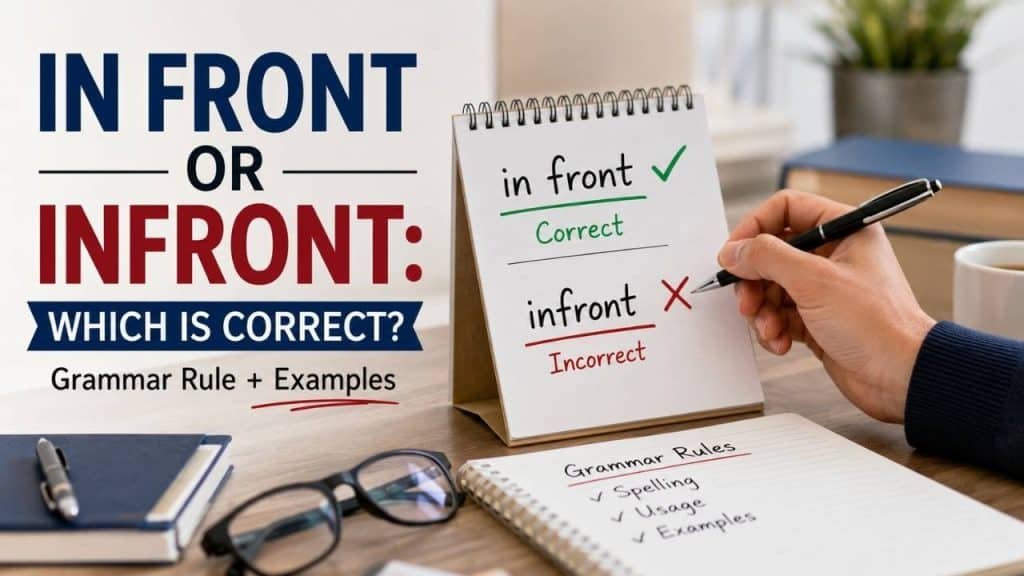

Many people pause while writing because they are unsure whether to use “in front” or “infront.” This small spelling difference causes confusion for students, professionals, and English learners alike.
If you have searched “in front or infront which is correct” or “is infront a word,” you are asking a common English grammar question. The good news is that the answer is simple. In standard English, “in front” is the correct spelling, while “infront” is a common spelling mistake.
In this guide, you will learn the grammar rule, understand the difference between in front and infront, explore plenty of sentence examples, and discover simple tips to remember the correct form. By the end, you’ll feel confident using “in front” in everyday writing.
Quick Answer
If you’re wondering whether “in front” or “infront” is correct, always choose “in front.” It is the accepted English spelling used in both American English and British English. The spelling “infront” is not a standard English word, and you should avoid using it in emails, essays, reports, or professional documents.
The phrase “in front” works as a prepositional phrase that describes the position of someone or something. For example, you can say, “The car is parked in front of the house.” Learning this simple grammar rule helps improve your writing accuracy, prevents common spelling mistakes, and makes your work look more polished and professional.
Is It “In Front” or “Infront”?

The correct form is “in front.” It is always written as two separate words because it functions as a prepositional phrase in English grammar. If you ask, “Is infront one word?” or “Should I write in front or infront?”, the answer is clear: “in front” is correct, while “infront” is incorrect.
Although you may notice “infront” in text messages, online comments, or social media posts, it is not accepted by dictionaries or major style guides.
Using the correct spelling shows that you understand proper English usage and helps readers trust your writing. Whether you are writing for school, work, or daily communication, always use “in front” to avoid this common grammar mistake.
Why “In Front” Is the Correct Form
Many writers ask why “in front” is two words instead of one. The answer lies in its grammar. The word “in” is a preposition, while “front” is a noun. Together, they create a prepositional phrase that describes the location of a person or object. Because each word keeps its own grammatical role, they stay separate in writing.
This follows standard English grammar rules and accepted writing conventions. Unlike closed compound words such as “inside” or “into,” the phrase “in front” has never become a single word in standard English. Understanding this rule helps you improve your writing skills, avoid common spelling mistakes, and use the phrase correctly in every type of writing.
What Does “In Front” Mean?
The phrase “in front” means ahead of someone or something or at the forward position. It describes where a person, place, or object is located in relation to another. You will often hear or read it in everyday conversations, books, news articles, and professional writing. For example, “She stood in front of the class,” or “The restaurant is in front of the park.”
In both examples, “in front” clearly shows position. Because it is a common English phrase, you should always write it as two words. Knowing the meaning of in front and using it in natural sentence examples will strengthen your English writing, improve clarity, and help you avoid confusing it with the incorrect spelling “infront.”
Can “Infront” Ever Be Correct?
The simple answer is no. “Infront” is not accepted in standard English, and you will not find it listed as the correct spelling in trusted English dictionaries or respected style guides. Sometimes people combine the two words because they assume it follows the pattern of other compound words. Others make the mistake while typing quickly on a phone or computer.
Even if you see “infront” on websites, social media, or in casual messages, it remains a spelling error, not a correct alternative. Whether you write in American English or British English, always use “in front.” Choosing the correct spelling makes your writing clearer, more professional, and grammatically accurate in every situation.
In Front vs. Infront (Comparison Table)
The easiest way to understand the difference between in front and infront is to compare them side by side. While both look similar, only one follows standard English grammar. “In front” is the correct prepositional phrase used in everyday writing, while “infront” is a common spelling mistake.
Whether you’re writing an email, essay, blog post, or business document, you should always use “in front.” Both American English and British English follow the same rule. If you’re unsure while proofreading, remember that trusted dictionaries and style guides recognize only the two-word form.
| Feature | In Front | Infront |
| Correct spelling | ✅ Yes | ❌ No |
| Standard English | ✅ Yes | ❌ No |
| Dictionary accepted | ✅ Yes | ❌ No |
| Formal writing | ✅ Yes | ❌ No |
| Informal writing | ✅ Yes | ❌ Not recommended |
| Grammar | Prepositional phrase | Incorrect spelling |
| Example | The car is in front of the house. | The car is infront of the house. ❌ |
How to Use “In Front” Correctly in Sentences
The best way to remember how to use “in front” is to see it in real sentence examples. This phrase always describes the position of someone or something. Because it is a prepositional phrase, write it as two separate words every time. Here are a few examples:
- The bus stopped in front of the school.
- She stood in front of the mirror before leaving.
- Please wait in front of the office.
- The children played in front of their house.
- Our teacher parked her car in front of the library.
- A beautiful fountain stands in front of the hotel.
These examples show the correct English usage in everyday situations. Whether you write for school, work, or personal communication, always use “in front” to keep your writing clear, natural, and grammatically correct.
Common Mistakes People Make
Many writers use “infront” because they believe it is a single word like inside or into. This misunderstanding causes one of the most common English spelling mistakes. Others type “infront” quickly on a phone and never notice the error. Social media posts, text messages, and informal writing also spread this incorrect spelling.
Another mistake is assuming that “infront” is accepted in casual writing. It is not. Even in friendly emails or online comments, “in front” remains the correct form. A good habit is to proofread your work before sharing it. Paying attention to word spacing, grammar rules, and writing accuracy helps you avoid this mistake and makes your writing look more professional.
Similar Word Pairs That Follow the Same Rule
The confusion between “in front” and “infront” is not unique. English has many word pairs that confuse writers because of word spacing and compound word rules. Learning these examples can improve your writing skills and help you avoid similar mistakes.
- Into vs. In To
- Onto vs. On To
- Everyday vs. Every Day
- Setup vs. Set Up
- Login vs. Log In
- Workout vs. Work Out
- Maybe vs. May Be
- Anymore vs. Any More
Each pair follows its own grammar rule, so you cannot assume that combining two words is always correct. Understanding these patterns strengthens your English grammar and helps you write with greater confidence.
asy Tricks to Remember the Correct Spelling
A simple memory trick can help you avoid writing “infront.” Think of the phrase as answering the question, “Where is it?” The word “in” tells you the relationship, while “front” names the position. Since both words have different jobs, they stay separate.
Another helpful trick is to read your sentence aloud. If it sounds like a location, write “in front” as two words.
You can also create a proofreading habit by searching your document for “infront” before you finish writing. If you find it, replace it with “in front.” These easy editing tips improve your writing accuracy, reduce spelling mistakes, and help you remember the correct form every time.
Does American English or British English Use “Infront”?
Some writers wonder if “infront” is accepted in American English or British English. The answer is no. Both forms of English use “in front” as the standard spelling. Whether you read newspapers, books, educational websites, or official documents from the United States or the United Kingdom, you will consistently see “in front” written as two words.
Trusted English dictionaries and major style guides follow the same rule. This means you never need to choose between different regional spellings for this phrase. If your goal is clear and professional communication, always use “in front.” Following this simple grammar rule ensures your writing is correct and understood by readers everywhere.
FAQs
Is “infront” a real word?
No. “Infront” is not a standard English word. Always write “in front.”
Why is “in front” written as two words?
It is a prepositional phrase made up of a preposition (in) and a noun (front), so the words stay separate.
Can I use “infront” in informal writing?
No. Even in casual writing, “in front” is the correct spelling.
Is “in front” used in American and British English?
Yes. Both American English and British English use “in front.”
How can I remember the correct spelling?
Think of “in” and “front” as two separate words working together to describe a location.
Conclusion
If you ever hesitate between “in front” and “infront,” remember one simple rule: always use “in front.” It is the only spelling accepted in standard English, American English, and British English.
The one-word form “infront” is a spelling mistake that does not appear in trusted dictionaries or respected style guides. Understanding this grammar rule helps you write more clearly and confidently in every situation.
Before you submit an email, essay, article, or report, take a moment to proofread your work and check for this common error. With regular practice and the simple memory tips shared in this guide, using “in front” correctly will soon become a natural part of your everyday writing.