
Whether you’re a student, teacher, writer, or English learner, knowing a wide range of verbs that start with S can make your vocabulary stronger and your writing more engaging. Verbs are action or state words, and learning S verbs helps you describe actions more clearly in conversations, essays, emails, and stories.
From everyday words like say, see, and send to stronger choices like strengthen, simplify, and succeed, these verbs appear in daily communication. This guide brings together 150+ verbs that start with S, along with their meanings, examples, and useful categories.
You’ll also discover common verbs that start with S, positive verbs beginning with S, action verbs that start with S, verbs that start with S for kids, academic verbs, phrasal verbs, and practical grammar tips. By the end, you’ll have a complete reference that makes learning English verbs starting with S simple, useful, and enjoyable.
Quick Answer
Verbs that start with S are action, state, or helping words that begin with the letter S. They describe what someone does, feels, or experiences. Common examples include say, see, send, smile, sleep, and study. Learning these S verbs expands your vocabulary, improves your writing and speaking, and helps you communicate more clearly in school, work, and everyday conversations.
What Are Verbs That Start With S?
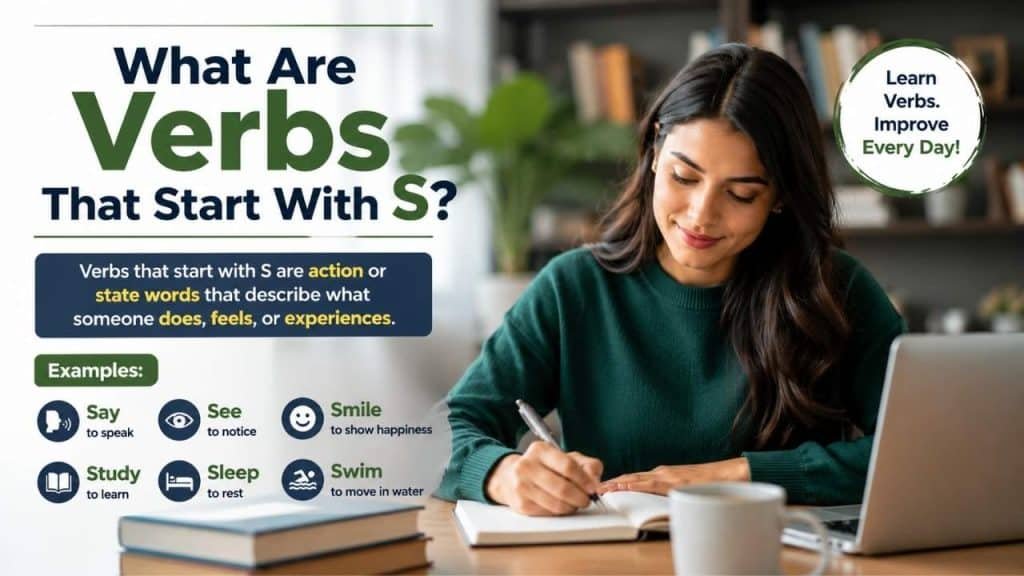
Verbs that start with S are simply action, occurrence, or state words that begin with the letter S. They describe what a person, animal, or thing does, feels, or experiences. Some are very common in everyday English, while others are more formal and useful in academic or professional writing.
For example, smile describes an action, sleep tells what someone is doing, and seem expresses a state or condition. Learning a list of verbs that start with S helps you improve your vocabulary and choose more precise words when speaking or writing. Many S words that are verbs also appear in books, classrooms, workplaces, and online communication.
As you continue reading, you’ll explore common S verbs, easy verbs beginning with S, and many verbs that start with S with meanings and examples to strengthen your English skills.
What Are Verbs That Start With S?
Verbs that start with S are action, state, or helping words that begin with the letter S. They tell us what someone does, feels, or experiences. For example, smile, study, sleep, and swim describe actions, while seem shows a state of being. Learning a list of verbs that start with S helps you speak and write with more confidence.
These S verbs appear in everyday conversations, school assignments, business emails, and creative writing. Some are easy enough for children, while others suit formal or academic situations. By understanding common verbs that start with S, positive verbs beginning with S, and action verbs that start with S, you can build a stronger vocabulary and express your ideas more clearly in every situation.
150+ Verbs That Start With S (A–Z List)
Below is a collection of 150+ verbs that start with S. This list of verbs that start with S includes common, positive, and action verbs that you can use in daily conversations, writing, and schoolwork. Learning these English verbs starting with S helps improve your vocabulary and makes your sentences more interesting. Some verbs are simple for beginners, while others work well in professional or creative writing. Keep this list as a quick reference whenever you need S words that are verbs.
| Verb | Meaning | Example |
| Sacrifice | Give up something valuable | She sacrificed her weekend to study. |
| Sail | Travel on water | They sailed across the lake. |
| Satisfy | Meet a need | The answer satisfied everyone. |
| Save | Keep safe | We saved enough money. |
| Say | Speak words | Please say your name. |
| Scan | Look over quickly | I scanned the report. |
| Scatter | Spread around | The wind scattered the leaves. |
| Schedule | Plan a time | We scheduled the meeting. |
| Scold | Speak angrily | The teacher scolded the student. |
| Score | Gain points | He scored the winning goal. |
| Scratch | Mark a surface | The cat scratched the sofa. |
| Scream | Shout loudly | She screamed for help. |
| Search | Look for | They searched the room. |
| Secure | Make safe | Lock the door to secure the house. |
| See | Notice with your eyes | I see a rainbow. |
| Seek | Try to find | They seek better opportunities. |
| Seem | Appear | You seem happy today. |
| Select | Choose | Please select one option. |
| Sell | Exchange for money | They sell fresh fruit. |
| Send | Deliver | I’ll send the email today. |
| Separate | Divide | Please separate the papers. |
| Serve | Help or provide | They serve breakfast daily. |
| Set | Put in place | She set the books down. |
| Settle | Resolve or become calm | We settled the problem. |
| Sew | Join with thread | My grandmother sews dresses. |
| Shake | Move quickly | Don’t shake the bottle. |
| Share | Give part to others | We shared our lunch. |
| Shine | Give light | The stars shine brightly. |
| Shoot | Fire or throw | He shot the ball. |
| Shop | Buy things | They shop every Saturday. |
| Show | Display | Please show your ID. |
| Shrink | Become smaller | Clothes may shrink in hot water. |
| Sing | Produce music | The children sing together. |
| Sit | Rest on a seat | Please sit here. |
| Skate | Move on skates | They skated at the park. |
| Sketch | Draw quickly | She sketched the building. |
| Skip | Jump over | The kids skipped happily. |
| Sleep | Rest | Babies sleep a lot. |
| Slide | Move smoothly | The box slid across the floor. |
| Smile | Show happiness | Everyone smiled warmly. |
| Solve | Find an answer | We solved the puzzle. |
| Speak | Talk | Please speak clearly. |
| Spell | Write letters correctly | Can you spell your name? |
| Spend | Use time or money | We spent the afternoon outside. |
| Spin | Turn around | The wheel spins fast. |
| Splash | Throw liquid | The kids splashed water. |
| Split | Divide into parts | We split the bill. |
| Spread | Cover a larger area | Butter spreads easily. |
| Sprint | Run fast | Athletes sprint to the finish. |
| Stand | Be upright | Please stand still. |
| Start | Begin | Let’s start now. |
| Stay | Remain | We stayed home. |
| Steal | Take unlawfully | Someone stole my bike. |
| Step | Move one foot | Please step forward. |
| Stick | Attach firmly | The label sticks well. |
| Stir | Mix | Stir the soup gently. |
| Stop | End movement | The bus stopped suddenly. |
| Store | Keep safely | We stored old files. |
| Stretch | Make longer | Stretch before exercising. |
| Strike | Hit | Lightning struck the tree. |
| Study | Learn | Students study every day. |
| Submit | Hand in | Please submit your homework. |
| Succeed | Achieve a goal | She succeeded through hard work. |
| Suggest | Offer an idea | I suggest another plan. |
| Support | Help | Friends support each other. |
| Surprise | Cause amazement | The gift surprised him. |
| Surround | Be around | Trees surround the house. |
| Survive | Stay alive | Many plants survive winter. |
| Suspect | Think something is true | Police suspect foul play. |
| Sustain | Keep going | Healthy habits sustain energy. |
| Sweep | Clean with a broom | Please sweep the floor. |
| Swim | Move through water | They swim every summer. |
| Swing | Move back and forth | Children swing at the playground. |
| Switch | Change | Switch off the lights. |
| Symbolize | Represent | The dove symbolizes peace. |
| Synchronize | Make happen together | We synchronized our watches. |
| Simplify | Make easier | Good teachers simplify difficult lessons. |
| Strengthen | Make stronger | Exercise strengthens your muscles. |
Common Verbs That Start With S
Many common verbs that start with S appear in everyday English. You probably use words like say, see, send, show, sit, sleep, study, and start without thinking about them. These English verbs starting with S help you talk about daily activities, school, work, and conversations. For example, you can say hello, send a message, show a picture, or study for a test.
Since these verbs appear so often, learning their meanings and correct usage will improve both your speaking and writing. If you are building your vocabulary, start with these common S verbs before learning more advanced ones. Once you master them, you can easily understand and use many other verbs beginning with S in real-life situations.
| Common Verb | Example Sentence |
| Say | Please say your answer clearly. |
| See | I see birds outside. |
| Send | I’ll send the file today. |
| Show | Can you show me the way? |
| Sit | Please sit down. |
| Sleep | Children need enough sleep. |
| Start | Let’s start the meeting. |
| Stop | Please stop talking. |
| Study | They study English every evening. |
| Speak | Always speak politely. |
Positive Verbs That Start With S
Learning positive verbs that start with S helps you communicate in a kind, confident, and encouraging way. These verbs work well in conversations, motivational writing, school projects, and even professional emails. Words like support, smile, strengthen, succeed, and simplify create a positive message and leave a good impression on readers or listeners.
Writers also use these positive verbs beginning with S to inspire people and make their content more engaging. Whether you are writing an essay, giving a speech, or sending a message to a friend, these verbs help you express optimism and action. Adding more S verbs like these to your vocabulary will make your English sound more natural, clear, and uplifting.
| Positive Verb | Meaning | Example |
| Smile | Show happiness | Everyone smiled after the good news. |
| Support | Help someone | Friends always support each other. |
| Succeed | Achieve a goal | She succeeded through hard work. |
| Strengthen | Make stronger | Reading strengthens your vocabulary. |
| Simplify | Make easier | Good examples simplify learning. |
| Share | Give to others | We shared our ideas. |
| Save | Protect | Recycling helps save the environment. |
| Shine | Stand out | Her talent shines every day. |
| Solve | Find an answer | They solved the problem quickly. |
| Serve | Help others | Volunteers serve the community. |
Action Verbs That Start With S
Action verbs that start with S describe activities that people or things perform. They add energy to your writing and help readers picture what is happening. Strong S action verbs such as sprint, swim, slide, swing, search, shake, stretch, and scatter make sentences more vivid and interesting. Instead of using general words, choose specific verbs beginning with S to create a clearer image.
For example, writing “The athlete sprinted to the finish line” sounds stronger than simply saying “The athlete ran.” Whether you write stories, essays, or everyday messages, using action verbs beginning with S makes your ideas more lively and easier to understand. They also improve your vocabulary and make your writing more engaging for readers.
| Action Verb | Example Sentence |
| Sprint | The runner sprinted across the finish line. |
| Swim | We swam in the lake yesterday. |
| Search | They searched for the missing keys. |
| Stretch | Always stretch before exercising. |
| Shake | He shook the bottle gently. |
| Slide | The child slid down the playground slide. |
| Scatter | The wind scattered the papers. |
| Swing | Kids swung happily at the park. |
| Sweep | Please sweep the floor. |
| Stir | Stir the soup before serving. |
Strong S Verbs for Writing and Storytelling
Using strong S verbs for writing and storytelling helps you create clearer and more exciting sentences. Instead of choosing weak or general verbs, use words that paint a vivid picture in the reader’s mind. For example, sprint sounds more powerful than run, while shatter creates a stronger image than break. Verbs like soar, scatter, strike, slam, and stumble add emotion and movement to stories.
These powerful verbs that start with S make characters and scenes feel more realistic. They also improve essays, blog posts, and creative writing by replacing plain language with specific actions. Choosing the right S verbs for writing keeps readers interested and makes every sentence more memorable and engaging.
| Strong Verb | Better Than | Example |
| Sprint | Run | She sprinted toward the finish line. |
| Shatter | Break | The glass shattered on the floor. |
| Soar | Fly | The eagle soared above the mountains. |
| Strike | Hit | Lightning struck the old tree. |
| Scatter | Spread | The leaves scattered across the yard. |
| Slam | Close | He slammed the door shut. |
| Stumble | Walk | She stumbled over a rock. |
| Surge | Move | The crowd surged toward the gate. |
| Sweep | Clean | Strong winds swept through the valley. |
| Spark | Begin | Her idea sparked a great discussion. |
Resume & Professional Verbs That Start With S
If you want your resume or LinkedIn profile to stand out, using professional verbs that start with S can make a big difference. These words clearly show your skills, achievements, and responsibilities. Instead of writing simple phrases, choose strong resume verbs that start with S such as supervised, streamlined, solved, supported, and structured. Hiring managers often notice action-oriented language because it highlights what you accomplished.
These business verbs that start with S also work well in reports, emails, and presentations. Whenever possible, pair each verb with a result. For example, write “Streamlined the filing process and reduced paperwork” instead of simply saying “Worked on filing.” Strong verbs make your experience sound more confident, professional, and meaningful.
| Professional Verb | Best Used For | Example |
| Supervise | Leadership | She supervised a team of 10 employees. |
| Streamline | Process Improvement | We streamlined the workflow. |
| Solve | Problem Solving | He solved customer issues quickly. |
| Support | Teamwork | They supported new employees. |
| Structure | Planning | She structured the training program. |
| Spearhead | Leadership | He spearheaded the new project. |
| Schedule | Organization | I scheduled client meetings. |
| Strengthen | Improvement | We strengthened customer relationships. |
| Simplify | Efficiency | The update simplified daily tasks. |
| Submit | Administration | She submitted the final report. |
Academic Verbs That Start With S
Students and researchers often use academic verbs that start with S in essays, reports, and classroom discussions. These verbs help explain ideas, present evidence, and organize information in a clear way. Common English verbs starting with S for academic writing include study, summarize, suggest, support, state, solve, and select.
For example, you might summarize an article, support an argument with facts, or suggest a solution to a problem. These verbs beginning with S make your writing more organized and professional.
Instead of repeating simple words like “say” or “tell,” use more precise verbs that match your purpose. Practicing these academic S verbs will improve your school assignments and help you write with greater confidence.
| Academic Verb | Example Sentence |
| Study | We study grammar every week. |
| Summarize | Please summarize the chapter. |
| Suggest | The results suggest a new idea. |
| Support | Facts support the argument. |
| State | The author states the main point clearly. |
| Solve | Students solve math problems daily. |
| Select | Select the correct answer. |
| Submit | Submit your assignment before Friday. |
| Search | Researchers search for reliable sources. |
| Structure | Structure your essay with clear headings. |
Verbs That Start With S for Kids
Children learn best when they practice easy verbs that start with S in fun and simple sentences. Many verbs that start with S for kids describe actions they already do every day. Words like sing, smile, skip, swim, sit, sleep, and share are easy to understand and remember. Parents and teachers can use these common S verbs during games, reading time, or classroom activities.
Encourage children to create their own sentences using one verb each day. This simple habit builds vocabulary and improves speaking and writing skills. Learning S words that are verbs also helps children recognize action words while reading stories. With regular practice, they become more confident in using English verbs starting with S correctly.
| Kid-Friendly Verb | Example Sentence |
| Sing | We sing every morning. |
| Smile | Please smile for the photo. |
| Skip | The children skip happily. |
| Swim | They swim during summer. |
| Sit | Sit quietly in class. |
| Sleep | Babies sleep a lot. |
| Share | Always share your toys. |
| Stand | Please stand in line. |
| Start | Let’s start the game. |
| Sweep | Help sweep the floor. |
Phrasal Verbs That Start With S
Phrasal verbs that start with S combine a verb with a preposition or adverb to create a new meaning. Native English speakers use these expressions every day, so learning them will improve your speaking and writing. For example, set up means to arrange something, while speak up means to talk louder. Other useful S phrasal verbs include sit down, slow down, show up, stand up, and stick with.
Although the words seem simple, their meanings often differ from the individual words. Try using these expressions in conversations to remember them naturally. Learning phrasal verbs beginning with S helps you sound more fluent and understand everyday English with greater confidence.
| Phrasal Verb | Meaning | Example |
| Set up | Arrange | We set up the classroom. |
| Speak up | Talk louder | Please speak up during the meeting. |
| Sit down | Take a seat | Everyone sat down quietly. |
| Slow down | Reduce speed | Please slow down on wet roads. |
| Show up | Arrive | She showed up early. |
| Stand up | Rise | Please stand up when your name is called. |
| Stick with | Continue | I’ll stick with my decision. |
| Send back | Return | They sent back the damaged item. |
| Sign up | Register | We signed up for the course. |
| Sort out | Solve | Let’s sort out the problem together. |
Regular vs. Irregular Verbs That Start With S
Knowing the difference between regular and irregular verbs that start with S helps you avoid grammar mistakes. Regular verbs form the past tense by adding -ed, while irregular verbs change in different ways. For example, start becomes started, but see changes to saw, and sing becomes sang. Learning these patterns makes it easier to write correctly in school, at work, and in everyday conversations.
Many common verbs that start with S belong to the irregular group, so it helps to practice them often. Reading, writing, and speaking regularly will help you remember their correct forms. Keep this comparison table handy whenever you need a quick grammar reference.
| Regular Verbs | Past Tense | Irregular Verbs | Past Tense |
| Start | Started | See | Saw |
| Search | Searched | Sing | Sang |
| Smile | Smiled | Speak | Spoke |
| Support | Supported | Swim | Swam |
| Study | Studied | Spend | Spent |
| Stretch | Stretched | Sit | Sat |
| Simplify | Simplified | Shake | Shook |
| Schedule | Scheduled | Sleep | Slept |
| Save | Saved | Steal | Stole |
| Serve | Served | Strike | Struck |
Formal vs. Informal S Verbs
Some verbs that start with S fit formal writing, while others work better in casual conversations. Choosing the right verb helps you match the situation. In business emails or academic papers, use formal S verbs like submit, state, support, suggest, and structure. When chatting with friends or family, informal S verbs such as say, show, share, and start sound more natural.
Understanding this difference improves your communication and makes your writing more effective. Whether you write a report, an email, or a text message, selecting the right English verbs starting with S shows confidence and good language skills.
| Formal Verb | Informal Alternative |
| Submit | Send |
| State | Say |
| Suggest | Tell |
| Support | Help |
| Structure | Organize |
| Simplify | Make easier |
| Supervise | Watch over |
| Schedule | Plan |
| Secure | Keep safe |
| Select | Pick |
Common Mistakes When Using S Verbs
Many learners confuse similar verbs beginning with S, but a few simple rules can help. For example, sit means to rest on a chair, while set means to place something somewhere. Say focuses on the words you speak, but tell always needs a listener. Another common mistake involves see and look.
You see something naturally with your eyes, but you look when you choose to focus on it. Some learners also forget the irregular past tense forms of verbs like sing, speak, and swim. Practicing these common S verbs in complete sentences will help you avoid errors and use them correctly in everyday English.
| Incorrect | Correct |
| I set on the chair. | I sat on the chair. |
| She said me the answer. | She told me the answer. |
| I look a bird. | I see a bird. |
| He speaked loudly. | He spoke loudly. |
| They swimed yesterday. | They swam yesterday. |
Tips to Remember Verbs That Start With S
The easiest way to remember verbs that start with S is to practice them a little every day. Instead of trying to memorize a long list at once, group S verbs into categories such as action verbs, positive verbs, academic verbs, and common verbs. Read short stories, watch English videos, and try to notice how these verbs appear in real conversations.
You can also make flashcards, write five new sentences each day, or play vocabulary games with friends. Saying the words aloud helps you remember their pronunciation and meaning. The more you use English verbs starting with S, the more natural they become in your speaking and writing.
Quick Learning Tips
- Learn 5–10 new S verbs each day.
- Group verbs by category instead of memorizing randomly.
- Write your own example sentences.
- Read English books and articles regularly.
- Practice speaking the verbs aloud.
- Review old words every week.
- Use flashcards or vocabulary apps for daily revision.
FAQs
1. What are verbs that start with S?
Verbs that start with S are action, state, or helping words that begin with the letter S, such as say, see, study, smile, and swim.
2. What are some common verbs that start with S?
Some common S verbs include say, see, send, show, sit, sleep, speak, start, stop, and study.
3. What are positive verbs that start with S?
Examples of positive verbs beginning with S include support, smile, share, strengthen, simplify, save, and succeed.
4. What are action verbs that start with S?
Popular action verbs that start with S include sprint, swim, search, stretch, shake, slide, scatter, and swing.
5. Are there irregular verbs that start with S?
Yes. Some common irregular S verbs are see, sing, sit, sleep, speak, spend, steal, strike, and swim.
6. Which S verbs work well on a resume?
Good resume verbs that start with S include supervised, streamlined, solved, supported, structured, scheduled, and strengthened.
7. How can I remember verbs that start with S?
Practice a few S verbs every day, group them into categories, make flashcards, read English content, and write your own example sentences to improve long-term memory.
Conclusion
Learning verbs that start with S is an excellent way to build a stronger English vocabulary and improve your speaking and writing skills. From common verbs that start with S like say, see, and study to positive verbs, action verbs, academic verbs, and professional verbs, each word helps you express your ideas more clearly.
Practice these English verbs starting with S by using them in everyday conversations, school assignments, emails, and creative writing. The more often you read, write, and speak these S words that are verbs, the more confident you will become.
Save this guide as a reference, review the lists regularly, and keep adding new verbs beginning with S to your vocabulary. With consistent practice, you’ll use them naturally and communicate with greater confidence.