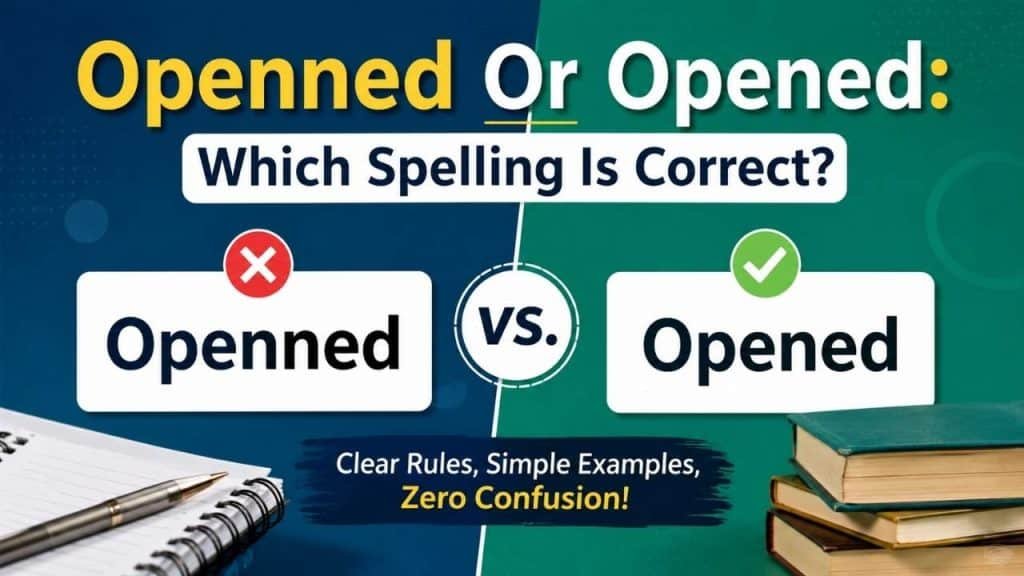

Many writers pause when they need to choose between openned or opened. At first glance, both spellings may seem correct because they sound similar when spoken. However, only one follows standard English spelling rules. If you have ever wondered, “Is openned a word?” or “How do you spell opened correctly?”, you are not alone. This is a common issue for students, professionals, and English learners.
The correct spelling is opened, which is the past tense of open. The form openned is a spelling mistake and does not appear in standard dictionaries. Understanding why opened vs openned differs can help you avoid similar errors in your writing.
In this guide, you will learn the correct spelling of opened, the grammar rule behind it, common examples, and simple tips to remember the proper form with confidence.
Quick Answer
The correct spelling is opened, not openned. Opened is the proper past tense of open and follows standard English grammar rules. The word openned is a misspelling and is not recognized in standard dictionaries. If you wonder “Is it openned or opened?”, always choose opened in both British and American English.
Openned vs Opened at a Glance
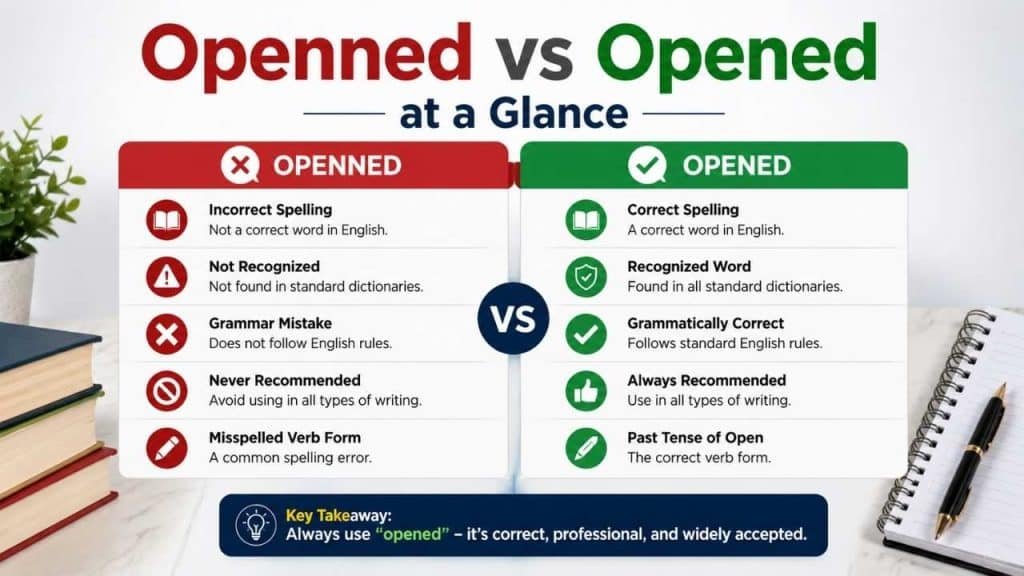
Many people search for opened vs openned because the two words look similar. However, only one is correct. The word opened is the accepted past tense and past participle form of the verb open. Writers use it in everyday communication, academic papers, business emails, and professional documents. On the other hand, openned is simply a spelling error.
| Openned | Opened |
| Incorrect spelling | Correct spelling |
| Not recognized in dictionaries | Standard English word |
| Grammar mistake | Grammatically correct |
| Never recommended | Accepted in all writing styles |
| Misspelled verb form | Past tense of open |
If you want to write clear and professional English, always use opened. Learning the difference between openned or opened can help you avoid one of the most common spelling mistakes in English writing.
Why Is “Opened” the Correct Spelling?
The spelling opened is correct because it follows the standard rule for forming the past tense of a regular verb. In English, most regular verbs create their past tense by adding -ed to the base form. Since open is a regular verb, it becomes opened.
For example:
- Open → Opened
- Walk → Walked
- Play → Played
- Start → Started
This simple pattern appears throughout English grammar. When writers ask, “How do you spell opened correctly?”, the answer is straightforward: add -ed to the verb open.
The word opened works in all forms of writing, including formal reports, school assignments, and casual conversations. Because it follows an established grammar pattern, dictionaries, style guides, and grammar experts all recognize it as the correct spelling. This is why opened remains the only acceptable choice in standard English.
Why Is “Openned” Incorrect?
The spelling openned may look reasonable at first, but it does not follow standard English spelling rules. Many people accidentally add an extra “n” because they think every verb ending follows the same pattern as words like planned or referred. However, English grammar does not apply that rule to every verb.
The word openned does not appear in standard dictionaries because it is a misspelling. You should avoid using it in essays, emails, reports, or professional documents. If you use openned, readers may view it as a grammar mistake.
When comparing opened vs openned, remember that only opened follows accepted grammar conventions. Understanding why openned is incorrect can improve your writing accuracy and help you avoid similar spelling mistakes with other regular verbs.
The Grammar Rule Behind “Opened”
Understanding the grammar rule behind opened makes the spelling easier to remember. English uses specific patterns when forming past tense verbs. Most regular verbs simply add -ed to the base word. Since open is a regular verb, its correct past tense becomes opened.
Some writers become confused because English sometimes doubles a final consonant before adding -ed. However, that only happens under certain conditions. The word open does not meet those conditions, so it keeps a single “n.”
Learning this rule helps answer questions such as “Why is opened spelled with one n?” and “Why isn’t the n doubled in opened?” Instead of memorizing the spelling, you can understand the logic behind it. Once you know the rule, you can apply it to many other verbs and avoid common spelling mistakes in future writing.
Understanding the Consonant-Doubling Rule
The consonant-doubling rule explains why some verbs double their final letter while others do not. A verb usually doubles its final consonant when it ends in a vowel followed by a consonant and the final syllable receives the strongest stress.
Examples include:
- Admit → Admitted
- Refer → Referred
- Permit → Permitted
The word open works differently. The stress falls on the first syllable: OH-pen, not the second. Because the final syllable is unstressed, English spelling rules do not require doubling the “n.”
Therefore:
- Open → Opened ✅
- Open → Openned ❌
This grammar principle explains exactly why opened is correct and why openned is wrong. Once you understand stress patterns and consonant doubling, many confusing verb spellings become much easier to recognize and remember.
Examples of “Opened” in Sentences
Reading examples helps reinforce the correct spelling of opened. Here are several examples from different situations.
Everyday Examples
- She opened the door when she heard the bell.
- I opened the package this morning.
- They opened the window to let fresh air inside.
Professional Examples
- The company opened a new branch in the city.
- Our team opened the meeting with a short presentation.
- The manager opened the discussion about future goals.
Academic Examples
- The researcher opened the study with a brief introduction.
- The professor opened the lecture by explaining the topic.
These examples show how frequently people use opened in daily communication. You can confidently use it in personal, professional, and academic writing.
Why People Commonly Write “Openned”
Many writers accidentally use openned because English spelling contains many exceptions and patterns that can seem confusing. People often notice words like planned, stopped, or referred and assume that every past-tense verb follows the same structure.
Pronunciation also contributes to the mistake. When people hear the word spoken aloud, they may assume it requires a double “n.” As a result, they write openned instead of opened.
Another reason involves pattern recognition. Our brains naturally look for familiar spelling structures. Since many common verbs double a consonant before adding -ed, writers sometimes apply that rule where it does not belong.
Fortunately, understanding the consonant-doubling rule removes much of the confusion. Once you know that open does not require a doubled consonant, remembering the correct spelling becomes much easier.
Commonly Confused Words Like Opened
The confusion between openned and opened is not unique. Many English words create similar spelling challenges. Writers frequently struggle with verbs that involve consonant doubling.
Examples include:
| Incorrect | Correct |
| Refered | Referred |
| Occured | Occurred |
| Prefered | Preferred |
| Stoped | Stopped |
| Planed | Planned |
These examples show why many people question opened vs openned. English contains many spelling patterns, and some seem inconsistent at first glance.
The best approach is to learn the underlying grammar rules rather than memorizing every word individually. When you understand how stress patterns affect spelling, you can identify correct forms more easily and avoid many common grammar mistakes in both formal and informal writing.
Is “Opened” Correct in British and American English?
Yes, opened is correct in both British English and American English. Some English words change spelling depending on the region, such as travelled/traveled or cancelled/canceled. However, opened remains the same in both versions of English.
This means you can confidently use opened whether you write for audiences in the United States, the United Kingdom, Canada, Australia, or other English-speaking countries.
Many users search for “opened or openned in British English” because they assume regional spelling differences might explain the extra “n.” However, no accepted English variety uses openned.
If your goal is clear and professional writing, always choose opened. It follows standard grammar rules and remains universally accepted across major English dialects.
Synonyms of Opened
Sometimes you may want to avoid repeating the word opened. In those cases, several synonyms can help improve variety in your writing.
Common alternatives include:
- Started
- Began
- Unlocked
- Revealed
- Initiated
- Unsealed
- Launched
- Introduced
For example:
- The company opened a new office.
- The company launched a new office.
- She opened the letter.
- She unsealed the letter.
While these words can replace opened in some situations, they do not always carry exactly the same meaning. Always choose the synonym that best matches your context.
Using a mix of related words can improve readability and make your writing feel more natural and engaging.
Tips to Remember the Correct Spelling
If you often confuse openned or opened, a few simple tricks can help.
First, remember that open is a regular verb. Most regular verbs form the past tense by adding -ed. Therefore:
Open + ed = Opened
Second, think about pronunciation. The word open places stress on the first syllable. Because the final syllable is unstressed, you do not double the “n.”
Third, compare it with similar regular verbs:
- Listen → Listened
- Happen → Happened
- Open → Opened
None of these verbs double their final consonant.
Finally, practice using opened in sentences. Repetition helps reinforce correct spelling habits. The more often you see and use opened, the easier it becomes to recognize the correct form instantly.
FAQs
Is Openned a Real Word?
No. Openned is a misspelling and does not appear in standard English dictionaries.
What Is the Past Tense of Open?
The correct past tense of open is opened.
Why Isn’t the N Doubled?
The word open does not meet the requirements of the consonant-doubling rule because the stress falls on the first syllable.
Can I Use Openned in Formal Writing?
No. You should always use opened in formal, academic, and professional writing.
Is Opened Grammatically Correct?
Yes. Opened is the correct and accepted past tense form of the verb open.
Conclusion
When comparing openned or opened, the correct choice is always opened. It follows standard English grammar rules, appears in dictionaries, and serves as the proper past tense of open. The spelling openned is a common mistake that results from misunderstanding the consonant-doubling rule.
Learning why opened is correct helps you improve your spelling and avoid similar grammar errors. Remember that open does not require a doubled “n” because the stress falls on the first syllable. Whether you write emails, essays, reports, or everyday messages, using opened will keep your writing accurate and professional.
The next time you wonder, “Is it openned or opened?”, you can confidently choose opened every time.