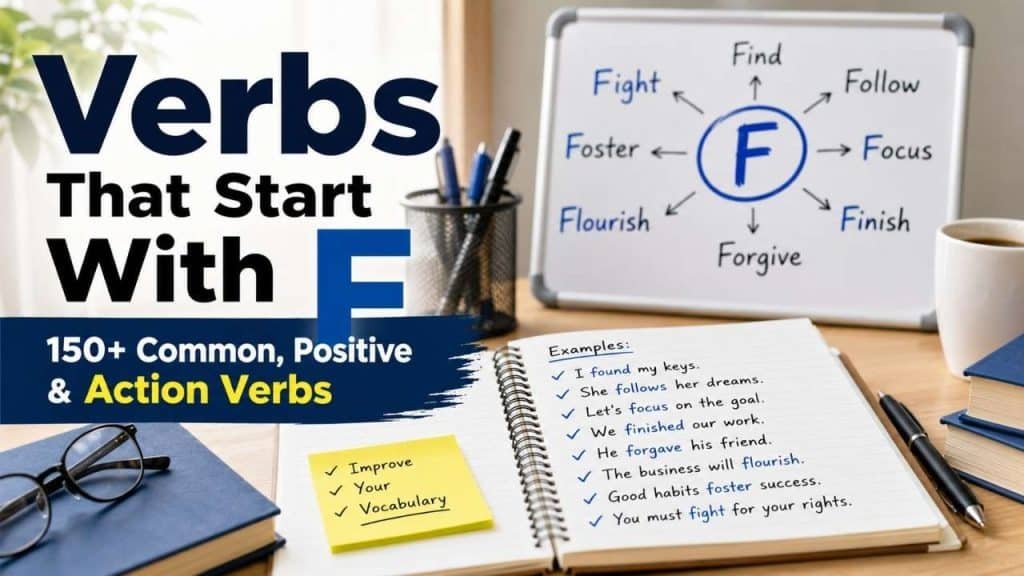

Learning verbs that start with F is an easy way to expand your English vocabulary and become a more confident speaker and writer. Verbs are action words that describe what a person, animal, or thing does.
Whether you are a student, teacher, writer, or English learner, knowing more F verbs can make your speaking and writing clearer and more engaging. In this guide, you will discover a complete list of verbs that start with F, along with their meanings, simple examples, and practical uses.
We also cover common verbs that start with F, positive verbs that start with F, action verbs beginning with F, and many useful words for school, work, and daily conversations. By the end, you’ll have a stronger vocabulary and know how to use these English verbs starting with F naturally in real-life situations.
Quick Answer
Verbs that start with F are action words that begin with the letter F and describe actions, processes, or states of being. Common examples include find, follow, fix, finish, feel, fight, and forgive. Learning these English verbs starting with F helps improve your vocabulary, writing, and speaking skills. This guide includes a complete list of verbs that start with F, along with their meanings, example sentences, and practical categories like positive, common, and action verbs beginning with F.
What Are Verbs That Start With F?
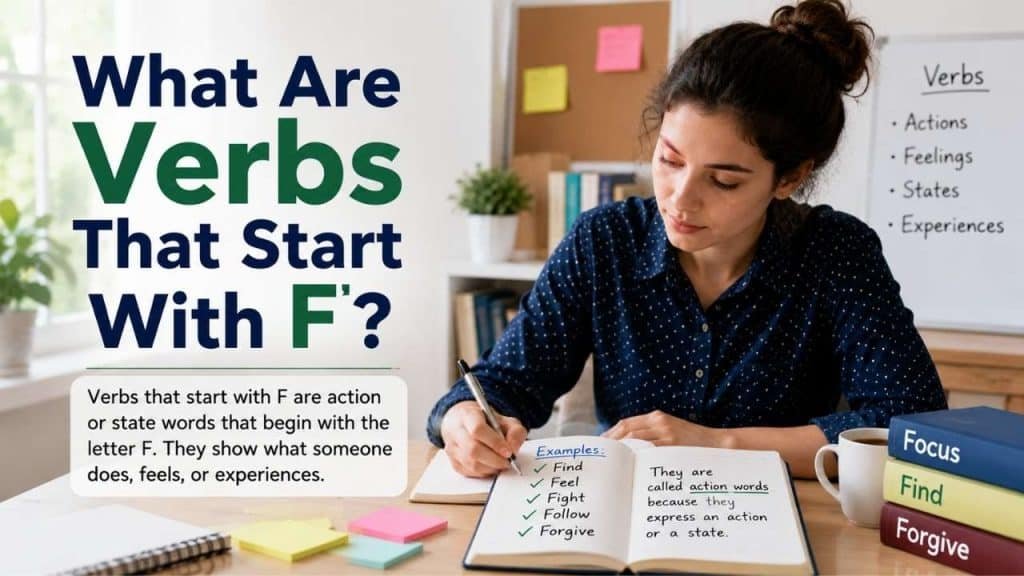
Verbs that start with F are simply verbs beginning with the letter F. Like all verbs, they show an action, a state, or an occurrence. Some describe physical actions, such as fight, fold, and fetch, while others describe thoughts or feelings, such as forgive, fear, and focus.
These verbs starting with F appear in everyday conversations, school assignments, business emails, and creative writing. Learning them helps you build a stronger vocabulary and communicate more clearly.
If you are looking for verbs that start with F with meanings or verbs beginning with F with examples, this guide has everything organized in one place. Whether you are improving your grammar or searching for useful F action words, these verbs can make your writing more natural and expressive.
Most Common Verbs That Start With F
Many common verbs that start with F are used every day in spoken and written English. Learning these words first will help you understand conversations and express your ideas more clearly. Below is a list of English verbs beginning with F along with their meanings and simple example sentences.
| Verb | Meaning | Example Sentence |
| Face | To confront something | She faced every challenge with confidence. |
| Fail | To be unsuccessful | They failed the first test but improved later. |
| Fall | To move downward | The leaves fall every autumn. |
| Fasten | To close securely | Please fasten your seatbelt. |
| Feed | To give food | They feed the birds every morning. |
| Feel | To experience an emotion | I feel happy today. |
| Fetch | To bring something | He fetched a glass of water. |
| Fight | To struggle or battle | The team fought until the end. |
| Fill | To make full | Please fill the bottle with water. |
| Find | To discover | She found her lost keys. |
| Finish | To complete | We finished the project on time. |
| Fix | To repair | He fixed the broken chair. |
| Float | To stay on water | The boat floated across the lake. |
| Follow | To go after | Always follow the instructions carefully. |
| Forgive | To stop feeling angry | She forgave her friend sincerely. |
These F verbs form the foundation of everyday English and are useful for learners of all levels.
Positive Verbs That Start With F
Using positive verbs that start with F can make your writing sound more encouraging, professional, and inspiring. These verbs are excellent for essays, speeches, resumes, and daily conversations because they express growth, support, and success. They also help you communicate with confidence while expanding your English vocabulary.
| Verb | Meaning | Example |
| Flourish | To grow successfully | Small businesses can flourish with good planning. |
| Forgive | To let go of anger | We should forgive honest mistakes. |
| Foster | To encourage growth | Good teachers foster creativity. |
| Fuel | To increase or support | Positive feedback fuels motivation. |
| Fulfill | To achieve or complete | She fulfilled her lifelong dream. |
| Fortify | To strengthen | Healthy habits fortify your body and mind. |
| Focus | To give full attention | Students should focus on learning. |
| Free | To release | Kindness can free people from fear. |
These action verbs that start with F help create stronger, more meaningful sentences while making your communication more positive and engaging.
Action Verbs That Start With F
Action verbs that start with F describe activities that people, animals, or things perform. These F action words make your sentences more vivid and engaging because they show movement or change.
Some of the most common verbs beginning with F include fight, fetch, fix, fill, fold, float, follow, face, fasten, and find. For example, you can say, “Please fetch the book,” or “They fixed the broken fence yesterday.”
These English verbs starting with F appear in conversations, stories, and workplace communication every day. Learning these common verbs that start with F helps you build stronger writing and speaking skills. Practice using them in complete sentences to improve your confidence and expand your English vocabulary naturally.
Daily Use Verbs That Start With F
Many daily use verbs that start with F appear in conversations, emails, and everyday tasks. These words help you express routine actions clearly and naturally. Popular examples include feel, find, finish, fill, follow, feed, fix, face, and fold. You might feel excited about a new project, find your keys before leaving home, or finish your homework after school.
Parents feed their children, travelers follow directions, and families fold clothes after washing them. Because these English verbs beginning with F appear so often, they deserve a place in your everyday vocabulary. Learning these verbs that start with F with examples will improve your communication skills and help you sound more natural in both spoken and written English.
Verbs That Start With F for Kids
Teaching verbs that start with F for kids is a fun way to build vocabulary from an early age. Choose easy F verbs that children can understand and use in simple sentences. Words like find, feed, fly, fold, float, fix, fill, and face are excellent choices because they describe familiar actions.
For example, “Birds fly in the sky,” “Please fold your clothes,” or “Let’s fill the glass with water.” Encourage children to act out each verb while saying it aloud to make learning more enjoyable.
These easy verbs that start with F also help improve reading, speaking, and writing skills. Regular practice with English verbs starting with F builds confidence and strengthens a child’s overall language development.
Academic Verbs That Start With F
Students often use academic verbs that start with F when writing essays, reports, and research papers. These verbs help explain ideas clearly and support logical thinking. Common examples include focus, formulate, find, frame, follow, and forecast.
You can focus on a topic before writing, formulate an argument with evidence, or frame a research question carefully. Teachers also ask students to follow instructions and find reliable sources for assignments.
These verbs beginning with F improve academic writing because they make ideas more precise and organized. Whether you are writing a school essay or preparing a university report, using these English verbs starting with F correctly will strengthen your communication and help you present information with greater clarity.
Formal vs. Informal F Verbs
Some verbs that start with F suit formal writing, while others fit casual conversations. Choosing the right word depends on your audience and purpose. In business or academic writing, formal verbs such as facilitate, formulate, finalize, and forecast sound professional and precise.
In everyday speech, people often use informal F verbs like fix, find, fool, and feel because they sound natural and conversational. For example, “The committee will finalize the proposal” sounds more formal than “We will fix the plan.”
Understanding the difference helps you write confidently in different situations. Learning both formal and informal English verbs beginning with F also improves your vocabulary and allows you to communicate effectively in school, work, and daily life.
Regular and Irregular Verbs That Start With F
Knowing the difference between regular and irregular verbs that start with F helps you use correct verb forms in writing and speaking. Regular verbs form the past tense by adding -ed, while irregular verbs change in different ways.
For example, fax → faxed, fasten → fastened, and fold → folded are regular verbs. On the other hand, find → found, fight → fought, fall → fell, feel → felt, feed → fed, and fly → flew are irregular verbs.
Learning these patterns makes grammar easier and helps you avoid common mistakes. Practice using each verb in the present, past, and future tense to become more confident with English verbs starting with F and improve your overall writing skills.
Phrasal Verbs That Start With F
Phrasal verbs that start with F combine a verb with a preposition or adverb to create a new meaning. They are common in everyday English and help your speech sound more natural.
Popular examples include figure out (understand), fill in (complete information), find out (discover), fall behind (fail to keep up), follow up (continue after an earlier action), and face up to (accept something difficult).
For example, you might figure out a math problem or follow up after a job interview. Learning these English verbs beginning with F improves both speaking and writing because native speakers use them regularly. Practice each phrase in real-life situations to build confidence and strengthen your English vocabulary.
Common Mistakes When Using F Verbs
Many learners make small mistakes when using verbs that start with F, but careful practice can help you avoid them. One common error is using the wrong verb form, such as writing finded instead of found or fighted instead of fought. Another mistake is choosing the wrong preposition in phrasal verbs, like saying follow to instead of follow or follow up on, depending on the context.
Some writers also confuse similar verbs such as feel and fill because they look and sound alike. Always check the meaning, tense, and sentence structure before using English verbs starting with F. Reading and writing regularly will help you use these common F verbs accurately and naturally.
Tips to Remember Verbs That Start With F
Learning verbs that start with F becomes easier when you use simple study techniques. Instead of memorizing a long F verbs list, group words into categories like action verbs, positive verbs, academic verbs, and daily use verbs.
Create your own example sentence for each new word because active practice improves memory. Flashcards, vocabulary notebooks, and quick quizzes also help you remember meanings and correct usage.
Try using newly learned English verbs beginning with F in conversations, emails, or short paragraphs every day. Reading books, articles, and stories also helps you see these verbs in context. Regular practice and repetition will expand your English vocabulary and make these verbs a natural part of your writing and speaking.
FAQs
1. What are verbs that start with F?
Verbs that start with F are action or state-of-being words that begin with the letter F, such as find, follow, finish, and forgive.
2. What are some common verbs beginning with F?
Some common examples include find, feel, fight, fix, feed, follow, fall, finish, and fill.
3. What are positive verbs that start with F?
Positive F verbs include flourish, forgive, foster, fulfill, fortify, and fuel.
4. Are there verbs that start with F for kids?
Yes. Easy examples include fly, find, fill, feed, fold, fix, and face.
5. Why should I learn English verbs starting with F?
Learning these verbs improves your English vocabulary, writing, speaking, and overall communication skills.
6. What are some phrasal verbs that start with F?
Common examples include figure out, fill in, find out, fall behind, follow up, and face up to.
7. How can I remember verbs that start with F more easily?
Practice them in sentences, group similar verbs together, use flashcards, and review them regularly in real-life conversations and writing.
Conclusion
Learning verbs that start with F is an excellent way to improve your English vocabulary and communicate more effectively. From common verbs that start with F like find, finish, and follow to positive verbs, action verbs, academic verbs, and useful phrasal verbs, each word helps you express your ideas more clearly.
Instead of memorizing long lists, practice these English verbs starting with F in everyday conversations, writing tasks, and reading activities.
The more often you use them, the more natural they will become. Keep reviewing new words, create your own example sentences, and expand your vocabulary one step at a time. With regular practice, these verbs beginning with F will become a valuable part of your everyday English.