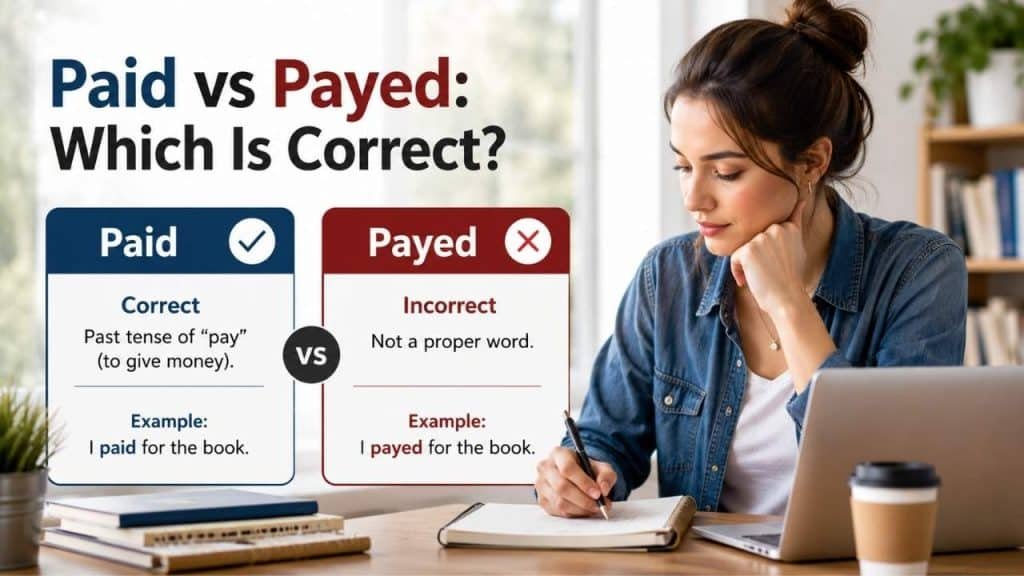

Have you ever stopped while writing and wondered whether “paid” or “payed” is the correct spelling? You’re not alone. Many English learners and even native speakers search for the difference between paid vs payed because both words appear in dictionaries, yet only one is correct in most situations.
If you’re asking, “Is it paid or payed?” or “Is payed a real word?”, this guide will clear up the confusion. In everyday English grammar, paid is the standard past tense and past participle of pay, while payed is a rare word used only in specific nautical contexts.
In this article, you’ll learn the difference between paid and payed, discover easy grammar rules, explore real examples, avoid common spelling mistakes, and know exactly when to use paid and when payed is actually correct.
Quick Answer
Paid is the correct past tense and past participle of pay in almost every situation involving money, bills, salaries, or giving attention. Payed is a real word, but it is only correct in rare nautical contexts, such as letting out a rope or sealing a ship’s deck. If you’re unsure whether to write paid or payed, choose paid unless you’re specifically referring to maritime terminology.
Paid vs Payed: Which Is Correct?
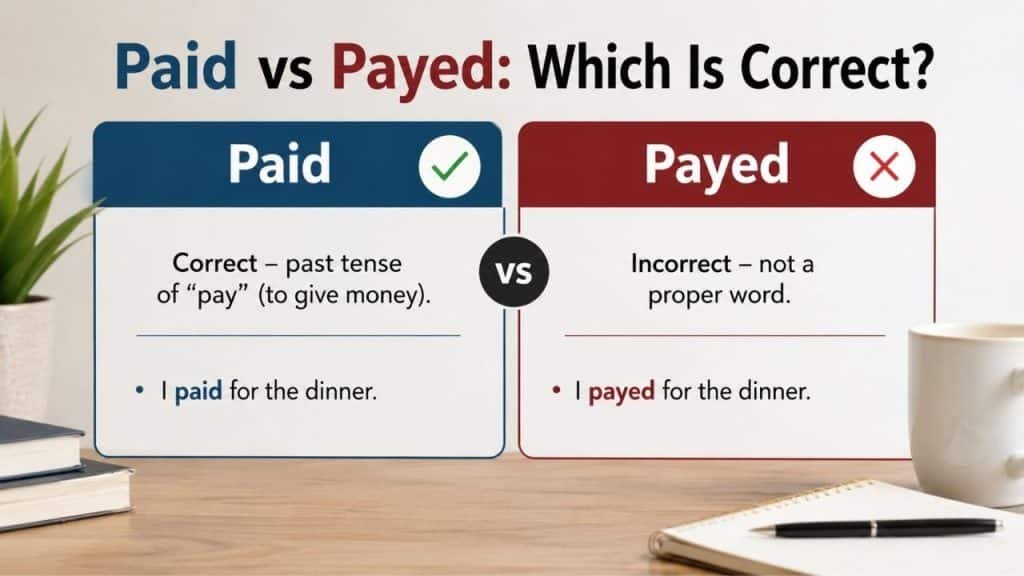
The correct spelling in almost every situation is paid. It is the accepted past tense of pay and the past participle of pay used in everyday English writing, business writing, and conversation. For example, you would write, “I paid the bill,” “She paid the rent,” or “They paid attention.”
These are all correct because they refer to making a payment or giving attention. The word payed is not a spelling mistake in every case, but it has a completely different meaning. It is a specialized nautical term used when talking about ships, ropes, or sealing a vessel’s seams.
If you’re writing about money, salaries, bills, taxes, or purchases, always choose paid instead of payed. Understanding this simple rule helps you avoid one of the most common grammar mistakes in English.
Why Do People Confuse “Paid” and “Payed”?
People often confuse paid and payed because they follow a common English pattern. Many verbs form their past tense by adding -ed, such as walked, talked, and played. Since pay ends with a similar sound, some writers naturally assume the past form should be payed.
However, English has many irregular verbs that do not follow regular spelling rules. The verb pay changes to paid when it refers to money or general use.
Another reason for confusion is that payed is a real word, so spell checkers and dictionaries may recognize it. Understanding the context behind each word makes it easier to know when to use paid and why payed is usually incorrect.
What Does “Paid” Mean?
Paid means that someone has given money in exchange for something or has completed a financial responsibility. It is the most common form of the verb pay and appears frequently in everyday English.
As the past tense of pay, it describes an action that already happened. For example, “I paid the restaurant bill yesterday” shows that the payment happened in the past.
As the past participle of pay, it appears with helping verbs, such as “She has paid the fee” or “They have paid their taxes.” You can use paid for many situations, including paid salary, paid rent, paid attention, paid subscription, and paid services. In normal writing, paid is almost always the correct choice.
What Does “Payed” Mean?
Payed is a less common word that has a specific meaning. It does not usually describe money or regular payments. Instead, it appears mainly in nautical language related to ships, ropes, and sailing. For example, sailors may use payed out the rope to describe letting a rope move out slowly. The word can also describe covering or sealing parts of a ship to prevent leaks.
Although many people ask, “Is payed a real word?”, the answer is yes, but its use is very limited. In everyday English writing, business communication, or school assignments, you should use paid, not payed. Remember that payed belongs mostly to maritime situations, while paid handles normal payment-related meanings.
Paid vs Payed at a Glance
| Word | Meaning | Usage | Example |
| Paid | Past form of pay related to money or services | Common everyday English | I paid my phone bill yesterday. |
| Payed | A nautical term related to ropes or ships | Rare and specialized use | The sailor payed out the rope slowly. |
The main difference between paid and payed is their meaning and context. Paid is the standard spelling used by most English speakers when discussing payments, salaries, bills, or purchases. Payed is only correct when referring to certain nautical terms. If you are writing an email, report, essay, or normal conversation, choose paid. This simple comparison can help you avoid confusion and improve your English grammar skills.
When Should You Use “Paid”?
You should use paid whenever you talk about money, services, or something that has been completed financially. It is the correct choice in almost all everyday situations. For example, you can say, “I paid my rent on time,” “She paid for the tickets,” or “He paid attention during the lesson.” The word paid also appears in common phrases like paid leave, paid vacation, paid subscription, and paid internship.
In business writing, school work, and professional communication, paid is always the safer option. Many people search for paid or payed salary or paid or payed bill, and the answer is simple: use paid. Whenever the meaning involves money or a completed action, choose paid.
When Is “Payed” Actually Correct?
Although payed is rare, it is not completely wrong. It becomes correct when you use it as a nautical term connected with ships, ropes, or sailing. For example, sailors may say they payed out a rope when they allowed it to move or extend. The word can also describe a process where workers cover or seal parts of a ship to protect it from water.
This special meaning explains why dictionaries include payed even though most people rarely use it. If you are writing about daily payments, money, or services, payed is not the right choice. However, in marine or sailing discussions, this unusual word can be accurate and acceptable.
Common Mistakes People Make
Many writers make mistakes with paid vs payed because both words look similar. A common error is writing, “I payed the bill yesterday” or “She payed her salary.” These sentences should use paid because they describe normal payments. Another mistake is assuming that every past tense verb needs -ed at the end.
English has many irregular verbs, and pay is one of them. The correct forms are pay → paid → paid when discussing money. To improve your English grammar, always check the meaning before choosing a spelling. If the sentence talks about a person, company, bill, service, or purchase, paid is almost certainly the correct word.
Memory Trick to Remember the Correct Spelling
A simple memory trick can help you remember the difference between paid and payed. Think of this rule: “Money is paid, but ropes are payed.” If you are talking about dollars, bills, salaries, or services, choose paid. If you are talking about ships, sailing, or ropes, payed may be correct.
This quick reminder makes it easier to avoid spelling mistakes in everyday writing. You can also remember that paid is the common word you see in phrases like paid attention, paid off, and paid leave. Most people will never need payed unless they study sailing or maritime topics. Using this simple grammar tip will help you choose the correct spelling with confidence.
Why Spell Check Sometimes Confuses People
Many people wonder why their grammar checker or spell checker accepts payed when they believe it is wrong. The reason is that payed is a real word, but it has a limited meaning. Digital tools often check whether a word exists, not whether it fits the sentence correctly. For example, a grammar tool may accept “I payed the bill” because the spelling exists, even though paid is the correct word in that situation.
This can confuse English learners and writers. To make better choices, focus on the meaning of the sentence instead of depending only on technology. Understanding the difference between paid and payed helps you write more accurately than simply trusting an automated checker.
Is “Payed” Used in American and British English?
The word paid is widely used in both American English and British English for normal payments. Whether you write for a US audience or a UK audience, you should use paid when talking about money, bills, or services. The word payed has the same limited meaning in both varieties of English and mainly appears in nautical contexts.
There is no major American or British difference that changes this rule. For example, both American and British writers say, “I paid the invoice” and “She paid the fee.” If you are writing an article, email, or professional document, choosing paid will match standard English usage and avoid unnecessary confusion.
Real-Life Examples of Paid and Payed
Seeing examples makes the paid vs payed difference easier to understand. Here are common examples using paid: “I paid my credit card bill yesterday,” “The company paid its employees on Friday,” and “She has paid for the course.” These sentences describe normal payments. Examples with payed are much less common: “The sailor payed out the rope carefully” or “The crew payed the cable into the water.”
These examples show that payed belongs to a specific sailing context. In everyday English, including conversations, emails, and reports, you will almost always need paid. Understanding these examples helps you use the correct word and prevents common grammar mistakes.
Paid vs Payed Quiz
Test your understanding of the paid vs payed grammar rule:
- I ___ the restaurant bill last night.
Answer: paid - She has ___ her school fees.
Answer: paid - The sailor ___ out the rope slowly.
Answer: payed - They ___ for the new equipment yesterday.
Answer: paid - The crew ___ the rope from the ship.
Answer: payed
If you remember one rule, remember this: paid is for money, and payed is for rare sailing situations. This simple quiz can help you recognize the correct usage quickly. Practicing examples is one of the best ways to improve your grammar and writing skills.
FAQs
Is payed a real word?
Yes, payed is a real word, but it has a rare meaning connected to ships, ropes, and sailing. It is not the normal past tense of pay.
Is paid the past tense of pay?
Yes. Paid is the correct past tense and past participle of pay when discussing money or payments.
Can I use payed for money?
No. You should use paid for salaries, bills, purchases, and services.
Why does payed appear in dictionaries?
Dictionaries include payed because it has a specialized nautical meaning.
Is it paid attention or payed attention?
The correct phrase is paid attention.
Conclusion
The difference between paid and payed becomes simple once you understand the context. Use paid when you talk about money, payments, bills, salaries, or everyday actions. It is the standard past tense of pay and the form you will use most often. Use payed only when you are discussing rare nautical terms involving ships, ropes, or sailing.
Although both words are correct in certain situations, they do not mean the same thing. If you are unsure whether to write paid or payed, choose paid in almost every case. Remember the easy rule: money is paid, but ropes are payed. This small grammar tip will help you write more clearly and avoid common English spelling mistakes.