
When learning English grammar, many people wonder whether they should say “have fun” or “enjoy.” Although both expressions relate to happiness and pleasure, they are not always interchangeable. Choosing the right phrase depends on the context, the activity, and what you want to express.
This small difference often confuses English learners, especially in everyday English and spoken English. Understanding the difference between have fun and enjoy will help you sound more natural in conversations, emails, and social situations.
In this guide, you’ll learn the meaning of “have fun,” the meaning of “enjoy,” when to use each expression, and common mistakes to avoid. You’ll also find clear examples, practical tips, and a simple comparison to help you use both expressions with confidence in correct English.
Quick Answer
“Have fun” and “enjoy” are both correct English expressions, but they are used in different ways. “Have fun” wishes someone a good time while doing an activity, whereas “enjoy” encourages someone to take pleasure in an experience, event, object, or activity. Although they can sometimes express a similar idea, they are not always interchangeable. Knowing the difference between have fun and enjoy helps you choose the most natural expression in every situation.
What Does “Have Fun” Mean?
“Have fun” is a common English expression that means to enjoy yourself while doing an activity. People often use it as a friendly wish before someone starts an event or experience. For example, you might say, “Have fun at the party,” “Have fun on your vacation,” or “Have fun playing soccer.”
In each case, the speaker hopes the other person has a great time. This phrase appears most often in everyday English and casual conversations. Unlike “enjoy,” “have fun” focuses on the activity itself instead of a specific object or experience.
If you want to improve your vocabulary for everyday conversations, you can also explore our guide on Verbs That Start With P, which introduces useful action verbs for daily communication.
What Does “Enjoy” Mean?
The word “enjoy” means to take pleasure in something. It is a verb that usually comes before a noun or a verb ending in -ing. For example, you can say, “Enjoy your meal,” “Enjoy the movie,” or “I enjoy reading books.”
Unlike “have fun,” which often refers to activities, “enjoy” works with experiences, events, places, and things. This makes it a more flexible expression in English grammar. Learning the meaning of enjoy helps you choose the right phrase in different situations.
You may also notice that native speakers use “enjoy” in polite wishes, such as “Enjoy your weekend” or “Enjoy your stay.” Using it correctly makes your spoken English sound more natural and confident.
Have Fun vs Enjoy: Key Differences
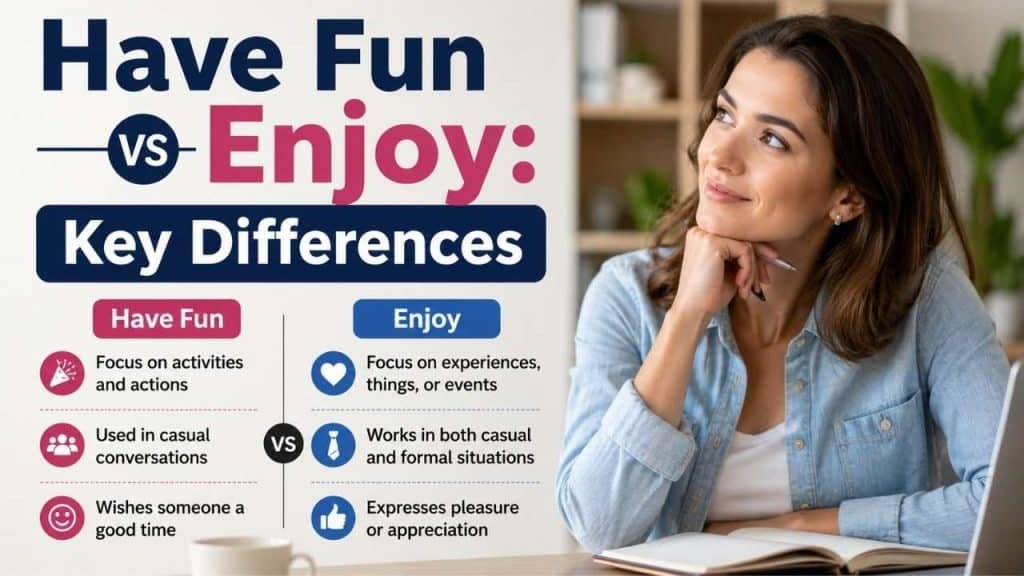
Although “have fun” and “enjoy” both express positive feelings, they do not always mean the same thing. The biggest difference between have fun and enjoy is their focus. “Have fun” encourages someone to have a good time during an activity, while “enjoy” tells someone to take pleasure in an experience, event, object, or action.
Another difference is tone. “Have fun” sounds more casual and friendly, while “enjoy” fits both casual and formal situations. You can say “Have fun at the concert,” but “Enjoy the concert” is also correct because a concert is an experience. Understanding these small differences helps you choose the most natural expression and avoid common mistakes in correct English.
Have Fun vs Enjoy Comparison Table
The table below gives a quick comparison to help you understand have fun vs enjoy. It highlights the meaning, usage, and common situations for each expression. If you ever wonder “Can I say enjoy instead of have fun?”, this comparison will help you make the right choice.
| Feature | Have Fun | Enjoy |
| Meaning | Wish someone a good time | Tell someone to take pleasure in something |
| Focus | Activities | Experiences, objects, events, or activities |
| Tone | Casual and friendly | Casual or formal |
| Common Examples | Have fun at the party. | Enjoy your meal. |
| Used Before | Activities or events | Nouns or -ing verbs |
| Best For | Games, trips, parties | Meals, movies, vacations, books |
This simple guide makes it easier to remember the correct usage of both expressions.
When to Use “Have Fun”
Use “have fun” when you want to wish someone an enjoyable time during an activity or event. It is one of the most common expressions in conversational English, especially among friends, family, classmates, and coworkers.
You can say “Have fun at the beach,” “Have fun on your trip,” or “Have fun playing basketball.” These examples all involve activities where people expect to enjoy themselves. Avoid using “have fun” with things like meals or books because it sounds unnatural.
Instead, use “enjoy” in those situations. Just as the idiom Cream Rises to the Top reminds us that quality naturally stands out, choosing the right expression makes your English clearer and more natural. Learning when to use have fun will help you sound like a confident English speaker.
When to Use “Enjoy”
Use “enjoy” when you want someone to take pleasure in an experience, object, event, or activity. Unlike “have fun,” this expression works well in both casual and formal English. You can say “Enjoy your meal,” “Enjoy the movie,” “Enjoy your vacation,” or “Enjoy reading this book.” In each example, the speaker encourages another person to appreciate the experience.
Since “enjoy” is a verb, it usually comes before a noun or a verb ending in -ing. This grammar pattern makes it different from “have fun.” Learning when to use enjoy helps you communicate more naturally in spoken English and written English. It is also one of the most common expressions that native speakers use every day.
Can “Have Fun” and “Enjoy” Be Used Interchangeably?
Many English learners ask, “Can you say enjoy instead of have fun?” The answer is sometimes, but not always. Both expressions share a similar idea, yet they fit different situations. For example, “Have fun at the party” and “Enjoy the party” are both correct because a party is an event that people attend for pleasure. However, you would not normally say “Have fun your meal.”
The correct phrase is “Enjoy your meal.” Likewise, “Enjoy your book” sounds natural, while “Have fun your book” does not. Understanding these differences helps you avoid common mistakes. Knowing when to use have fun and when to use enjoy makes your English sound smoother and more confident.
Formal vs Informal Usage
The tone of these expressions also matters. “Have fun” sounds warm, friendly, and informal, so people often use it with friends, family members, classmates, and coworkers. You might hear, “Have fun at the concert!” or “Have fun on your holiday!” On the other hand, “enjoy” works well in both informal and formal situations.
Restaurants often say “Enjoy your meal,” hotels say “Enjoy your stay,” and airlines may say “Enjoy your flight.” These expressions sound polite and professional. If you are writing an email or speaking to customers, “enjoy” is usually the better choice. Understanding the formal vs informal use of have fun and enjoy helps you choose the right expression for every situation.
How Native Speakers Actually Use These Expressions
Native speakers choose “have fun” and “enjoy” based on the situation instead of following strict grammar rules. Before someone starts an activity, they often say “Have fun!” It is short, friendly, and encouraging. When talking about meals, movies, vacations, or books, they usually say “Enjoy!” or “Enjoy your…” because it sounds more natural. In daily conversations, people rarely stop to think about the grammar.
They simply use the expression that fits the context. Listening to everyday English will help you notice these patterns. The more you hear these phrases, the easier it becomes to use them correctly. Paying attention to native speaker usage of have fun and enjoy can greatly improve your English fluency.
Common Collocations With “Enjoy”
A collocation is a group of words that naturally go together. Learning common collocations with “enjoy” will make your English sound more fluent. Some popular examples include “Enjoy your meal,” “Enjoy your stay,” “Enjoy your vacation,” “Enjoy the show,” “Enjoy the game,” “Enjoy your weekend,” and “Enjoy your flight.”
You can also use “enjoy” with -ing verbs, such as “enjoy reading,” “enjoy traveling,” and “enjoy learning English.” These combinations appear often in both spoken English and written English. Instead of translating directly from your first language, try to remember these natural word pairs. Using the right collocations helps you sound more like a native English speaker.
Common Situations Where We Say “Have Fun”
People usually say “have fun” before someone begins an activity that is meant to be enjoyable. It is a friendly way to wish someone a good time. Common examples include “Have fun at the party,” “Have fun on your trip,” “Have fun at the beach,” “Have fun playing soccer,” “Have fun shopping,” and “Have fun with your friends.”
These situations all involve activities where people expect to laugh, relax, or enjoy themselves. You would not normally use “have fun” for meals or books because those situations sound more natural with “enjoy.” Remembering these common situations makes it easier to choose the correct expression and improves your everyday English.
Common Mistakes Learners Make
Many English learners confuse “have fun” and “enjoy” because both expressions describe positive experiences. One common mistake is saying “Enjoy at the party.” The correct sentence is “Enjoy the party.” Another mistake is “Have fun your meal.” The natural expression is “Enjoy your meal.”
Some learners also forget that “enjoy” needs an object, such as “Enjoy the movie” or “Enjoy reading.” Saying only “Enjoy” is acceptable when the object is already clear from the conversation. Paying attention to these grammar patterns will improve your accuracy. Avoiding these common mistakes using have fun and enjoy helps you speak and write with greater confidence.
Real-Life Dialogue Examples
Seeing these expressions in real conversations makes them easier to remember. Here are a few simple examples.
Friend: I’m going camping this weekend.
You: Have fun!
Teacher: We’re visiting the science museum tomorrow.
Student: Great! We’ll have fun.
Waiter: Here is your dinner.
Customer: Thank you.
Waiter: Enjoy your meal!
Friend: I’m starting a new book tonight.
You: Enjoy it! I think you’ll love it.
These short conversations show how “have fun” usually fits activities, while “enjoy” works best with meals, books, movies, trips, and other experiences. Practicing similar dialogues will make these expressions feel natural in everyday communication.
Quick Decision Guide
If you are still unsure which expression to choose, use this simple guide.
- Is someone about to start an activity, game, trip, or event? → Have fun.
- Is someone about to eat, watch, read, visit, or experience something? → Enjoy.
- Are you speaking casually with friends? → Both may work, depending on the situation.
- Are you speaking politely in a restaurant, hotel, or workplace? → Enjoy is usually the better choice.
This quick rule will help you decide within seconds. When you understand the difference between have fun and enjoy, choosing the right expression becomes much easier. With regular practice, you’ll use both phrases naturally in correct English.
Synonyms and Alternatives
If you want to avoid repeating the same expressions, you can use several natural alternatives. Instead of “have fun,” try “Have a great time,” “Have a blast,” “Have an amazing day,” or “Enjoy yourself.” These phrases carry a similar meaning and sound friendly. Instead of “enjoy,” you can say “Take pleasure in,” “Savor,” “Appreciate,” or “Make the most of.”
However, remember that each alternative has a slightly different tone. “Savor” is more common with food, while “Appreciate” often refers to recognizing value. Choosing the right synonym keeps your writing fresh and helps you build a stronger English vocabulary without changing your intended meaning.
FAQs
Is it correct to say “Have fun” or “Enjoy”?
Yes. Both expressions are correct, but they are used in different situations.
Can I say “Enjoy” instead of “Have fun”?
Sometimes. Both work for events like parties, but “enjoy” is more natural for meals, movies, books, and similar experiences.
Which expression is more formal?
“Enjoy” is generally more formal and works well in professional settings, while “have fun” is more casual.
Can I say “Have fun your meal”?
No. The correct expression is “Enjoy your meal.”
Does “Enjoy” always need an object?
Usually, yes. You should say “Enjoy the trip” or “Enjoy reading.”
Do native speakers use both expressions?
Yes. Native speakers use both every day, choosing the one that best matches the situation.
How can I remember the difference?
Think of this simple rule: activities = have fun; experiences, objects, or events = enjoy.
Conclusion
Understanding “Have Fun or Enjoy” is easier once you know the purpose of each expression. “Have fun” is the best choice when you want someone to enjoy an activity, while “enjoy” encourages someone to take pleasure in an experience, event, object, or action.
Although the two phrases sometimes overlap, they are not always interchangeable. Learning the difference between have fun and enjoy will help you avoid common mistakes and make your English sound more natural.
Practice these expressions in everyday conversations, pay attention to how native speakers use them, and review the examples whenever you need a quick reminder. With a little practice, choosing the right phrase will become simple and automatic.