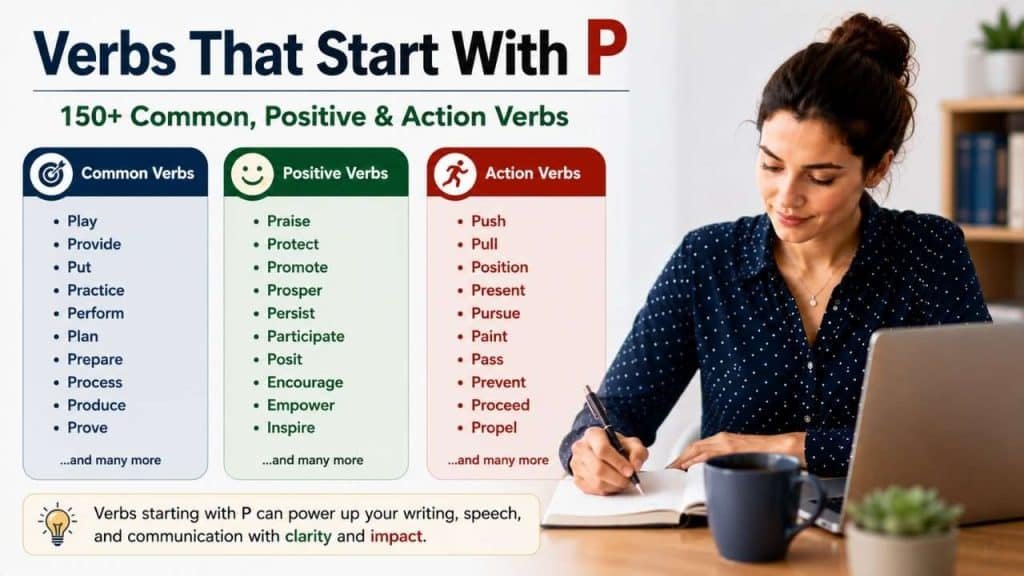

Verbs that start with P are an important part of English vocabulary because they help you describe actions, thoughts, emotions, and everyday activities more clearly. Whether you are a student, teacher, writer, job seeker, or English learner, expanding your list of P verbs can make your speaking and writing stronger. From common words like play, push, and pull to advanced choices like persevere, propose, and persuade, these verbs appear in daily conversations, school assignments, business emails, and creative writing.
In this guide, you’ll explore a well-organized list of verbs that start with P, complete with meanings, example sentences, and useful categories such as common verbs, positive verbs, action verbs, professional verbs, academic verbs, and verbs for kids.
You’ll also discover regular and irregular verbs that start with P, popular phrasal verbs, and practical tips for using these words with confidence. Whether you’re building your English vocabulary, improving your writing skills, or searching for verbs that start with P with meanings and examples, this guide will help you choose the right word naturally and accurately.
What Are Verbs That Start With P?
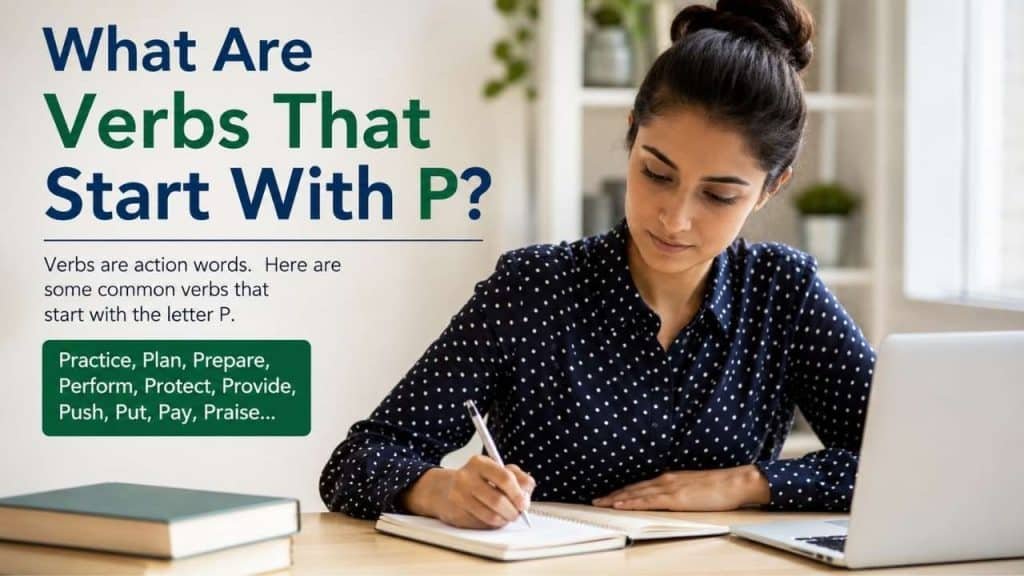
Verbs that start with P are action words that begin with the letter P and describe what someone or something does. These verbs help us explain actions, events, feelings, and changes in a clear way. In English, verbs are one of the most important parts of speech because they make sentences complete and meaningful.
A large number of English verbs starting with P appear in everyday conversations, academic writing, professional communication, and creative work. Common examples include play, plan, prepare, protect, and provide. Learning a variety of P verbs can improve your vocabulary and help you express ideas more effectively.
Whether you are a student, writer, or English learner, understanding verbs beginning with P can make your speaking and writing skills stronger.
List of Common Verbs That Start With P
Many common verbs that start with P appear in daily English because people use them to describe regular actions and experiences. These verbs help you communicate simple ideas in conversations, emails, stories, and school assignments.
| Verb | Meaning | Example |
| Pack | Put things together | I packed my bag before the trip. |
| Paint | Add color to something | She painted the wall blue. |
| Pay | Give money for something | He paid the bill yesterday. |
| Perform | Do an activity or task | The team performed well. |
| Pick | Choose or take something | She picked a flower. |
| Place | Put something somewhere | Please place the book here. |
| Plan | Decide what to do | We planned our weekend trip. |
| Play | Take part in a game | Children play outside. |
Building a strong list of verbs that start with P with meanings helps learners understand how these words work in real sentences.
Positive Verbs That Start With P
Positive verbs that start with P can help express growth, success, kindness, and helpful actions. These verbs are useful when you want to create an encouraging message or describe someone’s good actions.
Some examples include praise, protect, promote, prosper, progress, and provide. These words often appear in personal development articles, speeches, professional writing, and everyday conversations.
For example, a teacher may praise a student for hard work, while a company may promote an employee because of excellent performance. A person can progress by learning new skills and practicing regularly.
Using positive P verbs can make your writing sound more powerful and friendly. These words are especially helpful for students, writers, and professionals who want to communicate positive ideas clearly.
Action Verbs That Start With P
Action verbs that start with P describe activities, movements, and tasks that people or things perform. These verbs make sentences more active and help readers understand what is happening.
Some popular action verbs beginning with P include push, pull, pick, pour, press, protect, and prepare. These words describe physical actions as well as mental activities.
For example, you can push a door open, prepare a meal, or protect someone from danger. Writers often use strong action verbs to make stories, reports, and essays more interesting.
Learning P action words improves your ability to describe events clearly. Students, content writers, and English learners can use these verbs to create stronger sentences and improve their overall communication skills.
Powerful Verbs That Start With P for Writing
Strong word choices can make your writing more interesting and professional. Powerful verbs that start with P help replace weak words and create clearer messages. Instead of using simple verbs repeatedly, writers can choose stronger alternatives to express ideas with more impact.
For example, instead of saying someone “talked about” an idea, you can use presented or proposed. Instead of saying someone “helped” a project, you can use promoted or supported.
Useful writing verbs that start with P include persuade, produce, publish, portray, predict, and pursue. These verbs work well in essays, articles, reports, and stories.
Using a wider range of English verbs beginning with P allows writers to create more engaging content while improving their vocabulary and writing style.
Professional & Resume Verbs That Start With P
Choosing the right words on a resume can help you describe your skills and achievements clearly. Resume verbs that start with P can make your professional experience sound stronger and more effective.
Instead of writing “worked on a project,” you can use verbs like planned, produced, or processed to show your contribution. Other useful professional verbs include performed, prioritized, presented, promoted, and prepared.
These professional verbs that start with P are helpful for job applications, cover letters, LinkedIn profiles, and workplace communication. They show action and explain what you achieved in previous roles.
Using strong workplace verbs can help employers understand your abilities quickly. Whether you work in business, education, technology, or another field, choosing accurate verbs can improve the quality of your professional writing.
Academic Verbs That Start With P
Academic verbs that start with P help students explain ideas, research topics, and present information clearly. These verbs are commonly used in essays, reports, presentations, and educational writing. Using the right academic verbs can make your work sound more organized and professional.
Some useful P verbs for academic writing include prove, present, predict, propose, provide, publish, and process. For example, a student may present research findings, propose a new solution, or prove an argument with strong evidence.
These English verbs starting with P are valuable for learners who want to improve their writing skills. They help explain thoughts in a clear way and allow writers to describe research, analysis, and ideas more effectively.
Verbs That Start With P for Kids
Learning verbs that start with P for kids can help young learners build their English vocabulary in a fun and simple way. Children often learn better when they use words connected to everyday activities and familiar situations.
Easy P verbs for kids include play, paint, pick, push, pull, pour, pack, and practice. These verbs describe actions children see and perform every day. For example, kids play games, paint pictures, pack their bags, and practice new skills.
Teachers and parents can use these verbs beginning with P during classroom activities, reading exercises, and conversations. Learning simple action words helps children create better sentences and improves their speaking confidence. A strong vocabulary foundation makes future English learning easier and more enjoyable.
Regular and Irregular Verbs That Start With P
Understanding regular and irregular verbs that start with P helps English learners use correct verb forms in different tenses. Regular verbs usually form their past tense by adding -ed, while irregular verbs change in different ways.
Some regular P verbs include:
| Base Form | Past Tense | Past Participle |
| Paint | Painted | Painted |
| Plan | Planned | Planned |
| Play | Played | Played |
| Prepare | Prepared | Prepared |
Some irregular verbs beginning with P include:
| Base Form | Past Tense | Past Participle |
| Pay | Paid | Paid |
| Put | Put | Put |
Learning these P verbs with verb forms helps students write correct sentences and improve their grammar skills. Practicing verb forms regularly makes English communication easier and more natural.
Common Phrasal Verbs Starting With P
Phrasal verbs starting with P combine a verb with another word, usually a preposition or adverb, to create a new meaning. These expressions appear often in everyday English conversations, movies, and writing.
Some common phrasal verbs that start with P include:
- Pick up – to collect or learn something
I picked up a new skill during the course. - Pay back – to return money
She paid back the loan. - Point out – to show or mention something
The teacher pointed out the mistake. - Put off – to delay something
He put off the meeting. - Pass away – to die
Her grandfather passed away peacefully.
Learning these useful expressions helps English learners understand natural conversations and improve their speaking skills.
How to Use P Verbs in Sentences
Knowing verbs that start with P with examples helps you use them correctly in real communication. A verb becomes meaningful when you place it in a complete sentence. You can use P verbs in everyday conversations, academic writing, emails, and creative work.
For example:
- Plan: “We plan our schedule every Monday.”
- Protect: “Parents protect their children.”
- Promote: “The company promoted its new product.”
- Persuade: “She persuaded her friend to join the team.”
When choosing a verb, think about the situation and the meaning you want to share. A simple verb like put may work in casual speech, while a stronger verb like propose may fit formal writing.
Using the correct English verbs starting with P makes your sentences clearer and more effective.
Common Mistakes When Using Verbs That Start With P
English learners sometimes confuse certain P verbs because they have similar spellings or meanings. Understanding these differences can help you avoid common grammar mistakes.
One common mistake is confusing practice and practise. In American English, practice works as both a noun and a verb. Another mistake involves pay. Many learners write “payed” when they mean the past tense paid.
Some learners also confuse:
- Precede – to come before something
- Proceed – to continue or move forward
Using the wrong verb can change the meaning of a sentence. To improve your accuracy, always check the definition and example sentences before using unfamiliar verbs beginning with P.
Learning correct usage helps students, writers, and professionals communicate more clearly.
Tips to Remember Verbs That Start With P
Learning a large number of P verbs becomes easier when you use simple practice methods. Instead of memorizing a long list of words, try learning them in groups based on meaning and usage.
You can organize verbs that start with P into categories like action verbs, positive verbs, professional verbs, and academic verbs. Creating flashcards with the verb, meaning, and example sentence can also improve memory.
Another helpful method is using new words in daily writing. For example, write short sentences using words like plan, prepare, protect, and progress.
Reading books, articles, and English lessons can also introduce you to new vocabulary naturally. Regular practice helps you remember English verbs starting with P and use them confidently in conversations and writing.
FAQs
What are verbs that start with P?
Verbs that start with P are action words beginning with the letter P. Examples include play, plan, protect, prepare, and provide. These verbs describe actions, thoughts, and activities.
What are some positive verbs that start with P?
Some positive verbs that start with P include praise, promote, prosper, protect, progress, and provide. These verbs express helpful and encouraging actions.
What are common action verbs that start with P?
Common action verbs that start with P include push, pull, pick, paint, pour, perform, and prepare.
Are there irregular verbs that start with P?
Yes. Some irregular P verbs include pay and put. Their past forms do not follow the usual -ed pattern.
What are professional verbs that start with P?
Professional verbs include plan, produce, present, prioritize, process, and promote. These words work well in resumes and workplace writing.
What are some easy P verbs for kids?
Easy verbs that start with P for kids include play, paint, pick, push, pull, and practice.
Conclusion
Learning verbs that start with P is a simple way to improve your English vocabulary and communication skills. These verbs help you describe actions, share ideas, explain information, and create stronger sentences. From basic words like play and push to advanced choices like persuade and propose, P verbs appear in many areas of life.
This complete guide covered common verbs, positive verbs, action verbs, professional verbs, academic verbs, verbs for kids, regular and irregular verbs, and phrasal verbs starting with P. By practicing these words regularly, you can build a stronger vocabulary and write with more confidence.
Whether you are a student, teacher, writer, or English learner, using the right English verbs beginning with P can make your communication clearer, more natural, and more effective.