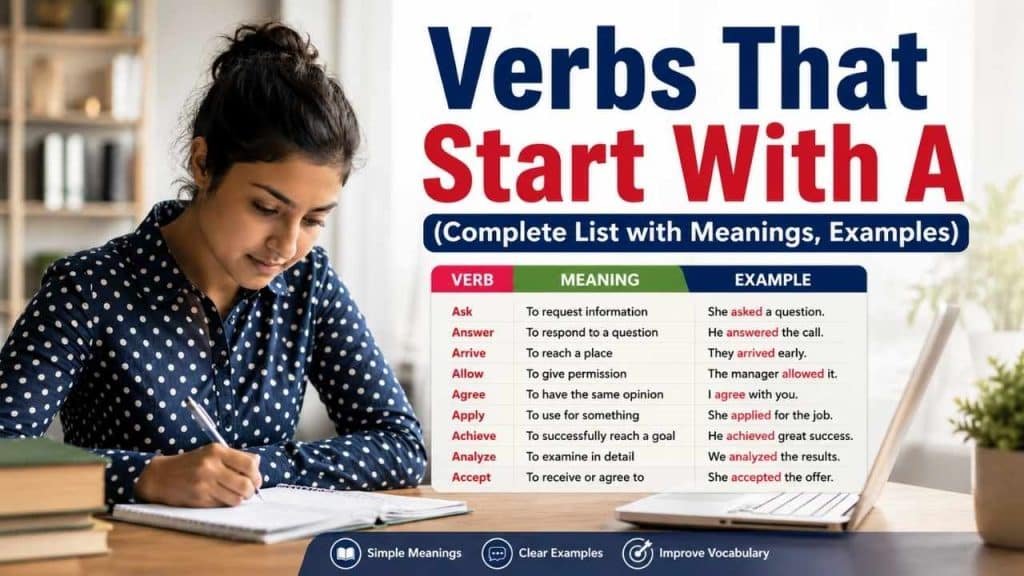

Verbs are action words that show what someone does, feels, or experiences. In simple terms, they are the most important part of a sentence because they bring it to life. In this guide, we focus on verbs that start with A, which are widely used in everyday English, academic writing, and IELTS preparation.
People often search for verbs starting with A list, action verbs starting with A, and English verbs starting with A to improve vocabulary and writing skills. These verbs help students, writers, and ESL learners express ideas more clearly.
For example, words like ask, answer, and arrive are basic but powerful verbs. On the other hand, words like analyze and articulate support formal and academic writing.
This article provides a complete list of verbs starting with A, along with meanings, examples, and usage tips in simple language.
Quick Answer
Verbs that start with A are action words beginning with the letter A that show what someone does, feels, or experiences. Common examples include ask, answer, arrive, allow, agree, apply, achieve, analyze, and articulate. These verbs are used in daily English, academic writing, and IELTS exams.
They can be simple, such as ask and answer, or advanced, such as analyze and advocate. Learners often study a verbs starting with A list with meanings and examples to improve vocabulary, writing skills, and fluency. These verbs are useful for students, writers, and ESL learners who want to express ideas clearly and effectively in both speaking and writing.
Quick Overview of Verbs Starting With A
Verbs starting with A include both common daily-use words and advanced academic vocabulary. These verbs are used in conversation, writing, and exams like IELTS. Many learners search for a verbs starting with A list with meaning and examples to build strong English skills.
Some of the most common A verbs include ask, answer, arrive, allow, and agree. These are basic action verbs starting with A that appear in daily communication.
There are also advanced verbs starting with A, such as analyze, allocate, advocate, and articulate. These are often used in formal writing and academic essays.
Overall, verbs starting with A can be divided into three levels: basic, intermediate, and advanced verbs starting with A for writing improvement. This helps learners choose the right vocabulary based on their needs.
Common Verbs That Start With A (Basic Level)
Basic verbs that start with A are used in everyday English and are easy to understand. These verbs are important for beginners who want to build strong communication skills.
- Ask – to request information
Example: She asks a question in class. - Answer – to respond to a question
Example: He answers the teacher politely. - Arrive – to reach a place
Example: They arrive at school early. - Allow – to give permission
Example: The teacher allows students to leave early. - Agree – to share the same opinion
Example: I agree with your idea.
These common verbs starting with A are useful for daily speaking and writing. They also form the foundation for more complex vocabulary. Learning these helps improve fluency in simple conversations and writing tasks.
Intermediate Verbs Starting With A
Intermediate verbs starting with A help learners express more detailed ideas. These verbs are often used in school writing, workplace communication, and general English practice.
- Apply – to use or request something formally
Example: She applies for a scholarship. - Announce – to make something public
Example: The school announces exam results. - Achieve – to reach a goal
Example: He achieves good grades through hard work. - Arrange – to organize something
Example: They arrange a meeting. - Assist – to help someone
Example: The teacher assists students in learning.
These English verbs starting with A improve sentence quality and clarity. They are often used in essays, reports, and professional communication. Using these verbs correctly helps learners move from basic English to more structured and effective writing.
Advanced & Academic Verbs Starting With A
Advanced verbs starting with A are commonly used in academic writing, IELTS essays, and professional communication. These verbs help improve writing quality and make ideas more precise.
- Analyze – to study something in detail
Example: Students analyze data in science class. - Articulate – to express clearly
Example: She articulates her ideas well in essays. - Allocate – to distribute resources
Example: The manager allocates funds carefully. - Advocate – to support or promote an idea
Example: He advocates for education reform. - Administer – to manage or organize
Example: The teacher administers the test.
These advanced action verbs starting with A are important for IELTS writing task 2 and academic essays. They help replace weak verbs and improve sentence strength. Using these verbs correctly shows strong vocabulary control and improves writing scores.
Action Verbs Starting With A
Action verbs starting with A describe physical or mental actions. These verbs show what someone is doing in a clear and direct way.
Common examples include:
- Ask
- Act
- Approach
- Attack
- Assist
- Announce
These verbs are widely used in storytelling, instructions, and daily communication. For example, “He acts quickly in emergencies” or “They approach the problem carefully.”
Using strong action verbs starting with A improves writing clarity and reduces weak expressions. Instead of using simple verbs repeatedly, action verbs make sentences more powerful and engaging. This is especially useful for students, bloggers, and content writers who want to improve readability and impact.
Strong Verbs Starting With A for Writing
Strong verbs starting with A help improve writing quality by making sentences more precise and powerful. Writers often use these verbs to replace weak or general words.
Examples include:
- Articulate ideas clearly
- Analyze problems deeply
- Advocate strong opinions
- Accelerate progress
- Amplify impact
For example, instead of saying “He explains his idea,” you can say “He articulates his idea clearly.” This improves clarity and professionalism.
These powerful verbs starting with A for writing improvement are useful in essays, blogs, and business communication. They help writers avoid repetition and make content more engaging. Learning these verbs is a simple way to improve overall writing strength and vocabulary quality.
Verbs Starting With A for IELTS & Academic Writing
In IELTS and academic writing, using strong vocabulary is important. Verbs starting with A for IELTS writing help students achieve higher band scores by improving clarity and formality.
Common IELTS-focused verbs include:
- Analyze arguments
- Advocate solutions
- Allocate resources
- Assess situations
- Articulate viewpoints
Example: “The study analyzes the impact of technology on education.”
These academic verbs starting with A are useful in Task 2 essays where formal tone is required. Instead of simple verbs, using advanced vocabulary shows language control and improves scoring potential. Learners preparing for exams should practice these verbs in real sentences to build confidence.
Verbs Starting With A with Example Sentences
Learning verbs starting with A with example sentences helps learners understand real usage. Below are simple examples:
- Ask – She asks for help politely.
- Answer – He answers every question clearly.
- Apply – They apply new rules in class.
- Achieve – She achieves her goals through practice.
- Analyze – Students analyze the data carefully.
- Agree – We agree on the final decision.
- Allow – The system allows easy access.
- Assist – He assists new learners daily.
These examples show how English verbs starting with A work in real sentences. Practicing them helps improve grammar, fluency, and writing accuracy. Learners should try creating their own sentences for better retention.
Common Mistakes When Using Verbs Starting With A
Many learners make mistakes while using verbs starting with A in English grammar. One common mistake is using weak verbs too often, such as repeating do or make instead of stronger verbs like analyze or articulate.
Another mistake is incorrect tense usage. For example, saying “He ask yesterday” instead of “He asked yesterday.” Verb forms must always match the tense.
Learners also confuse similar verbs, such as allow and enable, which have different meanings. Understanding context is important.
Avoiding these mistakes improves clarity and writing quality. Practicing verbs starting with A examples in sentences helps build confidence and reduces errors in both speaking and writing.
FAQs
What are verbs that start with A?
Verbs that start with A are action or state words beginning with the letter A. They describe actions such as ask, answer, arrive, and allow. These verbs are widely used in English grammar and communication.
What are some common verbs starting with A?
Some common verbs starting with A include ask, answer, arrive, agree, allow, apply, and achieve. These are everyday verbs used in speaking and writing.
What are action verbs starting with A?
Action verbs starting with A are verbs that show physical or mental actions. Examples include ask, act, approach, attack, and assist. They make sentences more direct and clear.
Why are verbs starting with A important?
These verbs are important because they improve vocabulary, sentence clarity, and writing quality. They are useful for students, ESL learners, and IELTS candidates who want better communication skills.
What are advanced verbs starting with A?
Advanced verbs starting with A include analyze, articulate, allocate, advocate, and administer. These are often used in academic writing and formal communication.
How can I learn verbs starting with A easily?
You can learn them by practicing a verbs starting with A list with meanings and example sentences, using them in daily writing, and revising them regularly for better memory retention.
Conclusion
Verbs starting with A are essential for building strong English vocabulary. They include basic, intermediate, and advanced words used in daily communication, academic writing, and IELTS exams.
From simple verbs like ask and answer to advanced verbs like analyze and articulate, each word improves expression and clarity. Learning these English verbs starting with A list helps students, writers, and ESL learners improve fluency.
By practicing meanings and examples regularly, learners can strengthen their grammar and writing skills. Using the right action verbs starting with A makes communication more effective and professional.