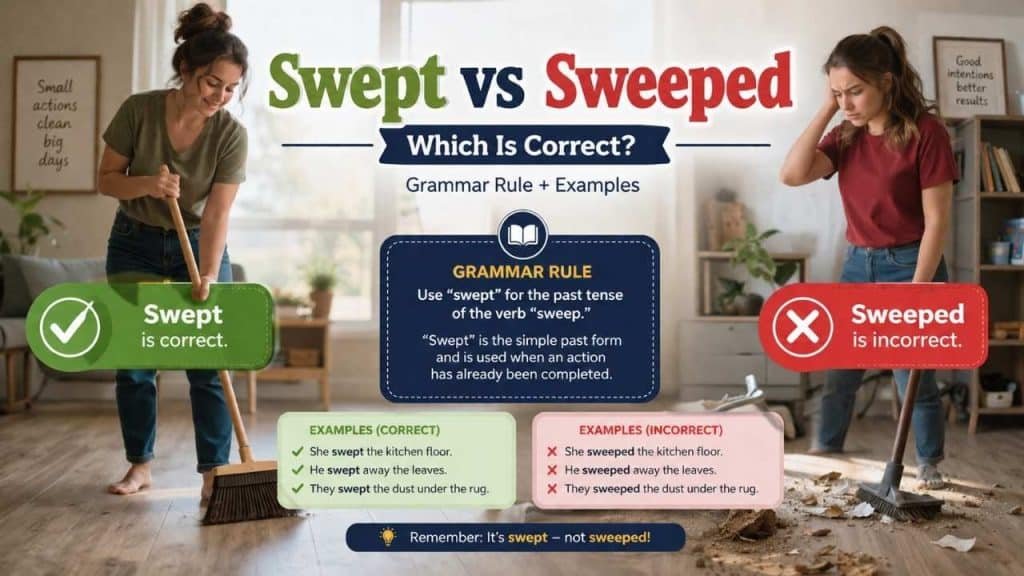

Have you ever written “sweeped” and wondered if it was correct? You’re not alone. Many English learners and even native speakers confuse “sweeped vs swept” because most English verbs form the past tense by adding -ed.
However, sweep is an irregular verb, so it follows a different rule. The correct past tense of sweep and past participle of sweep is “swept,” not “sweeped.” Learning this small grammar rule can help you avoid a common writing mistake and improve your confidence in both speaking and writing.
In this grammar guide, you’ll learn the difference between sweeped and swept, discover why sweeped is incorrect, review verb forms, see plenty of sentence examples, and pick up an easy memory trick to help you remember the correct form every time.
Quick Answer
“Swept” is the correct past tense and past participle of sweep, while “sweeped” is incorrect in standard English. Because sweep is an irregular verb, it does not form the past tense by adding -ed. Always use “swept” in both writing and speech. If you’re wondering “sweeped vs swept” or “is sweeped a word?”, remember that dictionaries and grammar experts recognize “swept” as the only correct form.
Sweeped vs Swept: What’s the Difference?
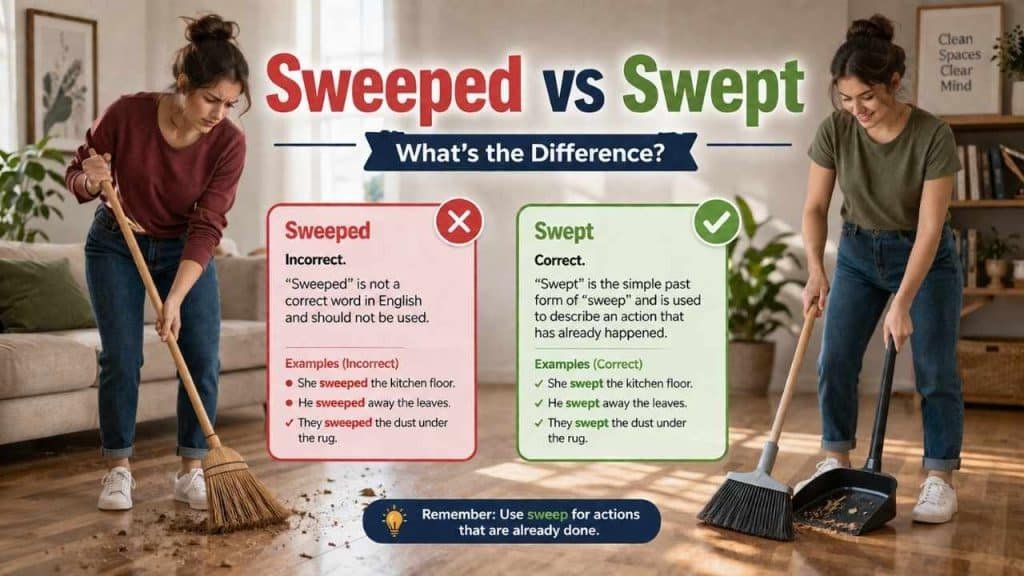
The difference between “sweeped” and “swept” is easy to understand once you know how irregular verbs work. Swept is the correct past tense and past participle of sweep, while sweeped is not accepted in standard English. Many people create the word sweeped because they expect every verb to follow the regular -ed pattern.
However, English has many irregular verbs that change their spelling instead of simply adding -ed. Whether you’re writing an essay, an email, or a social media post, you should always use swept. Learning this grammar rule will help you avoid common grammar mistakes, improve your English writing, and choose the correct verb form every time.
Meaning of Sweep
The verb sweep means to clean a surface by moving dust, dirt, or leaves with a broom or brush. It can also mean to move quickly across an area or carry something away with force, such as wind or water. In everyday English, people use sweep in many situations, from cleaning a room to describing natural movement. Since sweep is an irregular verb, its verb forms change differently from regular verbs. Understanding the meaning of sweep makes it easier to remember why the correct past tense is swept instead of sweeped.
Why “Swept” Is Correct
Swept is correct because sweep is an irregular verb. Instead of adding -ed, it changes its spelling in the simple past and past participle forms. This pattern is common in English and also appears in verbs like keep → kept and sleep → slept.
Every major dictionary and grammar guide lists swept as the correct form. If you’re writing about something that already happened, always use swept. Using the correct form helps your writing sound natural, professional, and grammatically accurate.
Why “Sweeped” Is Incorrect
Many learners ask, “Is sweeped a real word?” In modern English grammar, the answer is no. Although sweeped looks like it should be correct, it breaks the rule for this irregular verb. People often write sweeped because they apply the regular -ed ending to every verb.
However, sweep is an exception, and its correct past tense is swept. If you use sweeped in formal writing, it will usually be considered a grammar mistake. Choosing swept instead shows that you understand proper English grammar and correct usage.
Is “Sweeped” Ever a Correct Word?
If you’ve searched “is sweeped correct” or “is sweeped a word,” the simple answer is no. In standard English, sweeped is not the correct past tense of sweep. Instead, the only accepted form is swept, which serves as both the simple past and the past participle.
The confusion happens because many English verbs become past tense by adding -ed, but sweep is an irregular verb that follows a different pattern.
Dictionaries, grammar books, and style guides all agree that swept is the correct choice. Whether you’re writing for school, work, or everyday communication, using swept instead of sweeped makes your writing clearer, more natural, and grammatically correct.
What Is the Past Tense of Sweep?
The past tense of sweep is swept, and the past participle of sweep is also swept. This means you should never use sweeped when talking about an action that happened in the past. Here are the correct verb forms:
| Verb Form | Word |
| Base Form | Sweep |
| Simple Present | Sweep / Sweeps |
| Present Participle | Sweeping |
| Simple Past | Swept |
| Past Participle | Swept |
For example, you can say, “She swept the kitchen yesterday,” or “They have swept the sidewalk.” Both sentences use the correct verb conjugation. Learning these forms will help you avoid common grammar mistakes and improve your confidence in English writing and everyday conversation.
Why Is “Sweep” an Irregular Verb?
Sweep is an irregular verb because it does not form its past tense by adding -ed. Instead, it changes to swept, following an older pattern that has existed in English for many years. Many common verbs work the same way, including keep → kept, sleep → slept, and weep → wept.
These verbs have unique forms that must be memorized because they do not follow the regular grammar rule. Although this may seem difficult at first, you’ll quickly recognize the pattern with practice. Understanding why sweep changes to swept makes it easier to avoid using sweeped and helps you write more accurate, natural English in both formal and informal situations.
Sweeped vs Swept Comparison Table
If you’re still unsure about “sweeped vs swept,” this quick comparison makes the difference clear. The table below shows which word is correct and when you should use it.
| Feature | Sweeped | Swept |
| Correct in Standard English | ❌ No | ✅ Yes |
| Past Tense of Sweep | ❌ No | ✅ Yes |
| Past Participle of Sweep | ❌ No | ✅ Yes |
| Found in Modern Dictionaries | ❌ No | ✅ Yes |
| Appropriate for School or Business Writing | ❌ No | ✅ Yes |
Whenever you write about a completed action, always choose swept. Remember that sweep is an irregular verb, so adding -ed creates an incorrect form. This simple rule will help you avoid mistakes and use the correct English grammar every time.
How to Use “Swept” Correctly
Using “swept” correctly is easy once you know that it is the past tense and past participle of sweep. Use swept when talking about an action that has already happened or has been completed.
It works in everyday conversations, school assignments, business writing, and creative stories. For example, you can say, “I swept the kitchen this morning,” or “The workers have swept the parking lot.”
Both sentences use the correct verb forms of sweep. Avoid using sweeped, even if it sounds natural, because it is not accepted in standard English. Learning the correct usage of swept will improve your English grammar, make your writing more professional, and help you avoid a common grammar mistake.
Correct and Incorrect Sentence Examples
Seeing examples of swept in sentences is one of the easiest ways to remember the correct form. Compare these examples to understand the difference between sweeped and swept.
✅ Correct Sentences
- She swept the floor before dinner.
- The wind swept the leaves across the yard.
- We have swept the classroom already.
- He swept the porch every Saturday.
❌ Incorrect Sentences
- She sweeped the floor before dinner.
- The wind sweeped the leaves away.
- We have sweeped the classroom.
- He sweeped the porch yesterday.
Always replace sweeped with swept. Using the correct past tense of sweep makes your writing clearer, more natural, and grammatically correct.
Common Mistakes People Make
Many learners make the same mistake because they think every English verb forms the past tense by adding -ed. That rule works for regular verbs but not for irregular verbs like sweep. One common error is writing “I sweeped the room yesterday.” Another mistake is saying “They have sweeped the floor.”
Both sentences should use swept instead. Some people also use sweeped away or sweeped under the rug, but these expressions are incorrect. To avoid these common grammar mistakes, remember that swept is always the correct past tense and past participle of sweep. Checking your writing before you submit it can help you catch this mistake quickly.
Memory Trick to Remember “Swept”
A simple memory trick can help you remember that swept is correct. Think about other irregular verbs that end with a similar sound. For example, keep becomes kept, sleep becomes slept, and weep becomes wept. Notice how each verb changes instead of adding -ed. Sweep follows the same pattern and becomes swept.
You can also remember this sentence: “I swept with my broom, so I never write sweeped.” Reading or saying this sentence a few times makes the correct form easier to remember. Practicing with similar verb forms will improve your English grammar and help you avoid mistakes in both writing and speaking.
Other Irregular Verbs Similar to Sweep
Learning similar irregular verbs makes it easier to remember the correct verb conjugation of sweep. Many English verbs change their spelling instead of adding -ed. Here are a few common examples:
| Base Verb | Past Tense | Past Participle |
| Sweep | Swept | Swept |
| Keep | Kept | Kept |
| Sleep | Slept | Slept |
| Weep | Wept | Wept |
| Leave | Left | Left |
| Teach | Taught | Taught |
These examples show that sweep is not the only verb with a unique past tense. Learning groups of similar verbs helps you remember the correct forms more easily.
Popular Idioms That Use “Swept”
The word swept appears in many common English expressions. Learning these idioms improves both your vocabulary and your understanding of correct English usage.
- Swept off your feet – to fall in love very quickly.
- Swept away – to become deeply moved by emotions or excitement.
- Swept under the rug – to hide or ignore a problem instead of dealing with it.
- Swept aside – to remove or ignore something that blocks progress.
These expressions always use swept, never sweeped. Since they are common in books, movies, and conversations, learning them will help your English sound more natural. They also reinforce the correct past tense of sweep every time you use them.
Does American and British English Use “Swept” Differently?
Some English words have different spellings in American English and British English, but swept is not one of them. Both varieties of English use swept as the correct past tense and past participle of sweep. You will find the same spelling in dictionaries, grammar books, newspapers, and official writing on both sides of the Atlantic.
The incorrect form sweeped is not accepted in either version of English. Whether you are writing for a US audience or a UK audience, you should always choose swept. This makes the rule simple to remember because there are no regional differences for this verb.
Quick Grammar Quiz
Test your understanding of sweeped vs swept with this short quiz.
1. Which sentence is correct?
- A. She sweeped the floor.
- B. She swept the floor. ✅
2. What is the past tense of sweep?
- A. Sweeped
- B. Swept ✅
3. Which word is grammatically correct?
- A. Sweeped
- B. Swept ✅
4. Is sweep a regular verb?
- A. Yes
- B. No ✅
5. Which sentence is correct?
- A. They have sweeped the room.
- B. They have swept the room. ✅
If you answered all five correctly, you now understand the correct verb forms of sweep and can avoid this common grammar mistake.
FAQs
Is “sweeped” a real word?
No. Sweeped is not accepted in standard English. The correct form is swept.
What is the past tense of sweep?
The past tense of sweep is swept.
What is the past participle of sweep?
The past participle is also swept.
Why is “swept” correct instead of “sweeped”?
Because sweep is an irregular verb that changes spelling instead of adding -ed.
Can I use “sweeped” in formal writing?
No. Always use swept in school, business, and professional writing.
Is “swept” used in American and British English?
Yes. Both American English and British English use swept.
How can I remember the correct form?
Think of similar verbs like keep → kept and sleep → slept. Sweep → swept follows the same pattern.
Conclusion
Understanding “sweeped vs swept” is easier once you know that sweep is an irregular verb. The correct past tense and past participle of sweep are always swept, while sweeped is incorrect in standard English.
By learning the correct verb forms, practicing with sentence examples, and remembering similar verbs like keep → kept and sleep → slept, you can avoid this common grammar mistake.
Whether you’re writing an email, completing homework, or speaking in everyday conversations, choosing swept will make your English sound more natural and accurate. Whenever you feel unsure, remember one simple rule: if the action happened in the past, always use swept, never sweeped.