
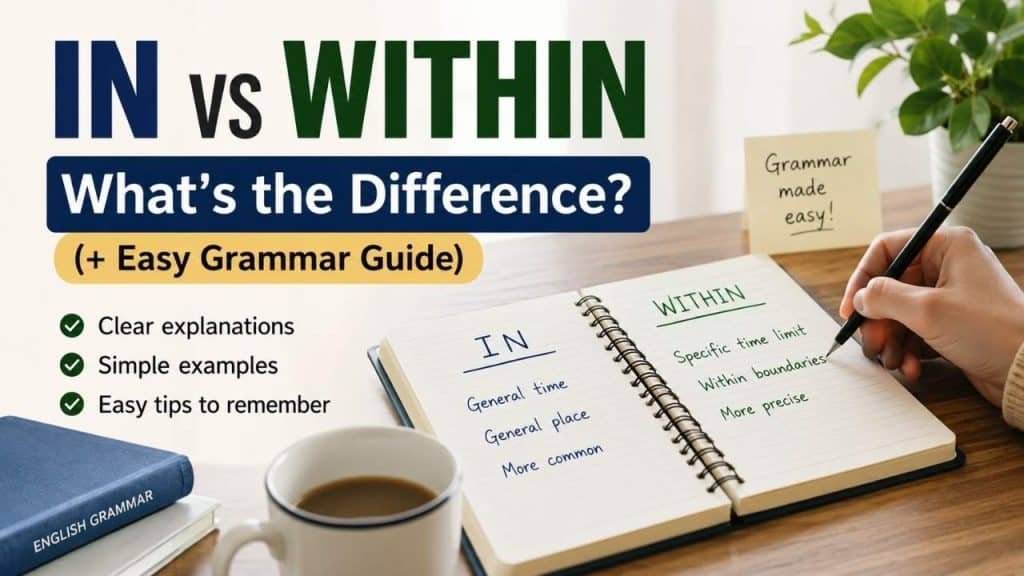
Have you ever wondered whether you should write in vs within? These two common English prepositions often seem interchangeable, but they don’t always mean the same thing. While both can describe time, place, or position, the choice between them can change the meaning or level of precision in a sentence. That’s why many English learners, writers, and professionals search for the difference between in and within and ask when to use in and within correctly.
In this grammar guide, you’ll learn the key differences between in vs within, understand the grammar rules, and see plenty of sentence examples from everyday English. We’ll also explain when “in” and “within” can be used interchangeably, when they cannot, and how to avoid common mistakes. By the end, you’ll know exactly which word fits your sentence and feel more confident in your writing.
Quick Answer
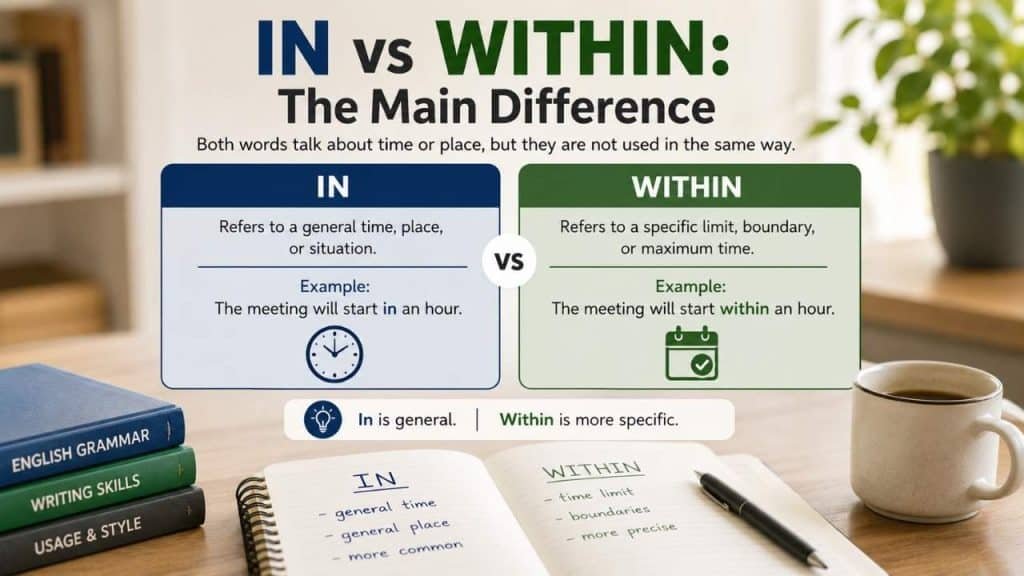
The main difference between in and within is that in refers to a general time, place, or situation, while within emphasizes a specific boundary, limit, or maximum period. In many cases, in vs within can express similar ideas, but within usually sounds more precise or formal. For example, “I’ll finish the report in two days” suggests the task will take about two days, while “I’ll finish the report within two days” means it will be completed no later than two days. Understanding this small difference helps you make better word choices and write with greater clarity.
What Does “In” Mean?
The word in is one of the most common prepositions in English grammar. It usually shows that someone or something is inside a place, during a period of time, or involved in a particular situation. Because it has many meanings, in appears in everyday conversations, business writing, academic work, and casual communication. Learning the meaning of “in” is the first step to understanding in vs within.
For example, you can say, “She is in the office,” “The meeting starts in June,” or “He is in trouble.” In each sentence, in simply tells us where something is, when something happens, or what condition someone is experiencing. It focuses on the general location or time rather than emphasizing a limit or boundary, making it the natural choice in most everyday situations.
What Does “Within” Mean?
The preposition within means inside the limits, boundaries, or maximum time allowed. Unlike in, it usually emphasizes that something happens before a deadline, inside a defined area, or within certain limits. This extra sense of precision is why within often appears in legal documents, business communication, academic writing, and formal instructions. Understanding the meaning of “within” makes it easier to choose between within vs in.
For example, “Please reply within 24 hours” means the reply must arrive before the 24-hour limit ends. Likewise, “The park lies within the city limits” highlights a specific boundary instead of a general location. Although within can sometimes replace in, it usually adds a stronger idea of restriction, limit, or enclosed space, making your writing more exact and professional.
In vs Within: The Main Difference
The biggest difference between in and within is the level of detail they express. In simply tells you that something happens inside a place, during a period, or as part of a situation. Within, however, highlights a boundary, limit, or maximum time.
This is the key idea to remember when comparing in vs within. For example, “The package will arrive in three days” usually refers to the expected arrival time. In contrast, “The package will arrive within three days” promises that it will arrive no later than three days.
In many situations, both words are correct, but within sounds more precise and formal. Choosing the right word helps improve your writing clarity, grammar, and overall word choice.
In vs Within Comparison Table
| Feature | In | Within |
| Meaning | Refers to a general place, time, or situation | Refers to a limit, boundary, or maximum period |
| Time | Indicates when something happens | Indicates that something happens before a deadline |
| Place | Shows that something is inside a location | Emphasizes being inside defined boundaries |
| Precision | More general | More specific and exact |
| Formality | Common in everyday English | More common in formal or professional writing |
| Interchangeable? | Sometimes | Sometimes, depending on the context |
| Example | She arrived in an hour. | She arrived within an hour. |
This comparison table gives a quick view of in vs within. While both words can describe time and place, within usually adds the idea of a limit or deadline. Use this guide whenever you’re unsure which preposition fits your sentence.
When to Use “In”
Use in when talking about a general location, time, or situation without focusing on a limit. It is the most common choice in everyday English grammar and appears in casual conversations, emails, stories, and reports. You can use in with months, years, parts of the day, rooms, cities, countries, and many common expressions.
For example, “I was born in 2005,” “She lives in New York,” and “We’ll meet in the morning.” These sentences simply describe where or when something happens. Choose in when you do not need to stress a deadline or boundary. If your goal is to give general information instead of highlighting limits, in is usually the correct and most natural preposition.
When to Use “Within”
Use within when you want to emphasize a boundary, limit, or maximum amount of time. It is common in formal writing, business communication, contracts, instructions, and academic documents because it sounds more precise. For example, “Please submit your application within seven days” means the application must be sent before the seven-day limit ends.
You can also use within for places, such as “The museum is within walking distance” or “The playground is within the school grounds.” In each example, within highlights a defined area or limit. Whenever you want readers to understand that something must happen before a deadline or stay inside specific boundaries, within is the better choice.
Using “In” and “Within” for Time Expressions
One of the most common questions about in vs within is how they work with time expressions. Although both words refer to time, they do not always mean the same thing. In often tells you when something will happen or how long it will take. For example, “The train will arrive in 20 minutes.”
Within, however, means before a certain amount of time has passed. For example, “The train will arrive within 20 minutes” means it can arrive at any point before the 20-minute limit. This small difference makes within more exact. Understanding these grammar rules helps you choose the correct word when discussing deadlines, schedules, and future events.
Using “In” and “Within” for Places and Locations
Both in and within can describe places and locations, but they focus on different ideas. Use in when you simply mean that something is inside a place. For example, “The books are in the library” or “She lives in Canada.”
Use within when you want to emphasize the boundaries of a place. For example, “The playground is within the school campus” or “The river flows within the national park.”
In these examples, within highlights that something stays inside a clearly defined area. If you are only talking about location, in is usually enough. If you want to stress limits or enclosed space, within is the better option.
Can “In” and “Within” Be Used Interchangeably?
Yes, in and within can sometimes be used interchangeably, but not in every sentence. When both words fit, within usually adds a stronger sense of precision or limitation. For example, “I’ll reply in two days” and “I’ll reply within two days” are both correct, but the second sentence promises that the reply will come before the two-day limit.
In many everyday conversations, native speakers naturally choose in because it sounds simpler. However, in legal, business, or academic writing, within is often preferred because it reduces confusion. Before replacing one word with the other, think about whether you want to emphasize a general time or place, or a specific boundary.
Does “Within” Sound More Formal Than “In”?
Yes, within generally sounds more formal than in. It often appears in contracts, company policies, government documents, instruction manuals, and professional emails because it clearly defines limits and deadlines.
For example, “Please respond within five business days” sounds more professional than “Please respond in five business days.” On the other hand, in is more common in everyday conversations and informal writing.
Native speakers use it naturally when no special emphasis is needed. Neither word is better than the other—they simply suit different situations. If you are writing for work, school, or official purposes, within may be the better choice. For casual conversations, in usually sounds more natural and friendly.
Common Mistakes to Avoid
Many learners make simple mistakes when using in vs within. One common error is using within when no limit or boundary exists. For example, saying “She lives within London” sounds unnatural unless you are talking about the city’s official boundaries. “She lives in London” is the correct choice.
Another mistake is confusing within with inside. Although they are similar, they are not always interchangeable. Some writers also use in when they really mean before a deadline, making their meaning less clear.
To avoid these mistakes, ask yourself whether you are talking about a general place or time, or whether you need to highlight a specific limit. This simple habit improves your English grammar and writing.
In vs Within vs Inside
Many people also compare in, within, and inside, but each word has a different purpose. In is the most general and simply means something is located in a place or happens during a period. Inside mainly describes physical space. For example, “The keys are inside the drawer.” Within focuses on limits, boundaries, or maximum time.
For example, “The report must be finished within three days.” Although all three words can sometimes describe location, they are not always interchangeable. Choosing the correct word depends on what you want to emphasize. Understanding the differences between in vs within vs inside will make your writing clearer, more accurate, and easier for readers to understand.
Quick Tips to Choose the Right Word
If you’re still unsure about when to use in and within, these simple tips can help. Use in when you are talking about a general place, time, or situation. Use within when you want to stress a deadline, limit, or boundary. If your sentence sounds too formal for everyday conversation, in may be the better option.
If you are writing instructions, business documents, or legal text, within often works best. When both words seem correct, read the sentence aloud and decide whether you want a general meaning or a more precise one. With regular practice and real-life examples, choosing between in vs within will become much easier and feel completely natural.
Practice Sentences (Quiz)
Test your understanding by choosing in or within for each sentence.
- Please finish the project ___ five days.
- She keeps her passport ___ the safe.
- The store is ___ walking distance.
- We moved here ___ 2024.
- The reply should arrive ___ 48 hours.
Answers:
- within
- in
- within
- in
- within
These examples show how in usually describes a general time or place, while within emphasizes a limit or boundary. Practicing with sentences like these is one of the fastest ways to remember the difference between in and within and improve your confidence in everyday writing.
FAQs
Is there a difference between in and within?
Yes. In gives a general idea of time or place, while within emphasizes a specific limit, boundary, or maximum period.
Can I use in instead of within?
Sometimes. If no deadline or boundary needs emphasis, in is often the more natural choice.
Is within more formal than in?
Yes. Within is more common in business, legal, and academic writing because it sounds more precise.
Can within describe places?
Yes. It can describe locations inside defined boundaries, such as within the city limits or within the building.
Are in and within interchangeable?
Only in some contexts. Replacing one with the other can slightly change the meaning or emphasis of a sentence.
Is within only used for time?
No. Within is also used for places, limits, organizations, and abstract ideas like within reason or within the law.
Which word should I use in everyday writing?
For most everyday conversations and general writing, in is the more natural choice. Use within when precision or limits are important.
Conclusion
Understanding in vs within becomes much easier once you know what each word emphasizes. In is the best choice for talking about a general place, time, or situation, while within highlights a boundary, limit, or deadline.
Although they can sometimes be used interchangeably, choosing the correct preposition makes your writing clearer and more accurate. Whenever you’re unsure, think about whether you want a general meaning or a specific limit.
With regular practice and plenty of real-life examples, you’ll quickly learn when to use in and within correctly. Remember this simple rule: use “in” for general information and “within” for defined limits, and you’ll make better grammar choices every time.