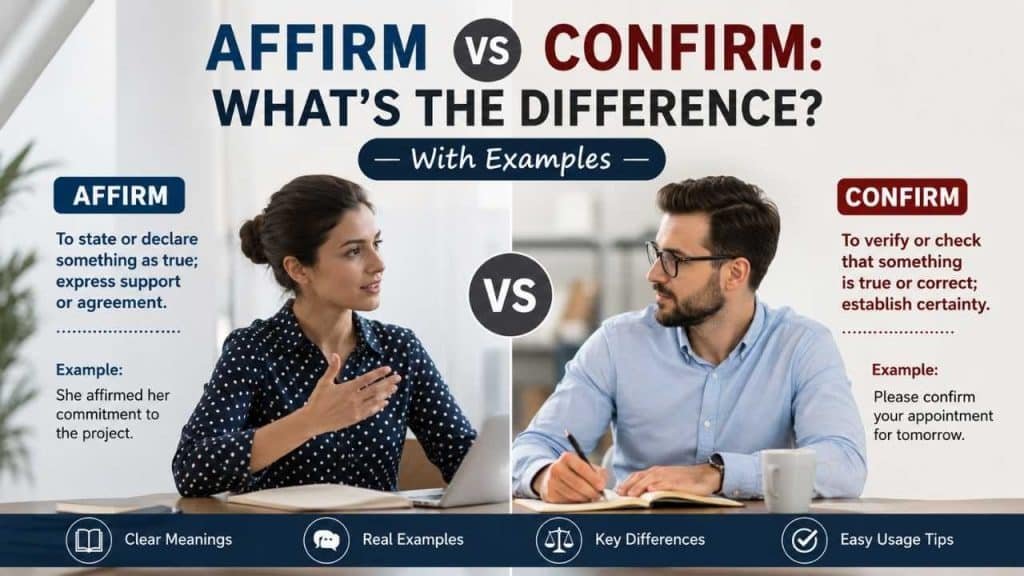

Have you ever wondered whether you should use affirm vs confirm? Although these two verbs are closely related, they are not interchangeable in every situation. Many English learners, students, and professionals confuse them because both involve expressing certainty.
However, affirm usually means to state or declare something as true, while confirm means to verify, prove, or establish that something is correct. Knowing the difference between affirm and confirm helps you communicate more clearly in conversations, emails, business writing, and even legal situations.
In this guide, you’ll learn the meaning of affirm vs confirm, discover when to use each word, compare them side by side, and explore plenty of real-life examples. By the end, you’ll feel confident choosing the right word in both everyday English and formal communication.
Quick Answer
The difference between affirm and confirm is simple. Affirm means to declare, assert, or express support for something, often a belief, decision, or statement. Confirm, on the other hand, means to verify, validate, or prove that something is true or accurate using evidence or additional information. For example, you can affirm your commitment to a project, but you confirm a meeting, confirm attendance, or confirm details before an event.
While both words express certainty, affirm focuses on making a positive declaration, whereas confirm focuses on checking or establishing facts. Understanding affirm vs confirm will help you choose the correct word in everyday, business, and legal English.
Affirm vs Confirm at a Glance
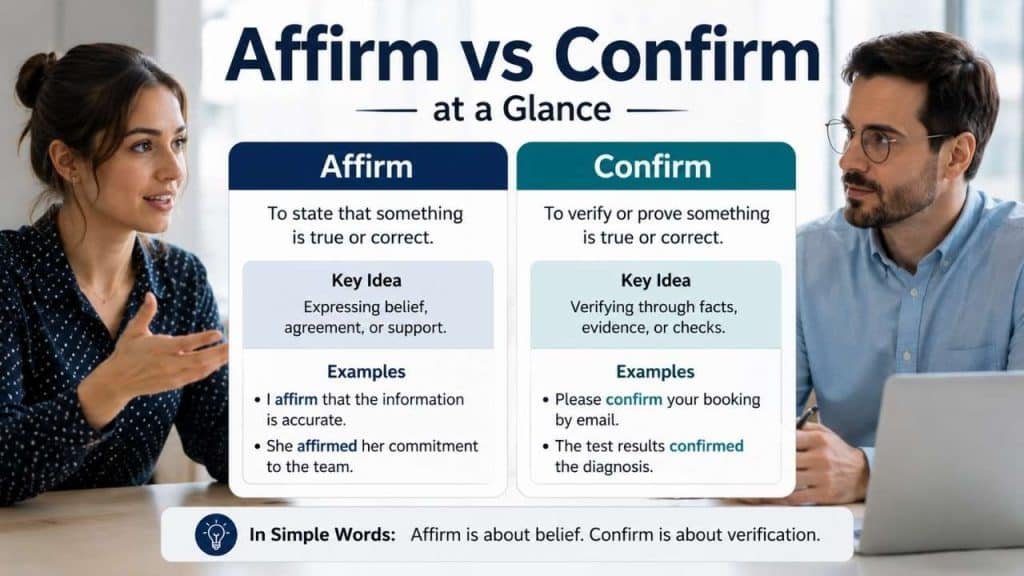
The easiest way to understand affirm vs confirm is to compare them side by side. Affirm is used when you declare, assert, or support a belief, opinion, statement, or decision. It often shows confidence or commitment. Confirm, however, is used when you verify, validate, or prove that information is correct.
It is common in business, travel, customer service, and daily communication. For example, a person may affirm their loyalty, but they confirm their flight booking or confirm a meeting. In legal situations, a court may affirm a judgment, while a company may confirm an order. Knowing these differences makes it much easier to choose the right word in every situation.
| Affirm | Confirm |
| Declare something is true | Verify something is true |
| Express support or belief | Check facts or information |
| Common in legal and formal contexts | Common in everyday and business communication |
| Affirm a belief | Confirm a reservation |
| Affirm a decision | Confirm attendance |
What Does “Affirm” Mean?
Affirm means to declare, assert, or state confidently that something is true. It often shows that a person strongly believes in an idea, supports a decision, or makes a formal statement. Unlike confirm, which checks facts, affirm focuses on expressing confidence or agreement. You may hear this word in legal English, official speeches, or formal writing.
For example, a witness may affirm an oath instead of swearing one, or a manager may affirm support for a new project. People also affirm their values, affirm their commitment, or affirm their position during discussions. Understanding the affirm meaning helps you know when to use it correctly instead of confirm, especially in formal or legal situations.
Common Uses of “Affirm”
You use affirm when you want to declare, support, or state something with confidence. It is common in both formal and professional situations. In everyday life, someone may affirm their beliefs or affirm their friendship by clearly expressing their feelings. In business, a leader might affirm support for a new policy or affirm a company’s values during a meeting.
In legal settings, judges may affirm a lower court’s decision, and witnesses can affirm an oath before giving testimony. Writers also use affirm to strengthen an argument or express confidence in an idea. These examples show that affirm is about making a positive statement rather than checking whether information is accurate.
Sentence Examples of “Affirm”
Looking at examples is one of the best ways to understand how to use affirm correctly. These sentences show different situations where affirm fits naturally.
- The manager affirmed her support for the new project.
- She affirmed her belief in honest communication.
- The witness chose to affirm instead of taking an oath.
- The court affirmed the earlier judgment.
- He affirmed that he would finish the work on time.
- The teacher affirmed the student’s effort during the presentation.
- The company affirmed its commitment to customer satisfaction.
- The speaker affirmed the importance of teamwork.
In each sentence, affirm means to declare, assert, or express confidence, not to verify information.
Common Collocations with “Affirm”
A collocation is a group of words that are commonly used together. Learning these combinations makes your English sound more natural. Since affirm often means to declare or express support, it usually appears with words related to beliefs, decisions, or official statements. For example, people affirm their commitment, affirm their support, or affirm their beliefs.
In legal English, courts may affirm a judgment, and witnesses may affirm an oath before giving testimony. You may also hear phrases like affirm your position, affirm your rights, or affirm your confidence. Knowing these common collocations helps you understand the affirm meaning and use the word correctly in both formal and everyday writing.
What Does “Confirm” Mean?
Confirm means to verify, prove, or show that something is true or correct. Unlike affirm, which focuses on making a statement, confirm focuses on checking facts or providing evidence. You often use this word in business English, everyday English, and customer service. For example, you confirm an appointment, confirm attendance, confirm a reservation, or confirm an order.
You can also confirm details, confirm information, or confirm receipt of an email. The confirm meaning is connected with accuracy and certainty. If you receive new evidence that supports a claim, it confirms the claim. This is why confirm is one of the most common verbs in professional and daily communication.
Common Uses of “Confirm”
People use confirm whenever they need to check, verify, or approve information. In everyday life, you may confirm a hotel reservation, confirm a doctor’s appointment, or confirm your travel plans before leaving home.
In the workplace, employees often confirm meeting times, confirm payment, or confirm project details with clients. Teachers may confirm attendance, while customer service teams confirm orders before shipping products.
Even friends may confirm plans before meeting. In each case, confirm means making sure something is accurate or officially accepted. Understanding these common situations makes it easier to know when to use confirm instead of affirm, helping you avoid common grammar mistakes.
Sentence Examples of “Confirm”
These examples show how to use confirm correctly in different situations. Notice that each sentence involves checking or verifying information.
- Please confirm your attendance before Friday.
- The hotel confirmed our reservation by email.
- She called to confirm the meeting time.
- The doctor confirmed the test results this morning.
- Can you confirm these details before we continue?
- The company confirmed receipt of my application.
- The airline confirmed my flight booking within minutes.
- New evidence confirmed the witness’s statement.
Each example shows that confirm means to verify, validate, or prove that something is correct. It is commonly used in business, travel, education, healthcare, and everyday conversations.
Common Collocations with “Confirm”
Like affirm, confirm has many common collocations that native speakers use every day. Learning these word pairs will improve your vocabulary and make your writing sound more natural.
Some of the most common phrases are confirm an appointment, confirm a reservation, confirm attendance, confirm payment, confirm an order, and confirm receipt. You may also confirm details, confirm information, confirm identity, confirm a booking, or confirm a schedule.
These combinations are especially common in emails, customer service, and business communication. Since confirm focuses on checking facts, it usually appears with information that needs to be verified. Using these collocations correctly will help you communicate clearly in both professional and everyday situations.
Key Differences Between Affirm and Confirm
Although affirm and confirm both relate to truth, they serve different purposes. Affirm means to declare, assert, or express support for something. Confirm means to verify, validate, or prove that something is correct. For example, you affirm your beliefs, but you confirm your appointment. A judge may affirm a court decision, while an office manager confirms meeting details.
Affirm is more common in legal English and formal statements, while confirm appears more often in business writing, travel, customer service, and daily conversations. Understanding these differences will help you choose the correct word naturally instead of guessing which one sounds better.
| Affirm | Confirm |
| Declare something is true | Verify something is true |
| Shows belief or support | Checks facts or information |
| Often used in legal and formal settings | Common in business and everyday English |
| Affirm a belief | Confirm a reservation |
| Affirm a judgment | Confirm an appointment |
| Express confidence | Provide verification |
When Should You Use “Affirm”?
Use affirm when you want to state, declare, or express support for something. It is the right choice when talking about beliefs, opinions, promises, values, or legal decisions. For example, you can affirm your commitment to a project, affirm your support for a friend, or affirm your beliefs during a discussion.
In court, a judge may affirm a judgment, and a witness may affirm an oath before giving testimony. These situations do not require checking facts. Instead, they involve making a confident statement or expressing agreement. If your goal is to assert or declare something as true, affirm is usually the correct word to use.
When Should You Use “Confirm”?
Use confirm when you need to verify or check that information is correct. It is the best choice for appointments, bookings, schedules, orders, payments, and other facts that require confirmation. For example, you confirm a reservation, confirm attendance, confirm an interview, or confirm receipt of an email. Businesses often ask customers to confirm details before completing a purchase.
Teachers may confirm attendance, while doctors confirm test results after reviewing medical reports. In daily conversations, people also confirm plans before meeting. Whenever your goal is to prove accuracy or make sure information is correct, confirm is the appropriate word instead of affirm.
Can Affirm and Confirm Be Used Interchangeably?
Many people ask whether affirm and confirm can replace each other. The answer is not usually. While both words relate to truth, they express different ideas. Affirm means to declare or express confidence, whereas confirm means to verify or prove something with evidence.
For example, saying “I affirm my support” sounds natural, but “I confirm my support” may suggest you are verifying it instead. Likewise, “I confirm my reservation” is correct because you are checking booking details, while “I affirm my reservation” sounds unusual. Choosing the correct word depends on whether you are making a statement or checking information.
Affirm vs Confirm in Legal English
In legal English, both affirm and confirm have specific meanings, but they are used differently. A court may affirm a judgment, which means it agrees with and keeps the lower court’s decision. A witness may also affirm an oath, choosing to make a formal promise without swearing.
Confirm, however, often means to officially verify or approve information, appointments, or facts. Legal professionals may confirm documents, confirm identities, or confirm evidence during an investigation.
Although both words appear in legal writing, affirm is more closely connected with declarations and court decisions, while confirm is linked to checking or validating information. Understanding this distinction helps you use both terms correctly in legal contexts.
Affirm vs Confirm in Business Communication
In business communication, confirm is much more common than affirm. Employees confirm meetings, confirm orders, confirm payment, and confirm appointments almost every day. These actions involve checking information and making sure everything is correct.
Affirm, however, is used when leaders or organizations express support or commitment. For example, a company may affirm its values, affirm its commitment to quality, or affirm support for a new policy.
In business emails, you might write, “Please confirm your attendance,” but you would say, “We affirm our commitment to excellent service.” Understanding this difference makes your professional writing clearer and more accurate.
Everyday Examples of Affirm vs Confirm
Understanding affirm vs confirm becomes easier when you see them in everyday situations. Imagine your friend says, “I affirm my promise to help you.” Here, they are expressing commitment. Now imagine your hotel sends an email asking you to confirm your reservation before arrival.
In another example, a teacher may affirm a student’s effort, while the school office confirms class schedules for the new term. A manager may affirm support for a new idea, but the HR team confirms interview times with candidates. These simple situations show that affirm is about expressing belief or support, while confirm is about checking facts or making sure information is correct.
Common Mistakes People Make
Many learners make mistakes because affirm and confirm seem similar. One common error is using affirm when talking about appointments or reservations. For example, “I affirm my booking” is incorrect. The correct sentence is “I confirm my booking.” Another mistake is saying “The judge confirmed the decision” when discussing an appeal. In many legal cases, the correct term is “The judge affirmed the decision.”
Remember that affirm usually means to declare or express support, while confirm means to verify facts. Before choosing a word, ask yourself one simple question: Am I expressing confidence, or am I checking information? The answer will guide you to the correct choice.
Memory Trick to Remember the Difference
A simple memory trick can help you remember affirm vs confirm. Think of the letter A in affirm as standing for “assert.” When you affirm, you assert, declare, or express support for something. Now think of the letter C in confirm as standing for “check.” When you confirm, you check, verify, or prove that information is correct. This easy rule works in most situations.
If you are expressing a belief, promise, or opinion, use affirm. If you are checking an appointment, reservation, payment, or details, use confirm. This quick reminder makes it much easier to choose the right word every time.
Related Words You Should Know
Several English words have meanings similar to affirm and confirm, but each has its own use. Verify means to check that something is true. Validate means to prove that something is acceptable or correct. Ratify means to officially approve an agreement or decision. Authenticate means to prove that something is genuine.
Assure means to remove someone’s doubts, while ensure means to make certain something happens. Acknowledge means to recognize that something exists or is true. Learning these related words expands your vocabulary and helps you choose the most accurate word for every situation instead of using affirm or confirm for everything.
FAQs
Is affirm the same as confirm?
No. Affirm means to declare or express support, while confirm means to verify or prove something is correct.
Can affirm and confirm be used interchangeably?
Only in a few situations. Most of the time, each word has a different purpose and should be used carefully.
When should I use affirm?
Use affirm when expressing beliefs, support, promises, confidence, or legal declarations.
When should I use confirm?
Use confirm when checking facts, appointments, reservations, orders, payments, or other information.
Is affirm mostly used in legal English?
It is common in legal English, but it is also used in formal speeches, discussions, and professional writing.
Why is confirm more common in business writing?
Because businesses often need to verify appointments, schedules, orders, payments, and customer information.
What is the easiest way to remember the difference?
Think A = Assert (Affirm) and C = Check (Confirm).
Which word is more common in everyday English?
Confirm is used more often in daily conversations because people frequently verify plans, bookings, and information.
Conclusion
Although affirm and confirm are closely related, they are not the same. Affirm means to declare, assert, or express support for a belief, decision, or statement. Confirm means to verify, validate, or prove that information is true. Once you understand this difference, choosing the correct word becomes much easier.
Whether you are writing a business email, speaking with friends, reading legal documents, or improving your English grammar, using the right word makes your communication more accurate and natural.
Remember the simple memory trick: A for Assert, C for Check. With regular practice and the examples in this guide, you’ll confidently know when to use affirm and when to use confirm in any situation.