
Many people wonder whether “looking forward to seeing you” is grammatically correct and appropriate for professional communication. You may have seen this phrase in a business email, a personal message, or even a job interview follow-up and asked yourself, “Is looking forward to seeing you correct?” The short answer is yes.
Native English speakers often use looking forward to seeing you to express excitement or anticipation about a future meeting. However, some learners get confused about the grammar and ask why we say “seeing” instead of “see.” Others want to know whether looking forward to see you is acceptable or if there are better alternatives.
In this guide, you’ll learn the meaning, grammar rule, and proper usage of this common expression. You’ll also discover professional alternatives, examples, and common mistakes to avoid in both formal and informal communication.
Quick Answer
Yes, “looking forward to seeing you” is grammatically correct. The phrase expresses anticipation or excitement about meeting someone in the future. We use “seeing” instead of “see” because “to” in “look forward to” acts as a preposition, which requires a gerund (-ing form). The expression works well in both professional and personal communication.
What Does “Looking Forward To Seeing You” Mean?
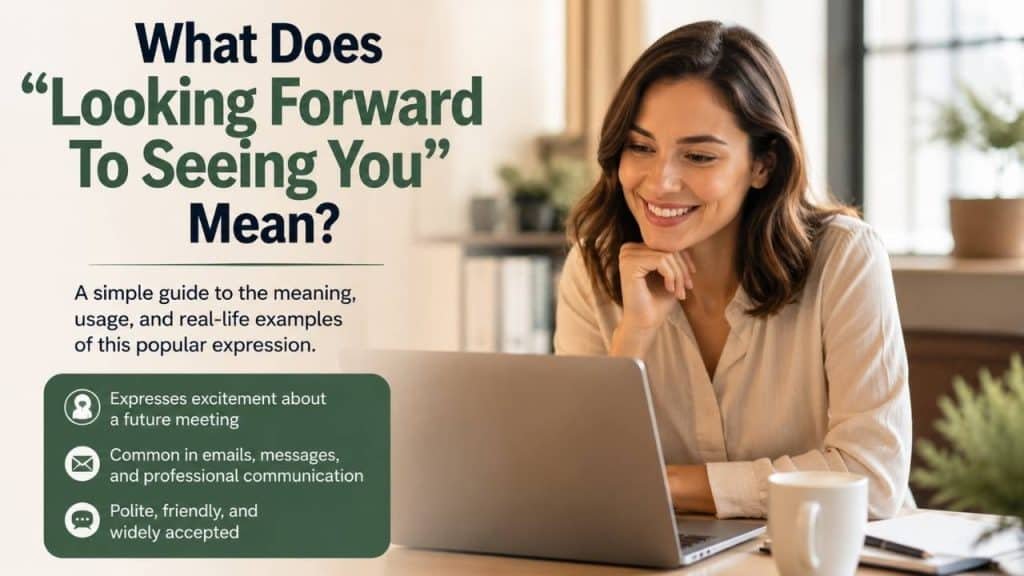
The phrase “looking forward to seeing you” means that you feel happy, excited, or eager about meeting someone in the future. People commonly use this expression in both professional communication and personal conversations. Whether you are writing a business email, arranging a meeting with a client, or sending a message to a friend, this phrase shows positive anticipation.
For example, if you have an upcoming meeting, you might write, “I’m looking forward to seeing you next week.” In a personal context, you could say, “I’m looking forward to seeing you soon.”
The expression sounds polite, friendly, and natural. Because of its versatility, native English speakers frequently use it in emails, letters, text messages, and workplace communication. It remains one of the most common and accepted email closing phrases in modern English.
Is “Looking Forward To Seeing You” Grammatically Correct?
Yes, “looking forward to seeing you” is grammatically correct. Many English learners ask, “Is looking forward to seeing you grammatically correct?” because they are unsure whether to use seeing or see after the phrase.
The answer lies in the structure of look forward to. In English grammar, the word to in this expression functions as a preposition, not as part of an infinitive verb. Because a preposition is normally followed by a noun or a gerund, the correct form becomes seeing.
Correct:
✔ Looking forward to seeing you.
✔ Looking forward to meeting you.
Incorrect:
✘ Looking forward to see you.
✘ Looking forward to meet you.
Understanding this rule helps you avoid one of the most common grammar mistakes in English usage.
Understanding the Grammar of “Look Forward To”
Many people wonder, “Why is it seeing instead of see?” The explanation is simpler than it seems. In the phrase look forward to, the word to acts as a preposition.
When a preposition appears before a verb, the verb usually takes the -ing form, also known as a gerund. Therefore, phrases like looking forward to seeing you, looking forward to meeting you, and looking forward to hearing from you are all correct.
Think of it this way:
- Look forward to + seeing
- Look forward to + meeting
- Look forward to + hearing
Because see is a base verb, it does not fit after the preposition. This grammar rule applies in formal writing, casual conversations, and business communication. Once you understand the pattern, using the phrase correctly becomes much easier.
When Should You Use “Looking Forward To Seeing You”?
You can use looking forward to seeing you whenever you want to express enthusiasm about a future meeting. The phrase works in many situations because it sounds polite and natural.
In business emails, it helps create a professional and friendly tone. During job interviews, it shows interest in meeting the interviewer. In client communication, it demonstrates respect and professionalism.
You can also use it in personal situations. Friends, family members, and acquaintances often use the phrase before social gatherings, holidays, or special events.
Examples:
- Looking forward to seeing you at the conference.
- Looking forward to seeing you next Friday.
- Looking forward to seeing you soon.
Since the phrase fits both formal and informal settings, it remains one of the safest and most widely accepted expressions in English communication.
Is “Looking Forward To Seeing You” Formal or Informal?
One reason this phrase remains popular is its flexibility. Looking forward to seeing you works well in both formal and informal communication.
In professional settings, it sounds courteous without appearing overly formal. Many people use it in emails to clients, coworkers, recruiters, and business partners. It conveys a positive attitude while maintaining professionalism.
In personal conversations, the phrase feels warm and friendly. Friends and family members often use it when discussing upcoming visits or events.
Compared with highly formal expressions, this phrase sounds approachable and natural. Compared with very casual phrases such as can’t wait to see you, it appears more professional.
Because of this balance, many experts consider it one of the best phrases for workplace communication and email etiquette.
Looking Forward To Seeing You vs Looking Forward To Meeting You
Although these expressions look similar, they have slightly different meanings.
Looking forward to seeing you usually suggests that you already know the person. You expect to meet them again in the future.
Example:
“I’m looking forward to seeing you at the annual meeting.”
Looking forward to meeting you often refers to meeting someone for the first time.
Example:
“I’m looking forward to meeting you during the interview.”
Both expressions follow the same grammar rule and use a gerund after look forward to. Choosing the right phrase depends on your relationship with the other person.
If you already know the individual, use seeing you. If you have never met them before, meeting you is usually the better choice.
Looking Forward To Seeing You vs Can’t Wait To See You
These phrases express similar feelings, but they differ in tone.
Looking forward to seeing you sounds professional, polite, and appropriate in business communication. It works well in emails, workplace conversations, and formal messages.
Can’t wait to see you sounds more emotional and informal. People often use it with close friends, family members, or romantic partners.
Examples:
Professional:
“Looking forward to seeing you at tomorrow’s meeting.”
Casual:
“Can’t wait to see you this weekend!”
If you communicate with clients, recruiters, managers, or colleagues, looking forward to seeing you is usually the safer option. If you want to express excitement in a personal conversation, can’t wait to see you may sound more natural.
Professional Alternatives to “Looking Forward To Seeing You”
Sometimes you may want a different phrase for variety or tone. Here are several professional alternatives:
- I look forward to our meeting.
- I look forward to connecting with you.
- I look forward to speaking with you.
- I look forward to discussing this further.
- I am eager to meet with you.
- It will be a pleasure to see you.
- I appreciate the opportunity to meet.
- I anticipate our upcoming discussion.
- I look forward to hearing your thoughts.
- I look forward to working together.
These alternatives work particularly well in business emails, client communication, networking messages, and interview follow-ups.
Examples of “Looking Forward To Seeing You” in Sentences
Here are examples showing how native speakers use the phrase.
Business Email:
“I’m looking forward to seeing you at our scheduled meeting next week.”
Job Interview:
“Thank you for your time. I’m looking forward to seeing you on Tuesday.”
Client Communication:
“We appreciate your cooperation and are looking forward to seeing you soon.”
Personal Message:
“I’m looking forward to seeing you during the holidays.”
Conference Invitation:
“We are looking forward to seeing you at the event.”
These examples show how the phrase adapts easily to different situations while maintaining a friendly and professional tone.
Common Mistakes to Avoid
Many learners make small mistakes when using this expression.
Incorrect:
✘ Looking forward to see you.
✔ Looking forward to seeing you.
Incorrect:
✘ Looking forward seeing you.
✔ Looking forward to seeing you.
Incorrect:
✘ I am look forward to seeing you.
✔ I am looking forward to seeing you.
Another common mistake involves choosing the wrong phrase. If you have never met the person before, looking forward to meeting you is often more accurate than looking forward to seeing you.
Paying attention to these details helps improve grammatical accuracy and makes your writing sound more natural.
How Native English Speakers Use This Phrase Today
Native English speakers continue to use looking forward to seeing you regularly in both spoken and written English. The phrase remains common because it sounds sincere, polite, and easy to understand.
In professional settings, people often use it near the end of emails. In personal communication, it appears in messages about future plans, family gatherings, and social events.
Although newer expressions exist, this phrase has not become outdated. Instead, it remains a trusted choice because it works in many contexts.
Whether you are writing to a colleague, a client, a recruiter, or a friend, the expression communicates positive anticipation without sounding overly formal or overly casual.
FAQs
Is looking forward to seeing you professional?
Yes. It is widely accepted in business communication and professional emails.
Can I use it in a job interview email?
Yes. It shows enthusiasm and professionalism.
Is it polite?
Absolutely. The phrase expresses positive anticipation respectfully.
Is it outdated?
No. Native speakers still use it frequently.
Can I use it with clients?
Yes. It is appropriate for client communication, meetings, and follow-up emails.
Conclusion
Looking forward to seeing you is a grammatically correct, professional, and widely used English expression. It communicates excitement about a future meeting while maintaining a polite tone.
Understanding why seeing is used instead of see helps you apply the phrase confidently in emails, conversations, and workplace communication.
Whether you are contacting a friend, colleague, client, or recruiter, this expression remains one of the most reliable ways to express anticipation about meeting someone in the future.