

Many English learners and native speakers wonder about the difference between “thank you both vs thanks to both of you.” At first glance, these expressions seem similar because both show gratitude and appreciation toward two people. However, they do not always work in exactly the same way.
If you have ever asked yourself, “Is thank you both correct?” or “Is thanks to both of you correct?”, the answer is yes—both phrases are grammatically correct. The real difference lies in their usage, tone, and the message you want to communicate.
In this guide, we’ll explore thank you both vs thanks to both of you, explain the grammar difference, discuss formal and informal usage, and provide practical sentence examples. By the end, you’ll know which phrase sounds more natural English and when to use each one with confidence in both written English and spoken English.
Quick Answer
Both “thank you both” and “thanks to both of you” are correct, but they serve slightly different purposes. “Thank you both” directly expresses gratitude to two people and sounds more natural in everyday communication. “Thanks to both of you” also shows appreciation but often emphasizes the contribution or help provided by those two people. Both phrases work well in spoken and written English.
At a Glance Comparison
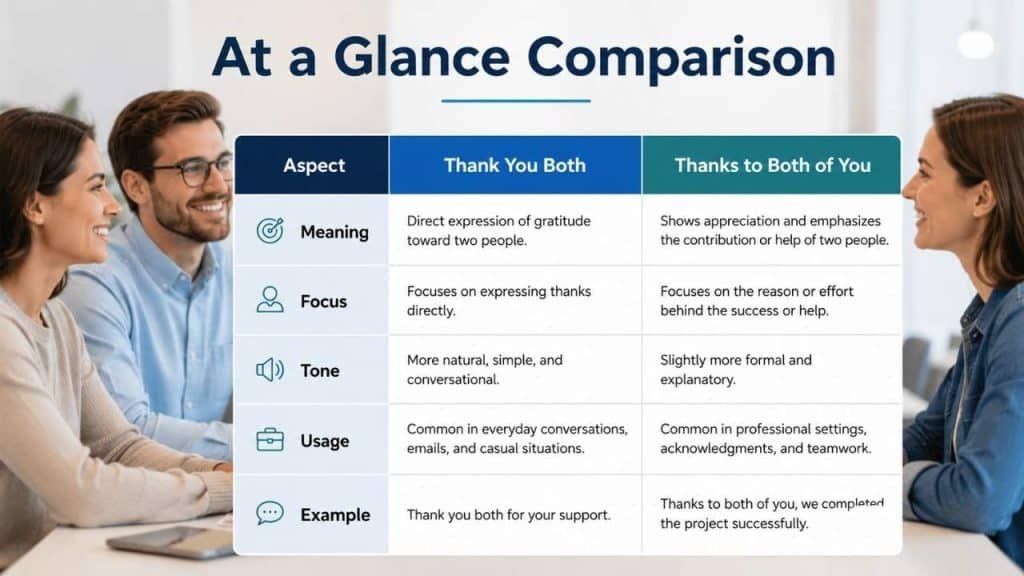
Although “thank you both” and “thanks to both of you” express appreciation toward two people, they differ slightly in meaning and usage. “Thank you both” acts as a direct expression of gratitude. Speakers commonly use it in everyday conversations, emails, meetings, and personal messages because it sounds natural and straightforward. O
n the other hand, “thanks to both of you” can also express gratitude, but it often highlights the role or contribution of the two people being thanked.
In terms of formal vs informal usage, both phrases work well in professional and casual situations. However, native speakers generally prefer “thank you both” because it feels more conversational and direct. If you are wondering which phrase sounds more natural, “thank you both” usually wins in spoken English, while both expressions remain acceptable in written English and professional communication.
Is “Thank You Both” Grammatically Correct?
Yes, “thank you both” is completely correct and widely accepted in English grammar. The phrase directly addresses two people and expresses sincere gratitude. Because it is short, clear, and natural, many native speakers use it in both spoken English and written English.
The word “both” simply refers to two people, while “thank you” serves as a direct message of appreciation. Together, they create a polite and effective expression. This phrase works well in professional emails, classroom discussions, business meetings, and everyday conversations.
Here are a few examples:
- Thank you both for your support.
- Thank you both for attending the meeting.
- Thank you both for helping me finish the project.
If you are searching for a natural way of expressing gratitude, “thank you both” is often the safest and most common choice.
Is “Thanks to Both of You” Grammatically Correct?
Yes, “thanks to both of you” is also grammatically correct. However, this expression works slightly differently from “thank you both.” While both phrases show appreciation, “thanks to both of you” often places more emphasis on the help, effort, or contribution made by the two people.
In many situations, speakers use this phrase when they want to acknowledge the role others played in achieving a positive result. This subtle difference makes the expression feel a little more descriptive than direct.
Consider these examples:
- Thanks to both of you, the event was a success.
- Thanks to both of you, we completed the project on time.
- Thanks to both of you for your guidance and support.
If you want to highlight the impact of someone’s actions while showing gratitude, “thanks to both of you” can be an excellent choice in both personal and professional communication.
Thank You Both vs Thanks to Both of You: Key Differences
When comparing thank you both vs thanks to both of you, the main difference lies in focus and tone. “Thank you both” directly addresses two people and expresses gratitude in a simple, personal way. In contrast, “thanks to both of you” often draws attention to what those people did and how their actions helped create a positive outcome.
Another difference involves style. “Thank you both” sounds more conversational and appears frequently in everyday communication. Native speakers use it naturally in emails, messages, meetings, and casual conversations. Meanwhile, “thanks to both of you” can sound slightly more formal or explanatory because it emphasizes contribution.
Neither phrase is wrong. The best choice depends on your context and purpose. If you want direct appreciation, choose “thank you both.” If you want to recognize someone’s efforts, “thanks to both of you” may fit better.
When to Use “Thank You Both”
Use “thank you both” whenever you want to express direct gratitude to two people. This phrase works well in almost every situation because it sounds friendly, natural, and easy to understand. Whether you are speaking with friends, colleagues, teachers, or family members, the phrase communicates appreciation clearly.
Many professionals use “thank you both” in workplace emails because it sounds polite without being overly formal. Students often use it when thanking teachers, while team members use it to recognize coworkers after completing a project.
Examples include:
- Thank you both for your valuable feedback.
- Thank you both for joining today’s meeting.
- Thank you both for helping me solve the problem.
If you are unsure which phrase to choose, “thank you both” is usually the more natural English expression. It fits comfortably into both personal and professional communication settings.
When to Use “Thanks to Both of You”
Use “thanks to both of you” when you want to acknowledge the efforts, support, or contribution of two people. This phrase works especially well when their actions helped produce a successful result. Rather than simply expressing gratitude, it highlights the reason behind your appreciation.
You may hear this expression during presentations, team discussions, project reviews, or public acknowledgments. It helps connect success or progress to the people who made it possible.
Examples include:
- Thanks to both of you, we met our deadline.
- Thanks to both of you, the event ran smoothly.
- Thanks to both of you for making this project successful.
While the phrase remains common in written English and professional settings, it appears less often in casual conversations. For direct thanks, most speakers prefer “thank you both,” but this expression remains useful when emphasizing contribution and teamwork.
Which Phrase Sounds More Natural?
If your goal is to sound like a native speaker, “thank you both” usually feels more natural. English speakers often prefer short, direct expressions of gratitude because they are simple and effective. As a result, you will hear “thank you both” more frequently in conversations, emails, meetings, and personal messages.
By comparison, “thanks to both of you” sounds slightly more formal and context-specific. It works best when you want to mention the role two people played in achieving a positive result. Although the phrase is perfectly correct, people generally use it less often in everyday communication.
For example, most speakers would naturally say:
- Thank you both for your help.
Instead of:
- Thanks to both of you for your help.
Therefore, if you want the safest and most commonly used option, “thank you both” is usually the better choice.
Common Mistakes to Avoid
Many English learners make small mistakes when using “thank you both” and “thanks to both of you.” One common error is assuming that one phrase is correct while the other is wrong. In reality, both expressions are grammatically correct and widely used.
Another mistake involves using the phrases interchangeably without considering context. “Thank you both” focuses on direct appreciation, while “thanks to both of you” often emphasizes contribution. Choosing the wrong expression can make your message sound less natural.
Some learners also overcomplicate their language by selecting overly formal alternatives when a simple phrase would work better. In most situations, direct and clear communication creates the strongest impression.
Finally, avoid confusing “thank you both” with “thank both of you.” Although both are understandable, native speakers generally prefer “thank you both” because it sounds smoother and more conversational.
Alternative Ways to Thank Two People
If you want variety in your communication, several alternatives can replace “thank you both” and “thanks to both of you.” Choosing different expressions can make your writing and speech sound more engaging while still showing genuine appreciation.
Professional alternatives include:
- I appreciate both of your efforts.
- My sincere thanks to both of you.
- I am grateful to both of you.
Casual alternatives include:
- Thanks, you two!
- I appreciate you both.
- You both have my thanks.
Formal alternatives include:
- I would like to express my gratitude to both of you.
- Please accept my sincere appreciation.
These options work well in emails, workplace communication, speeches, and personal messages. Regardless of the phrase you choose, sincere gratitude always leaves a positive impression and strengthens professional and personal relationships.
Examples in Real-Life Contexts
Understanding real-life usage makes it easier to choose the correct phrase. In a professional email, you might write, “Thank you both for your valuable contributions during the meeting.” This sentence provides direct appreciation and sounds natural.
In a team project, you could say, “Thanks to both of you, we successfully completed the assignment ahead of schedule.” Here, the phrase highlights the contribution of the two individuals.
For personal communication, examples include:
- Thank you both for attending my birthday celebration.
- Thank you both for being there when I needed help.
For workplace communication:
- Thank you both for your support throughout the project.
- Thanks to both of you, our team achieved excellent results.
These examples show that both phrases are correct. The best choice depends on whether you want to express direct gratitude or emphasize someone’s contribution.
FAQs
Is “thank you both” grammatically correct?
Yes, “thank you both” is grammatically correct. It is a common and natural way to express gratitude to two people. Native speakers frequently use this phrase in conversations, emails, and professional settings because it sounds direct, polite, and easy to understand.
Is “thanks to both of you” grammatically correct?
Yes, “thanks to both of you” is also correct. This phrase expresses appreciation while often emphasizing the contribution or support provided by two people. It works well in both personal and professional communication.
What is the difference between “thank you both” and “thanks to both of you”?
The main difference is emphasis. “Thank you both” directly expresses gratitude, while “thanks to both of you” often highlights the actions or efforts of the two people being thanked.
Which phrase sounds more natural?
Most native English speakers consider “thank you both” the more natural expression. It is shorter, more direct, and commonly used in everyday conversations, emails, and messages.
Which phrase is more formal?
Both phrases can be used in formal and informal situations. However, “thanks to both of you” may sound slightly more formal because it often appears in acknowledgments, speeches, and professional discussions.
Can I use “thank you both” in a professional email?
Absolutely. “Thank you both” works very well in business emails, workplace communication, and professional messages. It sounds polite, respectful, and professional without feeling overly formal.
Can the two phrases be used interchangeably?
In many situations, yes. However, they are not always identical. “Thank you both” focuses on direct appreciation, while “thanks to both of you” often emphasizes the role or contribution of the people involved.
Is “thank both of you” correct?
Yes, “thank both of you” is grammatically correct. However, native speakers usually prefer “thank you both” because it sounds smoother, more natural, and more conversational.
What are some alternatives to “thank you both”?
You can use alternatives such as “I appreciate you both,” “My sincere thanks to both of you,” “I am grateful to both of you,” or “Thanks, you two!” depending on the level of formality.
How do you thank two people professionally?
In professional settings, you can say “Thank you both for your support,” “I appreciate both of your efforts,” or “My sincere thanks to both of you for your contribution.” These expressions sound respectful, professional, and appropriate for workplace communication.
Conclusion
When comparing thank you both vs thanks to both of you, neither phrase is wrong. Both are grammatically correct, polite, and suitable for expressing gratitude toward two people. The key difference lies in emphasis rather than correctness.
Choose “thank you both” when you want to offer direct appreciation. This phrase sounds natural, conversational, and widely accepted in both spoken English and written English. It also works well in emails, meetings, and everyday conversations.
Choose “thanks to both of you” when you want to highlight the contribution, effort, or support provided by two people. The phrase draws attention to how their actions helped create a positive result.
For most situations, native speakers prefer “thank you both” because it feels simpler and more direct. However, both expressions remain valuable tools for clear, polite, and effective communication.