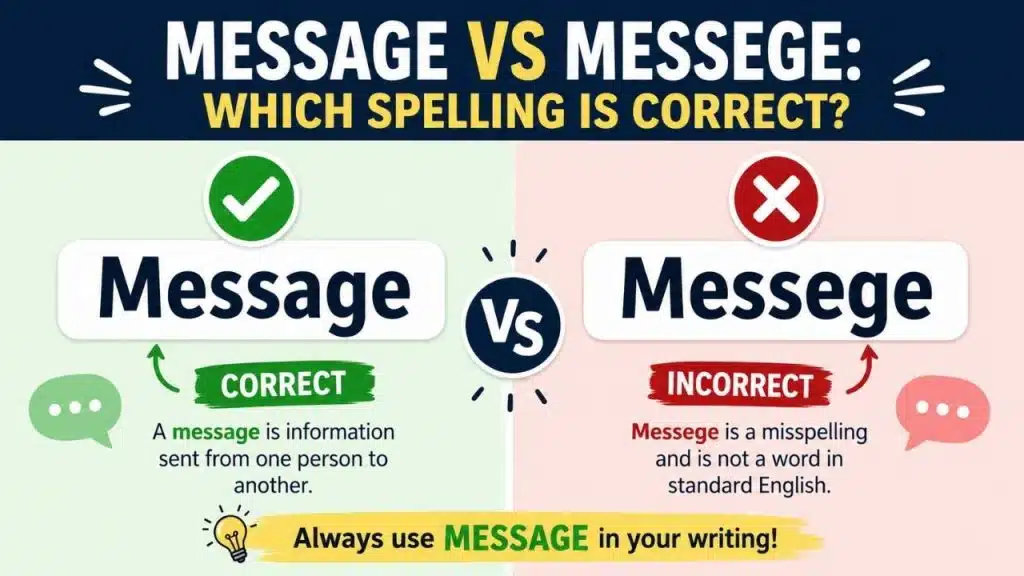

Have you ever paused while writing and wondered whether to use message or messege? This spelling confusion is common among students, professionals, and English learners. Since both words sound similar, many people accidentally use the wrong spelling in emails, text messages, assignments, and social media posts.
When comparing Message vs Messege, only one spelling is correct. Understanding the correct spelling of message helps you avoid mistakes and communicate more effectively. Many users search for message or messege, how to spell message correctly, or which is correct message or messege because they want a quick and accurate answer.
In this guide, you’ll learn the message vs messege difference, discover why people misspell the word, see practical examples, and learn easy memory tricks. By the end, you’ll know exactly how to use message correctly in both formal and informal writing.
Quick Answer
Message is the correct spelling and refers to information sent from one person to another through speech, writing, email, or text. Messege is a common misspelling and is not recognized as a standard English word. If you’re wondering message or messege, always use message in both formal and informal writing to ensure correct English usage.
Message vs Messege at a Glance
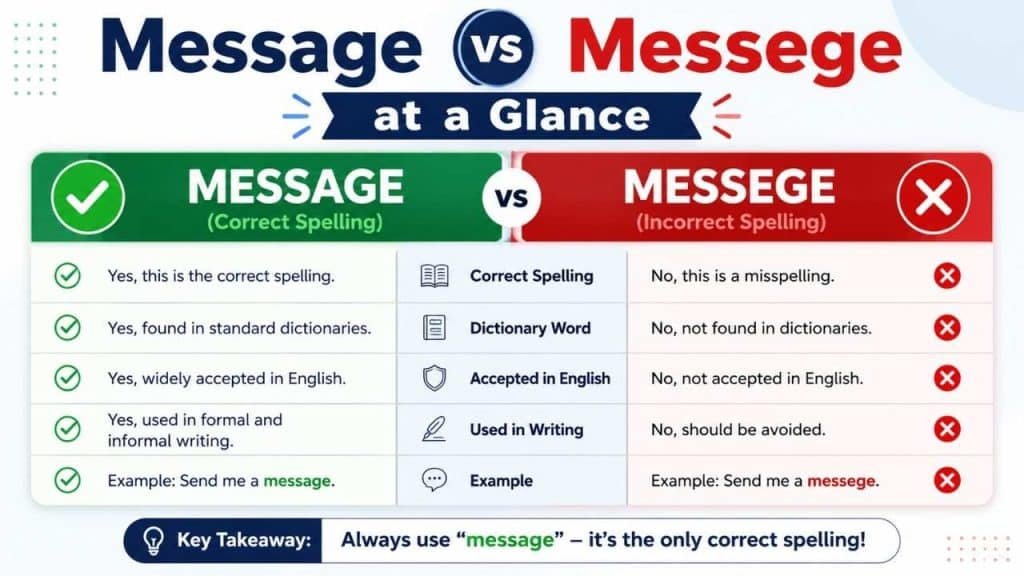
The easiest way to understand the difference is through a simple comparison.
| Feature | Message | Messege |
| Correct spelling | ✅ Yes | ❌ No |
| Dictionary word | ✅ Yes | ❌ No |
| Accepted in English | ✅ Yes | ❌ No |
| Used in professional writing | ✅ Yes | ❌ No |
| Common spelling mistake | ❌ No | ✅ Yes |
When discussing message vs messege, the key point is that only message follows standard English spelling rules. Dictionaries, style guides, and grammar references recognize message as the correct form.
People often use messege by mistake because of pronunciation patterns or typing errors. However, if you want to maintain professional and accurate writing, always choose message. This simple distinction can improve your grammar and help you avoid one of the most common spelling mistakes in English.
What Does “Message” Mean?
The message meaning is simple. A message is information that one person sends to another. People exchange messages through conversations, text messages, emails, letters, phone calls, and social media platforms.
As a noun, message refers to the actual information being communicated.
Examples:
- I received your message this morning.
- She left a message on my voicemail.
- The manager sent an important message to the team.
The word appears in both personal and professional communication. You might send a text message to a friend or receive an email message from a client.
Understanding the message definition helps you use the word correctly in different situations. Since communication plays an important role in daily life, message remains one of the most commonly used words in English.
Is “Messege” a Real Word?
Many people ask, is messege a word? The answer is no.
Messege is not a recognized English word. Standard dictionaries, grammar guides, and language authorities do not accept it as a correct spelling. Instead, it is considered a common spelling error.
People often search for messege meaning, assuming it might have a separate definition. In reality, messege has no independent meaning because it is simply a misspelled version of message.
You may occasionally see messege online in text messages, comments, or informal writing. However, these instances reflect mistakes rather than correct usage.
If you’re writing professionally, academically, or even casually, always use message. Avoiding messege helps your writing appear more polished, accurate, and trustworthy.
Why Do People Confuse Message and Messege?
The confusion between message vs messege usually comes from pronunciation and typing habits.
One reason involves sound patterns. When people hear the word spoken aloud, the middle vowel sound may seem unclear. This uncertainty can cause writers to choose the wrong spelling.
Another reason is simple typing mistakes. Fast typing often leads to common spelling errors, especially when people write emails, texts, or social media posts.
English learners also face challenges because English spelling does not always match pronunciation perfectly. As a result, some learners assume that messege follows the same pattern as other words ending with similar sounds.
Because of these factors, messege spelling appears frequently online. However, understanding the correct spelling rules helps eliminate confusion and improves overall writing accuracy.
How to Remember the Correct Spelling
Fortunately, remembering the correct spelling is easy once you use a simple memory trick.
Think of the word as:
Mess + age = Message
Notice that the middle vowel is a, not e.
Another helpful method involves visual repetition. Write the correct spelling several times:
- Message
- Message
- Message
This repetition trains your brain to recognize the correct word automatically.
You can also connect message with familiar phrases such as:
- Send a message
- Leave a message
- Text message
- Important message
The more often you see the correct spelling, the easier it becomes to remember.
Using these techniques can help anyone avoid the common mistake of writing messege and improve confidence in English spelling.
Examples of Message in Sentences
Seeing the word in context makes it easier to understand and remember.
Formal Examples
- Thank you for your message regarding the project.
- We received your message and will respond shortly.
- Your message has been forwarded to the appropriate department.
Informal Examples
- I sent you a message yesterday.
- Did you get my message?
- She replied to my message immediately.
Workplace Examples
- The manager shared an important message with the team.
- Please read the company message before the meeting.
- Employees received a safety message via email.
These examples show how message fits naturally into everyday communication.
Common Misspellings of Message
Like many English words, message has several common misspellings.
These include:
- Messege
- Mesage
- Messge
- Messsage
- Messeage
Among these errors, messege remains the most common. Many people accidentally type it because of pronunciation confusion or keyboard mistakes.
Recognizing these variations can help you identify errors during proofreading. Whenever you see one of these spellings, replace it with the correct form: message.
Checking your writing before sending emails, reports, or assignments can prevent these mistakes and improve your credibility.
Related Communication Terms
The word message appears in many communication-related expressions.
Text Message
A short written communication sent through a mobile phone.
Voice Message
A recorded audio communication left for someone to hear later.
Instant Message
A real-time message sent through messaging applications.
Direct Message
A private message exchanged through social media platforms.
These related terms show how widely the word message is used in modern communication. Understanding them can strengthen your vocabulary and help you use the word correctly in different contexts.
Message vs Other Frequently Misspelled Words
Some words create confusion because they look or sound similar to message.
Message vs Massage
A message is a form of communication, while a massage is a therapeutic treatment involving muscles and body tissues.
Message vs Mesage
Mesage is simply another misspelling of message.
Message vs Messenger
A messenger is a person, app, or service that delivers messages.
Understanding these differences helps prevent mistakes and improves your overall command of English vocabulary.
Message Pronunciation Guide
The pronunciation of message sometimes contributes to spelling confusion.
In American English, it is commonly pronounced:
MES-ij
In British English, the pronunciation is very similar.
Although the spoken word may sound as if it contains different vowel combinations, the correct spelling always remains message.
Listening to native speakers, using dictionaries with audio pronunciation, and practicing the word aloud can improve both spelling and pronunciation skills.
Remember that pronunciation may vary slightly across regions, but the spelling never changes.
FAQs
Is messege a word?
No. Messege is a misspelling of message and is not recognized in standard English dictionaries.
How do you spell message correctly?
The correct spelling is message.
Why is messege incorrect?
It does not follow the accepted spelling recognized by dictionaries and grammar references.
What does message mean?
A message is information communicated from one person to another.
What is the plural of message?
The plural form is messages.
Is message a noun or a verb?
Most commonly, message functions as a noun, but people also use it as a verb in modern communication contexts, such as “I’ll message you later.”
Conclusion
When comparing message vs messege, the answer is clear. Message is the correct spelling, while messege is a common misspelling. Whether you’re writing an email, sending a text, posting on social media, or completing academic work, you should always use message.
Understanding the correct spelling of message, learning its meaning, and recognizing common spelling mistakes can strengthen your writing skills. If you ever feel unsure, remember this simple rule: message belongs in every form of English communication, while messege does not.