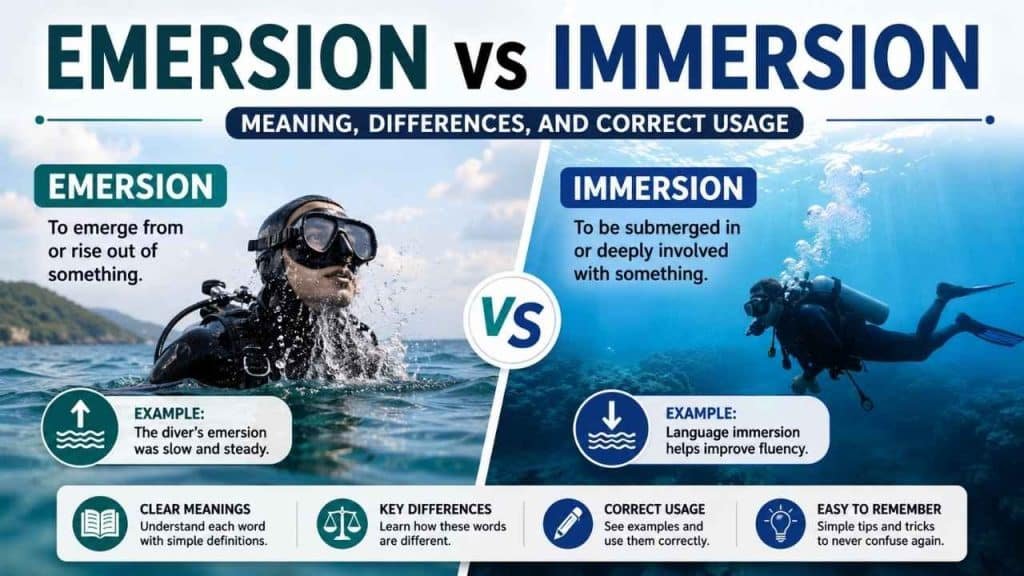

Many English learners and writers get confused when comparing emersion vs immersion because the two words look almost identical. However, they have very different meanings and uses. Understanding the difference between emersion and immersion helps you communicate more accurately and avoid common vocabulary mistakes.
Although both words come from related roots, they describe opposite actions in many situations. Emersion means coming out of or emerging from something, while immersion means being placed into or completely surrounded by something. You may encounter these terms in English grammar, language learning, biology, marine science, and other specialized fields.
This guide explains the emersion meaning, immersion meaning, key differences, correct usage, examples, and common mistakes. By the end, you’ll know exactly when to use each word and whether emersion and immersion can ever be used interchangeably.
Quick Answer
The difference between emersion and immersion is that emersion means emerging from or rising out of something, while immersion means being submerged in or deeply involved with something. Although the words look similar, they have opposite meanings in many contexts. Immersion is common in language learning and everyday English, whereas emersion is mostly used in science, biology, and astronomy.
Emersion vs Immersion at a Glance
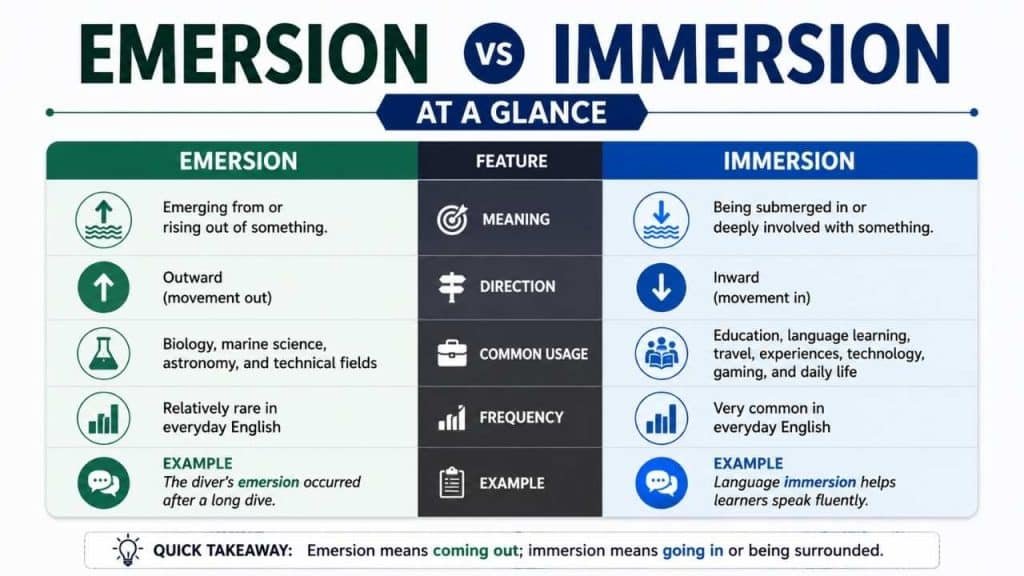
Before diving deeper, here’s a quick comparison of emersion vs immersion.
| Feature | Emersion | Immersion |
| Meaning | Emerging from something | Being submerged or deeply involved |
| Direction | Outward | Inward |
| Common Usage | Biology, astronomy, marine science | Education, language learning, experiences |
| Frequency | Rare | Very common |
| Example | The diver’s emersion was slow. | Language immersion improves fluency. |
The main difference between emersion and immersion lies in direction. Emersion involves moving out of an environment, while immersion involves entering or becoming surrounded by one.
Because immersion appears much more often in modern English, many people mistakenly use it when they actually mean something else. Understanding this simple distinction can improve your writing and speaking accuracy.
What Does Emersion Mean?
The emersion meaning refers to the act of emerging, rising, or coming out from something. Most often, it describes movement out of water or another surrounding environment.
The word comes from the Latin term emergere, which means “to rise out” or “to bring forth.” As a result, emersion often appears in scientific and technical fields.
For example, marine biologists may discuss the emersion of aquatic plants when water levels drop. Astronomers may use the term to describe a celestial body reappearing after being hidden.
Examples of Emersion in Sentences
- The diver’s emersion occurred after a twenty-minute dive.
- Scientists observed the emersion of several aquatic plants after the flood receded.
- The submarine began its emersion near the coastline.
- Astronomers recorded the moon’s emersion from Earth’s shadow.
Although emersion is a real word, it remains relatively uncommon in everyday English.
What Does Immersion Mean?
The immersion meaning refers to being deeply involved in, surrounded by, or submerged within something. Unlike emersion, immersion appears frequently in both everyday and professional communication.
The term comes from the Latin word immergere, meaning “to plunge into” or “submerge.” Today, people commonly use immersion in education, travel, technology, and entertainment.
For example, language schools often promote language immersion programs because students learn faster when they constantly interact with the target language. Similarly, gamers often describe feeling complete immersion when a game creates a realistic experience.
Examples of Immersion in Sentences
- Language immersion can accelerate learning.
- The traveler gained cultural understanding through total immersion.
- Virtual reality creates a strong sense of immersion.
- The student benefited from an immersive learning environment.
Because of its wide range of uses, immersion is much more familiar to most English speakers.
Key Differences Between Emersion and Immersion
Understanding the key differences between emersion and immersion helps prevent confusion.
First, the two words describe opposite movements. Emersion involves coming out, while immersion involves going into or being surrounded by something.
Second, their usage differs significantly. Emersion appears mostly in scientific, biological, and astronomical contexts. Immersion, on the other hand, appears in everyday conversations, education, travel, gaming, and professional training.
Another difference involves frequency. Most English speakers regularly encounter immersion, but many rarely see the word emersion.
Quick Comparison
- Emersion = moving out
- Immersion = moving in
- Emersion = uncommon
- Immersion = common
- Emersion = scientific usage
- Immersion = everyday usage
These distinctions make it easier to choose the correct word in different situations.
Emersion vs Immersion in a Sentence
Looking at real examples can make the emersion vs immersion distinction much clearer.
Correct Emersion Examples
- The diver’s emersion was delayed due to strong currents.
- Researchers documented the emersion of coastal vegetation.
- The submarine completed its emersion operation safely.
Correct Immersion Examples
- The school offers a full language immersion program.
- Cultural immersion helps travelers understand local traditions.
- The virtual reality headset increases user immersion.
Side-by-Side Comparison
| Emersion | Immersion |
| The diver’s emersion took several minutes. | The diver enjoyed complete immersion underwater. |
| Plant emersion occurred after the water level dropped. | Language immersion improved the student’s fluency. |
| Scientists tracked the emersion process carefully. | The game provided total immersion. |
These examples demonstrate how different the two words are despite their similar spelling.
Is Emersion the Opposite of Immersion?
In many contexts, yes. Emersion often functions as the opposite of immersion.
When someone becomes immersed, they move into or become surrounded by an environment. When emersion occurs, they emerge from that environment.
For example:
- A diver experiences immersion when entering the water.
- The diver experiences emersion when returning to the surface.
However, the relationship is not always perfectly opposite because each word developed specialized meanings in different fields. Immersion now carries additional meanings related to involvement, engagement, and participation. Emersion generally remains tied to physical emergence.
Even so, understanding them as opposite concepts provides a useful starting point when comparing emersion vs immersion.
Why Do People Confuse Emersion and Immersion?
Many people confuse these words because they share a similar spelling, pronunciation pattern, and Latin origin.
The confusion also happens because immersion appears far more frequently than emersion. Most people encounter immersion through education, travel, gaming, or language learning long before they ever see the word emersion.
Another reason involves word recognition. When readers see an unfamiliar word like emersion, they sometimes assume it is a typo for immersion.
Since both terms relate to environments and movement, the meanings can also seem connected at first glance.
Fortunately, remembering the direction of movement helps solve the problem:
- Emersion = coming out
- Immersion = going in
This simple rule eliminates most confusion.
Which Word Is More Common in Everyday English?
Without question, immersion is more common than emersion.
People frequently use immersion when discussing:
- Language learning
- Cultural experiences
- Education
- Gaming
- Virtual reality
- Professional training
You will see phrases such as language immersion, cultural immersion, and immersive learning regularly.
By contrast, emersion appears mainly in scientific literature, marine biology, astronomy, and technical discussions. Outside those fields, many people never encounter the word.
This difference in popularity explains why searches for immersion meaning, immersion examples, and language immersion significantly outnumber searches related to emersion.
For most everyday writing situations, immersion is the word people use more often.
Common Mistakes When Using Emersion and Immersion
One of the most common mistakes involves using emersion when discussing learning experiences.
Incorrect
❌ The school offers an excellent emersion program.
Correct
✅ The school offers an excellent immersion program.
Another mistake involves assuming the two words are interchangeable.
Incorrect
❌ The tourist gained cultural emersion during the trip.
Correct
✅ The tourist gained cultural immersion during the trip.
Incorrect
❌ The diver’s immersion occurred as he surfaced.
Correct
✅ The diver’s emersion occurred as he surfaced.
To avoid errors, always ask yourself whether something is moving into an environment or coming out of one.
Easy Memory Trick to Remember the Difference
A simple memory trick can help you remember emersion vs immersion instantly.
Think of the first letters:
- E in Emersion = Exit
- I in Immersion = Inside
When something exits or emerges, use emersion.
When something goes inside or becomes surrounded by an environment, use immersion.
For example:
- Diver returning to the surface → Emersion
- Diver entering the water → Immersion
This trick works because it connects the first letter of each word to its core meaning.
Many students find this method easier than memorizing formal definitions. If you remember “E for Exit” and “I for Inside,” you’ll rarely confuse these terms again.
Related Words and Synonyms
Several related words can help expand your understanding.
Synonyms of Emersion
- Emergence
- Appearance
- Surfacing
- Rising
- Coming out
Synonyms of Immersion
- Involvement
- Engagement
- Absorption
- Participation
- Submersion
Related Terms
- Emerge
- Immerse
- Emergence
- Submersion
- Immersive
- Immersed
Although these words share connections, each has its own specific meaning and usage.
Understanding related vocabulary can strengthen your grasp of emersion and immersion in different contexts.
FAQs
Is emersion a real word?
Yes. Emersion is a legitimate English word that means emerging or rising out of something, especially water.
Can emersion and immersion be used interchangeably?
No. They have different meanings and often describe opposite actions.
Which word is more common?
Immersion is much more common in modern English.
What is immersion in language learning?
Language immersion involves surrounding learners with a target language so they can develop fluency through continuous exposure.
What is emersion in biology?
In biology, emersion often describes aquatic plants or organisms emerging above the water’s surface.
What is the opposite of immersion?
In many contexts, emersion serves as the opposite of immersion.
Conclusion
The difference between emersion and immersion comes down to direction and context. Emersion means emerging from or rising out of something, while immersion means being submerged in, surrounded by, or deeply involved with something.
Although both words share similar roots, they serve different purposes. Immersion appears frequently in language learning, education, travel, and entertainment. Emersion appears more often in biology, marine science, and astronomy.
If you ever feel uncertain, remember this simple rule: Emersion = Exit and Immersion = Inside. That quick memory trick can help you choose the correct word and improve your English vocabulary with confidence.