

Many writers feel confused about month’s, months’, and months because they look almost the same. However, each form has a different job in English grammar. Knowing the difference helps you write clearly and avoid common grammar mistakes in emails, school assignments, business documents, and everyday conversations.
The simple rule is that month’s is the singular possessive form, months’ is the plural possessive form, and months is simply the plural noun with no apostrophe. The position of the apostrophe changes the meaning of the sentence, so it is important to understand apostrophe rules and possessive nouns before using these words.
In this complete grammar guide, you’ll learn the difference between month’s and months’, discover when to use month’s, understand when to use months’, and see plenty of grammar examples from real-life situations. You’ll also find comparison tables, simple explanations, common mistakes, and helpful tips that make these English writing rules easy to remember.
Quick Answer
The difference between month’s and months’ is based on possession. Use month’s when something belongs to one month (singular possessive), for example: one month’s rent. Use months’ when something belongs to more than one month (plural possessive), for example: two months’ salary. When there is no possession, simply use months without an apostrophe, such as: three months passed quickly.
So, the rule is simple:
- Month’s = one month owning something
- Months’ = multiple months owning something
- Months = just plural, no ownership
This is why understanding possessive nouns and apostrophe rules is important in English grammar. Many learners confuse month’s or months’ grammar, but once you understand the logic of singular vs plural possession, the usage becomes very easy. This clear breakdown helps you choose the correct form in writing, exams, and professional communication.
Month’s vs. Months’ at a Glance
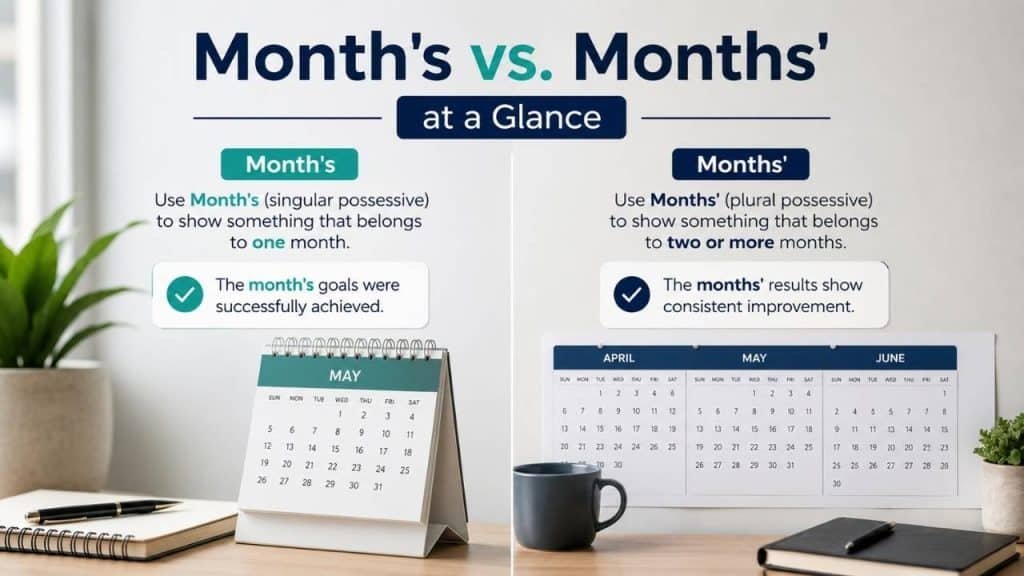
To understand month’s vs months’ grammar rules, it helps to compare them side by side. Both forms come from possessive nouns, but they show different levels of ownership. The placement of the apostrophe changes the meaning completely, which is why many writers search for month’s or months’ which is correct.
Here is a simple comparison:
| Form | Type | Meaning | Example |
| Month’s | Singular possessive | Belonging to one month | One month’s notice |
| Months’ | Plural possessive | Belonging to multiple months | Two months’ salary |
| Months | Plural noun | More than one month (no ownership) | Three months passed |
This table makes it easy to remember the difference between month’s and months’. In real writing, especially in business English or academic writing, this distinction is important for clarity. Misplacing the apostrophe is one of the most common English grammar mistakes learners make.
What Does “Month’s” Mean?
The word month’s is the singular possessive form of “month.” It shows that something belongs to or is connected with one month only. In simple terms, it means ownership by a single month, which is an important concept in possessive nouns and apostrophe placement.
The grammar rule is straightforward: add an apostrophe + “s” to a singular noun. So, month becomes month’s. This is commonly used in English writing, especially in situations involving time, contracts, rent, or scheduling.
You use month’s when referring to something that lasts for or belongs to one month. For example, one month’s rent, a month’s delay, or one month’s notice. These are common expressions in both formal writing and everyday communication.
Understanding when to use month’s helps avoid confusion with plural forms like months’ and ensures correct usage in sentences.
What Does “Months'” Mean?
The word months’ is the plural possessive form of “month.” It shows that something belongs to more than one month. In simple terms, it means ownership shared by multiple months, which is an important part of plural possessive nouns in English grammar.
The rule is simple: when a plural noun already ends in s, you add only an apostrophe at the end. So, months becomes months’. This small change in apostrophe placement completely changes the meaning of a sentence.
You use months’ when referring to something that lasts for or belongs to several months. Common examples include two months’ salary, three months’ experience, or six months’ training. These expressions are often used in business writing, job descriptions, and formal communication.
Understanding when to use months’ helps you avoid mistakes like writing months’s, which is incorrect. Once you learn this rule, using months’ or months grammar correctly becomes very easy in both speaking and writing.
When to Use “Months” (Without an Apostrophe)
The word months without an apostrophe is simply the plural form of “month.” It does not show possession. Instead, it only tells us about quantity in English grammar. Many learners confuse this with month’s or months’, but the meaning is completely different.
You use months when you are talking about time in general, without showing ownership. For example, three months passed quickly, I waited for six months, or several months went by. In all these cases, nothing belongs to the months, so no apostrophe is needed.
This is a key rule in apostrophe usage and plural nouns. If there is no ownership or relationship, you must never add an apostrophe. This is one of the most common English writing mistakes, especially in beginner-level writing.
Understanding when to use months correctly helps improve clarity in both academic writing and business communication.
Month vs. Month’s vs. Months vs. Months’
This section helps you clearly understand the full difference between all four forms used in English grammar. Many learners search for month’s or months’ grammar rules, but the confusion becomes easy to solve once you compare them side by side.
| Form | Meaning | Usage Example |
| Month | Singular noun | One month passed |
| Month’s | Singular possessive | One month’s rent |
| Months | Plural noun | Three months passed |
| Months’ | Plural possessive | Two months’ salary |
This table removes confusion between singular possessive and plural possessive forms. The key idea is simple: apostrophes show ownership, while no apostrophe means only quantity.
The Apostrophe Rule Explained
The apostrophe rule in English grammar is based on possession. When you understand this rule, the difference between month’s and months’ becomes very easy.
For a singular possessive, you add ‘s to the noun. For example, month → month’s. This shows that something belongs to one month. For a plural possessive, when the noun already ends in s, you only add an apostrophe. So, months → months’.
This rule is used in many time expressions, such as one day’s work, two weeks’ notice, and three months’ experience. These patterns are very common in business English, contracts, and academic writing.
Once you understand this structure, you can apply it to many other nouns, not just “month,” making your grammar writing skills much stronger.
Months of Experience vs. Months’ Experience
Many writers get confused when they use expressions like months of experience and months’ experience in English writing. Both are used in job descriptions, resumes, and professional communication, but they follow slightly different grammar patterns.
Months of experience is the more common and natural form. It simply describes the amount of time someone has worked, without showing possession. For example, I have six months of experience in marketing. Here, there is no ownership, so we avoid an apostrophe.
On the other hand, months’ experience uses the plural possessive form. It suggests that the experience belongs to those months, which is grammatically correct but less commonly used in modern writing. For example, I have six months’ experience in marketing.
Both forms are correct in English grammar, but months of experience is clearer and more widely accepted in business writing and academic writing. Understanding this helps avoid common grammar mistakes and improves your writing accuracy.
One Month’s vs. Two Months’
Expressions like one month’s, two months’, and similar time-based phrases are very common in everyday English. They are often used in rent agreements, salary discussions, notice periods, and other professional contexts.
When you say one month’s notice, you are referring to something that belongs to a single month. The grammar rule uses the singular possessive form, so you add ‘s to “month.” For example, one month’s rent or one month’s delay.
When you use two months’ notice, you are talking about something that belongs to more than one month. In this case, you use the plural possessive form, so you only add an apostrophe after “months.” For example, two months’ salary or two months’ training.
This distinction is important in English grammar rules because it ensures clarity in formal communication. Misplacing the apostrophe can change meaning or make writing look unprofessional.
Real-Life Examples
Understanding grammar becomes easier when you see real-life usage. The forms month’s, months’, and months are used in many areas of English writing, including business, education, and daily conversation.
In business writing, you might see phrases like one month’s notice, two months’ salary, or six months’ contract. These are common in job agreements and HR documents.
In academic writing, expressions like three months’ research or a month’s study period are often used to describe time durations.
In emails and formal communication, people use phrases like I will respond within one month’s time or after two months’ delay.
Even in daily conversation, you might hear sentences like I stayed there for three months or I need one month’s break. These examples show how important it is to understand possessive nouns and correct apostrophe usage in real situations.
Common Mistakes
Many learners make small but important grammar mistakes when using month’s, months’, and months in English writing. These mistakes usually happen because people confuse possessive nouns with simple plural forms.
One common mistake is writing “two month’s salary” instead of “two months’ salary.” This is incorrect because “two” means more than one month, so the plural possessive form must be used. Another frequent error is adding an apostrophe when it is not needed, such as writing “three month’s passed” instead of “three months passed.”
Some writers also forget the apostrophe completely in possessive cases, which leads to confusion in meaning. For example, “one months notice” is incorrect and should be written as “one month’s notice.”
These errors are common in both academic writing and business communication, especially among English learners. Understanding the basic rule of apostrophe placement helps avoid these issues and improves clarity in sentences.
Quick Grammar Cheat Sheet
This quick reference helps you remember the correct usage of month’s vs months’ grammar rules in seconds. It is useful for students, writers, and professionals who want to avoid English grammar mistakes in daily writing.
- Month’s = one month owns something
→ Example: one month’s rent - Months’ = more than one month owns something
→ Example: two months’ salary - Months = just plural, no ownership
→ Example: three months passed
The key idea is simple: apostrophe = possession, and no apostrophe = only quantity.
This cheat sheet helps you quickly decide between month’s or months’, especially when writing emails, essays, or professional documents. Keeping this rule in mind will improve your English writing skills and reduce common punctuation errors.
Memory Trick
A simple way to remember the difference between month’s, months’, and months is to focus on the number and ownership.
Think of it like this:
- If it is one month, use month’s (add ‘s).
- If it is more than one month, use months’ (apostrophe after s).
- If there is no ownership, just use months.
Another easy trick is:
“Before s = one, after s = many.”
This memory trick works for many possessive nouns, not just “month.” It helps you avoid confusion in English grammar rules and makes writing faster and more accurate.
With practice, you will automatically know whether to write month’s or months’ grammar forms correctly without thinking too much.
FAQS
Is month’s grammatically correct?
Yes, month’s is correct when showing possession of one month, such as one month’s rent.
Is months’ grammatically correct?
Yes, months’ is correct when something belongs to multiple months, such as two months’ salary.
Which is correct: month’s or months’?
Both are correct, but usage depends on whether you mean singular or plural possession.
Do months need an apostrophe?
No, months only needs an apostrophe when showing possession.
Is it one month’s notice or one months’ notice?
It is one month’s notice because it refers to a single month.
Is it months of experience or months’ experience?
Both are correct, but months of experience is more common and natural.
Why does the apostrophe move?
Because English changes apostrophe placement based on singular vs plural possession.
Does every plural need an apostrophe?
No, only plural nouns showing possession need an apostrophe.
Conclusion
Understanding the difference between month’s or months’ is a small but important part of mastering English grammar. Once you learn the rule of singular possessive and plural possessive, you can apply it to many other words beyond “month.”
Always remember:
- Month’s = one
- Months’ = many
- Months = just quantity
This simple logic helps you avoid common grammar mistakes and improves clarity in both formal writing and everyday communication. With regular practice, choosing between month’s vs months’ grammar forms becomes automatic and natural.