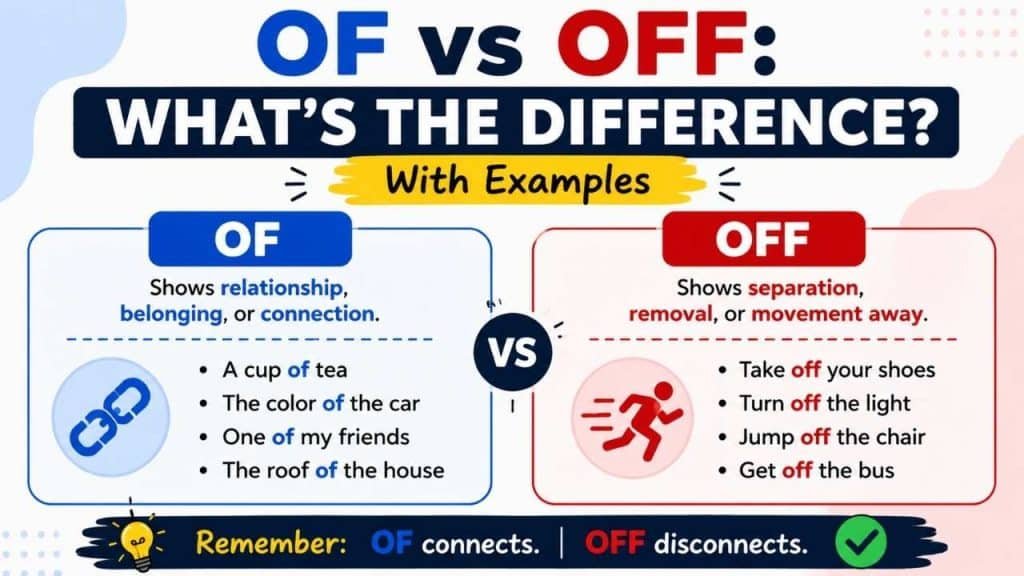

Many English learners confuse of vs off because both words sound similar in fast speech. However, these two words have very different meanings and grammar functions. Understanding the difference between of and off helps you avoid common grammar mistakes in speaking and writing.
The word “of” usually shows a relationship, connection, quantity, or belonging. On the other hand, “off” shows separation, removal, distance, or movement away from something. Even though they differ by only one letter, using the wrong word can completely change a sentence’s meaning.
Many people ask questions like “Is it of or off?” or “When should I use of and off?” because these confusing English words often create problems for beginners and ESL learners. In this guide, you will learn the of and off difference, common mistakes, grammar rules, pronunciation tips, and real sentence examples in a simple and easy way.
Quick Difference Between Of and Off
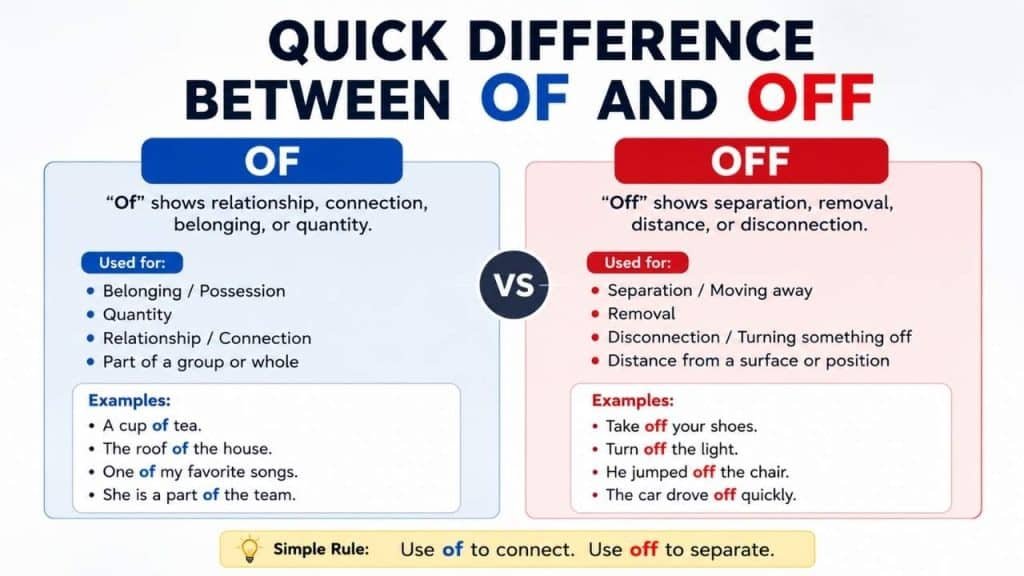
The quick difference between of and off is simple once you understand their basic functions. The word “of” connects things, while “off” shows separation or movement away. This small spelling change creates a big difference in English grammar and sentence structure.
You usually use “of” to show belonging, quantity, or connection. For example:
- a piece of cake
- the color of the car
- one of my friends
You use “off” when something moves away, stops, or becomes disconnected. For example:
- take off your shoes
- turn off the light
- jump off the chair
Many English learners confuse these words because the pronunciation sounds similar in spoken English. This confusion often causes common grammar mistakes like writing “take of” instead of “take off.” Learning the correct use of vs off helps improve both writing and communication skills.
Comparison Table: Of vs Off
Understanding of vs off grammar becomes much easier when you compare both words side by side. This table shows the most important differences, meanings, and sentence patterns in a simple format.
| Feature | Of | Off |
| Main Meaning | Shows connection or belonging | Shows separation or movement away |
| Grammar Role | Preposition | Preposition, adverb, adjective |
| Common Usage | Quantity, relationship, origin | Removal, distance, disconnection |
| Example | a cup of tea | take off your jacket |
| Common Mistake | “piece off cake” | “take of shoes” |
| Pronunciation | Soft “ov” sound | Strong “off” sound |
| Memory Tip | Connects things together | Pushes things away |
This grammar comparison helps beginners quickly understand the difference between off and of with examples. Many ESL learners find visual grammar tables easier because they organize information clearly and reduce confusion between commonly confused words.
What Does “Of” Mean?
The word “of” is one of the most common prepositions in English grammar. It usually shows a relationship, belonging, quantity, origin, or connection between people or things. Learning the meaning of of helps you build correct sentences in both spoken and written English.
You often use “of” to show possession or connection:
- the door of the house
- the pages of the book
- a member of the team
You also use it to show quantity:
- a glass of water
- a piece of pizza
- a group of students
Many sentence patterns in English use this word naturally. Common examples include:
- one of the best
- part of the story
- because of the weather
These patterns appear daily in conversations, academic writing, and professional communication. Understanding when to use of in a sentence improves grammar accuracy and helps English learners avoid confusing prepositions in English.
What Does “Off” Mean?
The word “off” usually shows separation, removal, distance, or disconnection. Unlike “of,” this word often describes movement away from something. Understanding the off meaning in English helps learners avoid common English word confusion.
You commonly use “off” when something leaves a surface or position:
- jump off the table
- fall off the bike
- take off your shoes
You also use it when something stops working:
- turn off the fan
- switch off the computer
In many phrasal verbs, “off” changes the meaning of the verb completely:
- cut off
- show off
- call off
- break off
These expressions appear often in everyday English and casual conversation. Many grammar mistakes happen because learners accidentally replace “off” with “of.” For example, writing “turn of the light” sounds incorrect because the sentence needs the idea of stopping or disconnecting something. Learning when to use off in a sentence improves both speaking and writing confidence.
Why Do People Confuse Of and Off?
Many English learners confuse of vs off because the two words sound very similar in spoken English. Native speakers often pronounce “of” quickly as “ov,” which makes it sound close to “off.” This pronunciation confusion causes many common grammar mistakes in writing and conversation.
Another reason involves spelling. Both words contain almost the same letters, so learners sometimes type the wrong one without noticing. For example:
- ❌ get of the bus
- ✅ get off the bus
People also confuse these words because they appear in very common sentence patterns. In fast speech, phrases like “kind of” or “off of” may sound unclear to beginners and ESL students.
This problem becomes even more common for people learning English as a second language because some languages do not use similar prepositions. Understanding the difference between of and off through examples, pronunciation practice, and grammar exercises helps learners avoid these confusing English words more easily.
When to Use “Of”
You should use “of” when you want to show connection, belonging, quantity, origin, or relationship. This word acts as a very common preposition in English grammar and appears in thousands of everyday sentences.
Use “of” to show belonging:
- the color of the bag
- the roof of the building
Use it to show quantity:
- a bowl of rice
- a pair of shoes
You can also use “of” to show relationships or groups:
- one of my classmates
- part of the movie
Many common English expressions also use this word:
- because of
- kind of
- full of
Learning when to use of and off correctly helps improve sentence structure and writing clarity. If your sentence shows connection instead of separation, you probably need “of.” Reading more English examples and practicing sentence patterns can help learners remember the correct use of of naturally.
When to Use “Off”
You should use “off” when you want to show separation, movement away, removal, or disconnection. This word often describes action and movement, so it appears frequently in spoken English and daily communication.
Use “off” when something leaves a place or surface:
- the cat jumped off the couch
- he fell off the ladder
Use it for removal:
- take off your hat
- cut off the string
You also use “off” when stopping machines or devices:
- turn off the TV
- switch off the light
Many phrasal verbs use “off” because the word naturally suggests distance or separation:
- drop off
- walk off
- pay off
- break off
If your sentence talks about moving away or disconnecting something, you likely need “off.” Understanding the correct off and of grammar rules helps learners avoid writing mistakes like “take of” or “turn of,” which sound incorrect in standard English usage.
Common Mistakes with Of and Off
Many learners make grammar mistakes with of and off because both words sound similar during fast conversation. However, even a small spelling mistake can completely change the meaning of a sentence.
Here are some common errors:
| Incorrect Sentence | Correct Sentence |
| take of your shoes | take off your shoes |
| he fell of the bike | he fell off the bike |
| piece off cake | piece of cake |
| turn of the light | turn off the light |
One major reason behind these mistakes involves pronunciation. Native speakers often pronounce “of” softly, which confuses beginners. Some learners also memorize spoken English without learning grammar patterns properly.
To avoid confusing prepositions in English, focus on sentence meaning. If the sentence shows connection or belonging, use “of.” If it shows removal or movement away, use “off.” Practicing examples daily helps English learners improve grammar accuracy and avoid common writing mistakes naturally.
Is “Off Of” Grammatically Correct?
Many people ask, “Is off of grammatically correct?” The short answer is yes, but the phrase depends on the situation and writing style. In casual American English, people often say “off of” during conversation. However, formal writing usually prefers just “off.”
For example:
- Informal: She jumped off of the chair.
- Formal: She jumped off the chair.
Both sentences sound natural, but professional and academic writing usually removes the extra “of” because it keeps sentences cleaner and simpler.
Native speakers commonly use “off of” in spoken English because it feels more conversational. You will hear it often in movies, interviews, and daily communication. Still, many grammar experts suggest avoiding it in formal writing.
Understanding the difference between “off” and “off of” helps improve grammar choices and writing style. If you want concise and polished English, using “off” alone usually works best in most situations.
Of vs Off in Pronunciation
Pronunciation plays a big role in the confusion between of vs off. Although the words have different meanings, they often sound similar in fast speech. This similarity causes many spelling mistakes for English learners and beginners.
Native speakers usually pronounce “of” softly. It often sounds like “ov” instead of a strong “of” sound. For example:
- cup of tea → “cup ov tea”
The word “off” has a clearer and stronger ending sound:
- turn off the radio
- take off your coat
Because both words appear often in spoken English, learners sometimes write what they hear instead of following grammar rules. This problem becomes common in casual conversation and listening exercises.
One simple memory trick helps here:
- Of sounds softer because it connects things.
- Off sounds stronger because it creates separation.
Practicing pronunciation slowly and reading sentences aloud can improve listening skills and reduce grammar mistakes with these commonly confused English words.
Memory Tricks to Remember Of vs Off
Simple memory tricks can help learners remember the difference between of and off more easily. These shortcuts work especially well for beginners and ESL students who struggle with confusing English words.
A helpful trick involves the extra letter:
- Off has two “F” letters because it pushes something far away.
- Of has one “F” because it simply connects things together.
You can also focus on meaning:
- Of = connection
- Off = separation
Here are two quick examples:
- a piece of chocolate → connection
- jump off the wall → movement away
Visual learning also helps many students. Imagine “off” physically pushing something away from a surface. In contrast, imagine “of” linking two ideas together.
Repeating sentence examples daily improves memory faster than memorizing grammar rules alone. Reading English books, listening to conversations, and practicing small grammar exercises can help learners use of and off naturally and confidently in real communication.
Real-Life Examples of Of and Off
Seeing real-life examples makes the of vs off difference much easier to understand. These words appear daily in conversations, school writing, business communication, and social media posts.
Daily Conversation
- I got off the train early.
- She bought a bag of apples.
School and Academic Writing
- The title of the essay looks interesting.
- Please turn off your phone during class.
Workplace Communication
- He took the day off from work.
- The manager of the company spoke today.
Social Media and Casual English
- That song is kind of relaxing.
- Log off your account before leaving.
These examples show how each word works naturally in different situations. The word “of” usually connects ideas, while “off” shows movement, removal, or separation. Practicing everyday examples helps English learners improve grammar understanding and avoid common writing mistakes more effectively.
Mini Quiz: Can You Choose the Correct Word?
Test your understanding of of vs off with this quick grammar quiz. Try to choose the correct word before checking the answers below.
Fill in the blanks
- Please turn ___ the lights before leaving.
- She drank a cup ___ coffee this morning.
- The child fell ___ the chair.
- One ___ my friends lives in Canada.
- Take ___ your jacket because it feels warm.
Answers
- off
- of
- off
- of
- off
This exercise helps learners recognize the correct use of of and off in sentence structure. If the sentence shows connection or belonging, the answer is usually “of.” If it shows movement away, stopping, or removal, the correct word is usually “off.”
Practicing small grammar activities like this improves memory, increases confidence, and helps learners avoid confusing English grammar mistakes in real communication.
FAQs
What is the difference between of and off?
The word “of” shows connection, belonging, quantity, or relationship. The word “off” shows separation, removal, distance, or movement away from something.
Is it “of” or “off”?
The correct choice depends on the sentence meaning. Use “of” for connection and “off” for separation or disconnection.
Why do people confuse of and off?
People confuse these words because they sound similar in spoken English and share similar spelling patterns.
Is “off of” correct?
Yes, people commonly use “off of” in informal American English. However, formal writing usually prefers simply using “off.”
How can I remember the difference between of and off?
Remember this simple trick:
- Of = connection
- Off = separation
What part of speech is “of”?
The word “of” works as a preposition in English grammar.
What part of speech is “off”?
The word “off” can work as a preposition, adverb, or adjective depending on the sentence.
Conclusion
Understanding the difference between of and off becomes much easier once you focus on meaning and sentence structure. Although these commonly confused words sound similar, they perform very different grammar functions in English.
Use “of” when you want to show connection, belonging, quantity, or relationship. Use “off” when you want to show separation, movement away, removal, or disconnection. Learning these simple grammar rules helps improve writing clarity and speaking confidence.
Many English learners struggle with of vs off grammar because pronunciation can sound confusing in fast conversation. However, regular practice, sentence examples, and memory tricks make the difference easier to remember over time.
The best way to master these words involves reading, listening, and practicing daily examples. Once you understand the patterns, you will naturally choose the correct word in both spoken and written English without hesitation.