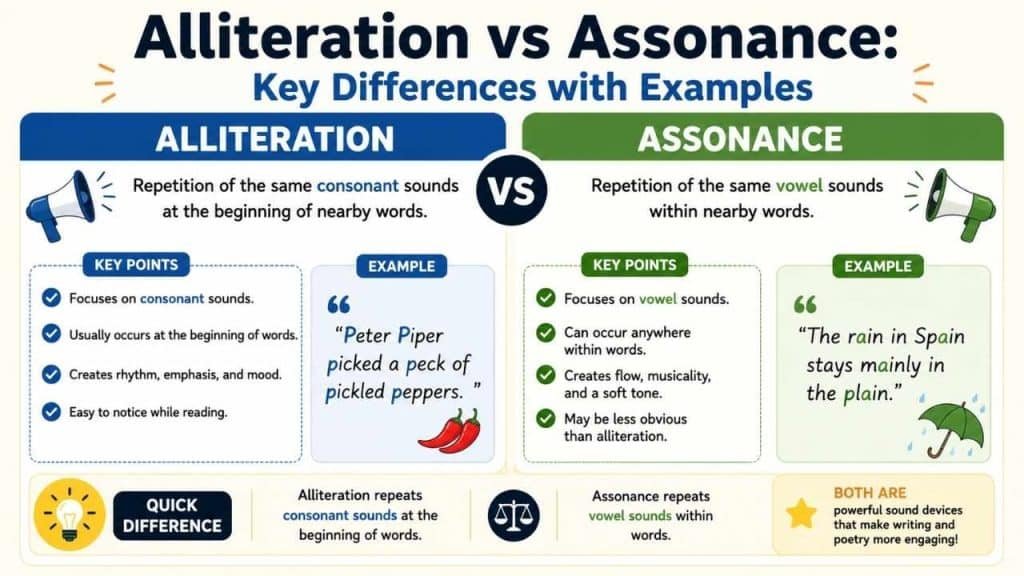

Sound devices are an important part of English literature and poetry, but many learners confuse them. Two of the most commonly mixed-up terms are alliteration vs assonance. These are both types of literary devices in poetry that use repetition of sounds to create rhythm and meaning. However, they are not the same.
Alliteration focuses on the repetition of consonant sounds, while assonance focuses on the repetition of vowel sounds. This simple difference often appears in exams, making it essential for students studying English literature devices or preparing for GCSE and A-level English literature.
In this guide, you will clearly understand the difference between alliteration and assonance, see easy examples, and learn how to identify them quickly. By the end, you will confidently recognize these sound devices in poetry without confusion.
Quick Answer
The difference between alliteration and assonance is the type of sound repetition used. Alliteration repeats consonant sounds at the beginning of nearby words, while assonance repeats vowel sounds within words. Both are important sound devices in poetry used to create rhythm, mood, and emphasis. They are commonly tested in English literature devices and help improve literary devices comparison understanding.
Comparison Table: Alliteration vs Assonance
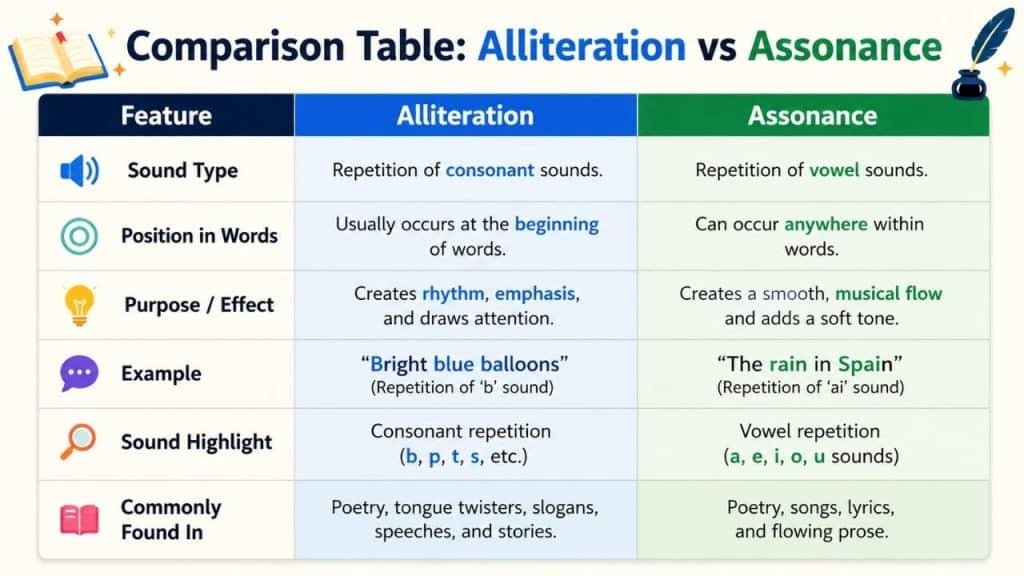
| Feature | Alliteration | Assonance |
| Sound Type | Repetition of consonant sounds | Repetition of vowel sounds |
| Position | Usually at the beginning of words | Anywhere inside words |
| Effect | Creates rhythm, emphasis, and mood | Creates flow, musical tone |
| Example | “She sells sea shells” | “The rain in Spain stays mainly” |
This simple comparison clearly shows the difference between alliteration and assonance in poetry. Students often use this table for exam revision English literature because it makes learning fast and easy. Both devices play a key role in repetition in poetry and are widely used in writing. Understanding this table helps you quickly identify phonetic devices in poetry without confusion.
What is Alliteration?
Alliteration is a literary device where writers repeat the same consonant sound at the beginning of nearby words. It is widely used in poetry, storytelling, and figurative language devices to create rhythm and make phrases more memorable. For example, “bright blue balloons” repeats the “b” sound. This repetition improves the flow and adds emphasis to writing.
Alliteration is commonly studied in English literature devices and appears frequently in GCSE poetry devices comparison questions. It is easy to identify because the repeated sound usually appears at the start of words. Writers also use alliteration in advertising and speeches to make messages more powerful. This technique strengthens the emotional impact of writing and improves readability in both creative and academic contexts.
What is Assonance?
Assonance is a sound device that repeats vowel sounds within nearby words. Unlike alliteration, it does not depend on the first letter but focuses on internal sound patterns. For example, “the light of the fire is bright” repeats the long “i” sound. Assonance is widely used in literary devices in poetry to create rhythm, mood, and musical flow. It helps writers make sentences sound smooth and expressive.
You will often see assonance in poems, songs, and even speeches where emotional tone is important. It is a key part of sound devices in literature and is frequently tested in A-level English literature devices questions. Understanding assonance improves your ability to analyze poetry and identify phonetic devices in poetry accurately.
Alliteration vs Assonance
The main difference between alliteration vs assonance lies in sound type and placement. Alliteration uses consonant repetition at the start of words, while assonance uses vowel repetition inside words. Alliteration creates a sharp, rhythmic effect, whereas assonance produces a smoother, flowing sound.
In literary devices comparison, both are essential for building tone and mood in writing. Writers often combine them in poetry to enhance emotional impact and musical quality. Another key difference is how easily they are recognized—alliteration is more obvious, while assonance requires careful listening.
These differences are important for students studying English literature devices and preparing for exams. Understanding both helps improve your poetry analysis tools and strengthens your ability to interpret sound devices in poetry accurately.
Memory Trick to Remember the Difference
A simple way to remember alliteration vs assonance is through a memory trick. Think of Alliteration = Alphabet repetition, because it usually repeats the same consonant sound at the start of words. On the other hand, Assonance = Airy vowel sounds, because it focuses on repeating vowel sounds inside words.
This trick helps students quickly recall the difference between vowel and consonant repetition in poetry. Many learners use mnemonics during exam revision English literature to avoid confusion between literary devices.
Another easy idea is: Alliteration = “same starting sound,” while Assonance = “same inner vowel sound.” These simple memory tools make it easier to identify sound devices in poetry during exams and improve understanding of literary devices comparison questions.
Can a Sentence Contain Both Alliteration and Assonance?
Yes, a single sentence can include both alliteration and assonance. Writers often combine these sound devices in literature to create stronger rhythm and emotional impact. For example, a sentence may repeat consonant sounds at the beginning of words while also repeating vowel sounds inside words.
This combination enhances the musical quality of writing and improves its flow. In literary devices in poetry, this technique is common because it adds depth and texture to language. Understanding this helps students answer advanced A-level English literature devices questions.
It also shows how flexible figurative language devices can be in creative writing. Recognizing both patterns together improves your poetry analysis skills and strengthens your understanding of repetition in poetry.
Why Writers Use Alliteration and Assonance
Writers use alliteration and assonance to improve the sound, rhythm, and emotional effect of their writing. These sound devices in poetry make sentences more engaging and memorable. Alliteration adds sharpness and emphasis, while assonance creates a smooth and musical flow.
Both techniques are important in literary devices in poetry because they help express mood and tone more effectively. Writers also use them in speeches, branding, and storytelling to attract attention. In English literature devices, these techniques are often analyzed to understand meaning and style.
They also help readers connect emotionally with the text. Learning the difference between alliteration and assonance in poetry improves comprehension and strengthens your ability to analyze figurative language devices in exams and literature studies.
Common Mistakes Students Make
Students often confuse alliteration vs assonance because both involve sound repetition. One common mistake is thinking that all repetition is alliteration, but that is not correct. Another error is mixing consonance vs assonance vs alliteration, which leads to incorrect answers in exams.
Some students also assume that sound repetition must always appear at the beginning of words, which only applies to alliteration. Assonance, however, can appear anywhere inside a word. These misunderstandings affect performance in GCSE literary devices and A-level English literature exams.
To avoid confusion, always focus on whether the sound is a vowel or consonant. Practicing examples regularly helps improve recognition of sound devices in poetry and strengthens your understanding of literary devices comparison questions.
Quick Practice Examples
Try identifying whether each example uses alliteration or assonance:
- “Peter Piper picked a peck of pickled peppers.”
- “The rain in Spain stays mainly in the plain.”
- “Wild wind whistles wildly.”
These exercises help you practice how to identify alliteration in a sentence and how to identify assonance in poetry. Practicing such examples improves your understanding of sound devices in literature and builds confidence for exams. You can also try creating your own sentences using both techniques. This is a powerful way to master literary devices in poetry and improve your English literature devices skills.
FAQs
What is the main difference between alliteration and assonance?
The main difference is that alliteration repeats consonant sounds, while assonance repeats vowel sounds in nearby words.
What is alliteration in simple words?
Alliteration is a sound device in poetry where the same consonant sound repeats at the start of words, like “wild wind whistles.”
What is assonance in simple words?
Assonance is a literary device where vowel sounds repeat inside words, such as “the rain in Spain.”
Can alliteration and assonance appear in the same sentence?
Yes, writers often combine both sound devices in poetry to create rhythm and musical flow in writing.
Is assonance a type of alliteration?
No, both are separate figurative language devices with different sound patterns and rules.
Why do writers use alliteration and assonance?
Writers use them to improve rhythm, mood, and emphasis in poetry, speeches, and creative writing.
How can I quickly identify alliteration vs assonance?
Check the sound type: consonants = alliteration, vowels = assonance.
What are examples of alliteration?
Examples include phrases like “bright blue balloons” and “she sells sea shells.”
What are examples of assonance?
Examples include “the light of the fire is bright” with repeated vowel sounds.
Where are these devices commonly used?
They are widely used in poetry, literature, advertising, and speeches to make language more engaging.
Conclusion
In conclusion, the difference between alliteration vs assonance is simple once you understand the sound patterns. Alliteration repeats consonant sounds at the start of words, while assonance repeats vowel sounds inside words. Both are important sound devices in poetry and are widely used in literary devices in poetry to create rhythm, mood, and meaning.
They help writers make language more musical and expressive in poems, speeches, and creative writing. Students often study these in English literature devices because they appear in exams and reading analysis. By learning the difference between alliteration and assonance in poetry, you can easily avoid confusion and improve your understanding of figurative language devices.
With practice, you will quickly identify both devices in any text and answer literary devices comparison questions with confidence.