People often confuse idiom vs proverb because both belong to figurative language in English. However, they are not the same. Understanding the difference between idioms and proverbs helps learners improve communication, writing, and exam performance.
An idiom vs proverb comparison shows that idioms express ideas in a hidden or non-literal way, while proverbs share general truths or advice. For example, idioms like “break the ice” do not mean their literal words, but a proverb like “honesty is the best policy” gives a clear life lesson.
In this article, we will explain idioms and proverbs meaning, their definitions, and key differences with simple examples. You will also learn how they appear in daily communication and why students often confuse them. This guide will make the topic easy for anyone searching for difference between idioms and proverbs with examples or simple explanations.
Quick Answer
Idioms and proverbs are both parts of figurative language, but they are different. Idioms are short phrases with hidden meanings that are not literal, while proverbs are complete sentences that give advice or truth. Idioms make speech more expressive, whereas proverbs teach life lessons. Understanding both improves English fluency, vocabulary, and communication skills in daily life and exams.
What Is an Idiom?
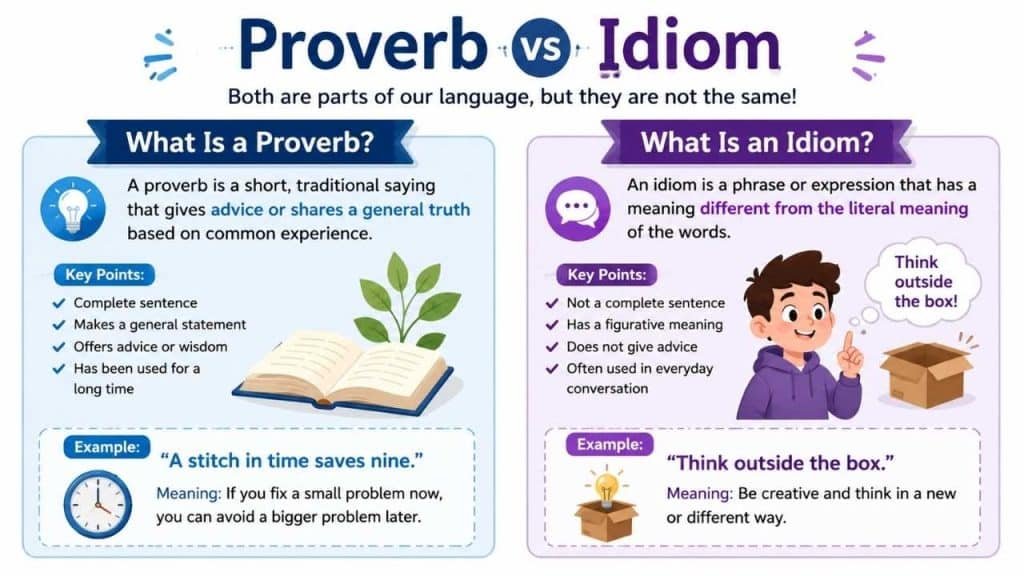
An idiom is a group of words that carries a non-literal meaning. This means the actual words do not match the real meaning. Instead, the expression has a special meaning understood by native speakers. For example, “spill the beans” means to reveal a secret, not to drop beans. Idioms are widely used in daily English conversation, making speech more natural and expressive.
When people search for what is an idiom, they usually want simple explanations with examples like “piece of cake” (very easy) or “hit the sack” (go to sleep). Idioms do not give direct advice; instead, they express feelings, actions, or situations creatively.
They are often part of figurative language, which also includes metaphors and phrases used in informal communication. Understanding idioms helps learners improve fluency and understand native speakers more easily in real-life conversations and media content.
What Is a Proverb?
A proverb is a short, complete sentence that gives advice, wisdom, or a general truth. Unlike idioms, proverbs have a clear meaning that matches the words used. For example, “actions speak louder than words” teaches that behavior is more important than promises.
When learners search for what is a proverb, they usually expect simple, meaningful statements that are easy to remember. Proverbs often reflect life experience and cultural values passed down through generations. Common examples include “practice makes perfect” and “honesty is the best policy.” These expressions help people understand correct behavior in different situations.
Unlike idioms, proverbs are not just phrases; they stand alone as full sentences. They are widely used in education, speeches, and moral teaching. Understanding proverb meaning helps learners improve writing and speaking skills while also gaining cultural and practical knowledge of English communication.
Idiom vs Proverb: Key Differences (Comparison Table)
Understanding the difference between idioms and proverbs becomes easy when we compare them side by side. An idiom is a short phrase with a hidden meaning, while a proverb is a complete sentence that gives advice or truth. Idioms are used in casual speech, but proverbs are used to teach lessons or share wisdom.
Idioms do not give direct moral guidance, but proverbs always carry a message. For example, “break the ice” is an idiom, while “slow and steady wins the race” is a proverb. This comparison also shows that idioms are often figurative expressions, while proverbs are more direct and meaningful. Many learners search for idioms vs proverbs difference, especially for exams, so this table helps them quickly revise and understand both concepts clearly.
| Feature | Idiom | Proverb |
| Meaning | Hidden, non-literal | Direct, literal wisdom |
| Structure | Phrase | Full sentence |
| Purpose | Express ideas | Give advice/truth |
| Example | Break the ice | Honesty is the best policy |
Idioms vs Proverbs in Real-Life Communication
In real life, people use both idioms and proverbs, but they use them in different situations. Idioms appear mostly in casual conversations, movies, and daily speech. For example, someone may say “I’m feeling under the weather” to mean they are sick. On the other hand, proverbs are used when giving advice or sharing life lessons.
For example, “time is money” reminds people to value time. When learners search for how idioms and proverbs are used in English, they often want real-world usage examples. Idioms help make speech sound natural and expressive, while proverbs make communication more meaningful and wise. In workplaces, idioms are common in informal talks, but proverbs are used in motivational speech or teaching.
Understanding this difference helps learners improve both speaking and writing skills and makes communication more effective in different social and professional situations.
Idioms vs Proverbs Examples with Meanings
Examples make the idiom vs proverb difference much easier to understand. Idioms usually have meanings that cannot be guessed from the words themselves. For example, “piece of cake” means something very easy, and “hit the sack” means to go to bed. These are common idioms and proverbs examples used in daily English.
On the other hand, proverbs express clear truths or advice. For example, “practice makes perfect” means you improve by repeating actions, and “actions speak louder than words” means actions are more important than promises. When people search for idiom meaning and proverb meaning, they want simple explanations like these.
Idioms help make language more colorful, while proverbs give life lessons. Learning both helps students understand English better and use expressions naturally in writing, speaking, and exams. These examples also improve vocabulary and comprehension skills effectively.
Why People Confuse Idioms and Proverbs
Many learners confuse idioms and proverbs because both belong to figurative language in English. They also sound similar and are used in everyday communication, which increases confusion. Another reason is that both idioms and proverbs are short and often appear in textbooks without clear separation.
When students search for why idioms and proverbs are confusing, they usually struggle with meaning differences. Idioms use hidden meanings, while proverbs give direct life lessons, but this difference is not always clearly taught. Cultural exposure also plays a role because native speakers use both naturally in speech. Additionally, some expressions seem similar in structure, which leads to mistakes.
Understanding this confusion helps learners avoid errors in writing and speaking. By learning clear definitions, examples, and comparisons, students can easily separate idioms from proverbs and improve their English language accuracy in both academic and real-life communication.
Idioms vs Proverbs: Quick Memory Trick
A simple way to remember the difference between idioms and proverbs is to use a memory trick. Think of idioms as “hidden meaning phrases” and proverbs as “life lesson sentences.” Idioms never give full advice, while proverbs always share wisdom or truth.
For example, “break the ice” does not give advice, but “honesty is the best policy” teaches correct behavior. When learners search for idioms vs proverbs simple explanation, they want easy ways to remember concepts quickly. This trick helps students in exams and daily learning because it reduces confusion.
Another way to remember is that idioms are short expressions inside sentences, while proverbs can stand alone. By using this simple method, learners can quickly identify whether a phrase is an idiom or proverb without memorizing long grammar rules or complex definitions.
Common Mistakes Students Make
Students often make mistakes when learning idioms and proverbs difference because they treat both as the same type of expression. One common mistake is using idioms in a literal sense, which changes the meaning completely.
Another mistake is using proverbs in casual conversation where idioms would be more natural. When learners search for idioms and proverbs examples and meanings, they often misunderstand context usage. Some students also mix up definitions, thinking every short expression is either an idiom or proverb without checking structure. Another issue is translating expressions directly from their native language, which leads to incorrect usage.
These mistakes affect writing quality and speaking fluency. By understanding correct meanings and practicing examples, learners can avoid these errors. Clear learning of idiom meaning and proverb meaning helps students improve grammar accuracy and communication skills in both academic and real-world English usage.
FAQs
What is the main difference between idioms and proverbs?
Idioms have hidden meanings in phrases, while proverbs give clear advice or truth in full sentences.
Can an idiom become a proverb?
Rarely. Idioms stay expressive phrases, while proverbs remain complete sentences with life lessons.
Why are idioms and proverbs important in English learning?
They improve fluency, vocabulary, and understanding of real English usage.
They also help in exams and daily communication.
Are idioms and proverbs the same thing?
No, idioms are phrases with non-literal meanings, while proverbs are full sentences with advice.
How can I easily remember idioms vs proverbs?
Idioms = hidden meaning phrases, Proverbs = life lesson sentences.
Do idioms and proverbs have cultural meanings?
Yes, both reflect culture, traditions, and shared life experiences.
Where are idioms and proverbs commonly used?
Idioms are used in casual speech, while proverbs are used in advice and formal communication.
What are common mistakes in using them?
Students often take idioms literally or mix them with proverbs.
Are idioms and proverbs used in exams?
Yes, they are often included in vocabulary and comprehension questions.
Can learning them improve speaking skills?
Yes, they make English more natural, fluent, and expressive
Conclusion
In conclusion, the difference between idioms and proverbs is clear once you understand their purpose and structure. Idioms are short phrases with hidden meanings, while proverbs are complete sentences that give advice or truth. Idioms make English more expressive and natural, while proverbs share wisdom and life lessons.
Both are important parts of figurative language in English and are widely used in daily communication, exams, and writing. Learning idioms and proverbs meaning with examples helps improve vocabulary, fluency, and understanding of real-life English. With regular practice, students can easily identify and use them correctly in both speaking and writing.