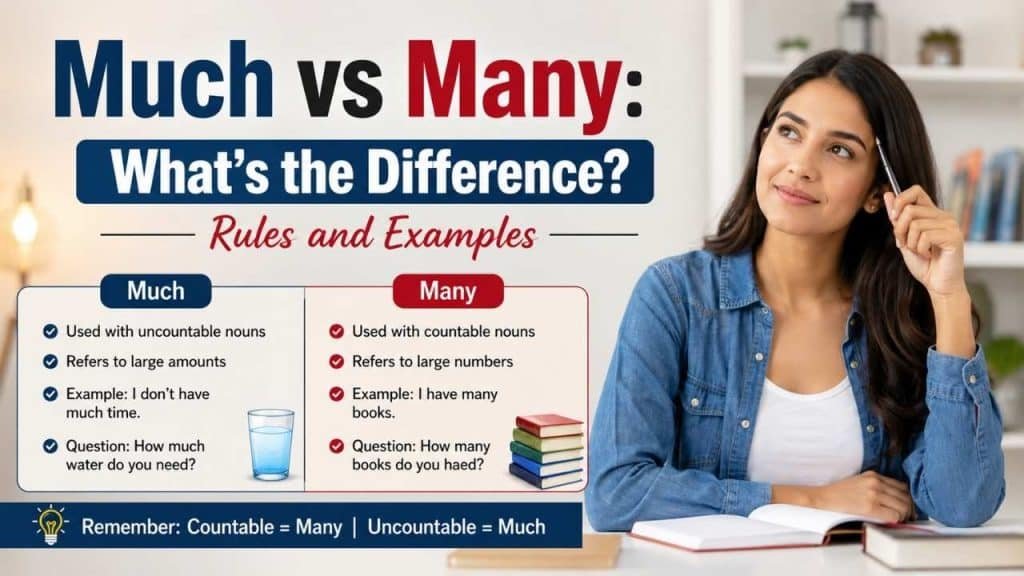

Many English learners confuse much vs many because both words talk about quantity. However, they follow different grammar rules. Understanding the difference between much and many becomes easy when you learn about countable and uncountable nouns. Use many with countable nouns like books or students. Use much with uncountable nouns like water or money.
If you often wonder when to use much and many, this guide will help you. You will learn simple rules, clear explanations, and real much vs many examples that improve your English grammar. We will also explain how much vs how many works in questions and daily conversation.
By the end of this article, you will know how to use much and many correctly without making common grammar mistakes.
Quick Answer: Much vs Many
The difference between much vs many is simple. Use much with uncountable nouns like water, money, and time. Use many with countable nouns like books, students, and cars. Remember this rule: if you can count it, use many; if you cannot count it, use much. This helps you avoid common English grammar mistakes easily.
Quick Difference Between Much and Many
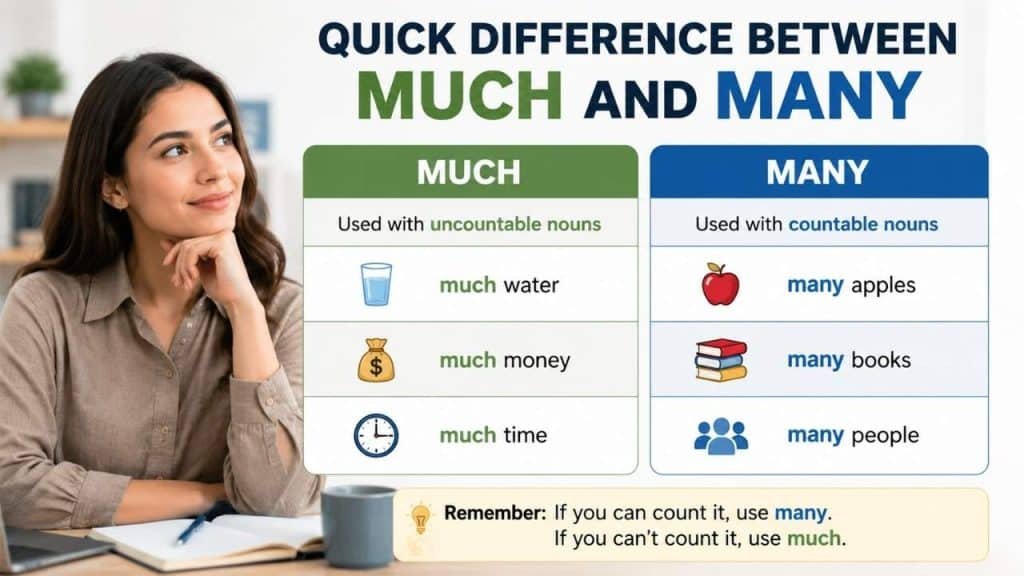
Understanding the quick difference between much and many helps you avoid common English grammar mistakes. Both words describe quantity, but they work with different noun types. Use many with countable nouns that you can count one by one, such as cars, books, or students. Use much with uncountable nouns that you cannot count separately, such as water, time, or information.
Here is a simple rule to remember:
| Much | Many |
| Used with uncountable nouns | Used with countable nouns |
| Much sugar | Many apples |
| Much money | Many friends |
These simple much vs many examples make the rule easier to understand. If you still wonder when to use much and many, think about whether the noun is countable or uncountable before writing your sentence.
What Does “Much” Mean?
The word much talks about a large amount of something that you cannot count separately. In English grammar, we use much with uncountable nouns like water, milk, money, time, and information. These nouns do not have a plural form, so they follow different grammar rules than countable nouns.
People often use much in questions and negative sentences. For example:
- How much water do you drink?
- I do not have much time today.
In formal writing, much can also appear in positive sentences.
- She showed much interest in the project.
Many learners ask how to use much and many correctly. A simple trick helps: if you cannot count the noun one by one, use much. Learning this rule makes much vs many easier to understand in daily conversation and writing.
What Does “Many” Mean?
The word many describes a large number of people, animals, or things that you can count. In English grammar, we use many with countable nouns like books, students, chairs, and cars. These nouns usually have singular and plural forms, which makes them easy to count.
People commonly use many in questions, negative sentences, and positive sentences. For example:
- How many students are in your class?
- There are many shops near my house.
- I do not have many friends here.
If you want to understand when to use much and many, remember this simple rule: use many when the noun has a plural form. This rule helps learners avoid common grammar mistakes. Clear much vs many examples also improve your confidence when speaking or writing in English every day.
Countable vs Uncountable Nouns
To understand much vs many, you first need to learn about countable and uncountable nouns. Countable nouns are things you can count one by one. Examples include books, apples, students, and chairs. These nouns have singular and plural forms. We usually use many with them.
Uncountable nouns describe things you cannot count separately. Examples include water, sugar, money, air, and information. These nouns usually do not have a plural form, so we use much with them.
| Countable Nouns | Uncountable Nouns |
| many books | much water |
| many ideas | much information |
| many apples | much sugar |
Many learners make mistakes because they confuse noun types. Once you understand this rule, how to use much and many correctly becomes much easier in both writing and conversation.
When to Use Much
Use much when you talk about an amount of something that cannot be counted separately. In English grammar, much works with uncountable nouns like water, money, time, and food. People often use it in questions and negative sentences.
Examples:
- How much money do you need?
- We do not have much milk left.
In formal English, writers also use much in positive sentences.
- She has much experience in teaching.
However, in casual conversation, native speakers often replace much with phrases like a lot of. For example:
- I have a lot of homework.
If you wonder when to use much and many, focus on the noun first. If you cannot count it one by one, choose much. This simple rule helps learners avoid common grammar mistakes and improve their everyday English.
When to Use Many
Use many when you talk about a large number of things or people that you can count. In English grammar, many always works with countable nouns. These nouns include words like students, cars, books, and cookies. Since you can count these items separately, many becomes the correct choice.
Examples:
- How many books did you buy?
- There are many people at the park.
- I do not have many questions today.
People use many in positive, negative, and question sentences. It appears often in daily conversation and writing because countable nouns are very common. If you still feel confused about much vs many, remember this easy rule: if the noun has a plural form, use many. Learning these simple grammar rules helps you write clearer sentences and speak English with more confidence every day.
Much vs Many in Questions
People often use much and many in questions when they ask about quantity. The choice depends on whether the noun is countable or uncountable. Use how much with uncountable nouns like water, money, or time. Use how many with countable nouns like books, students, or cars.
Examples:
- How much sugar do you need?
- How much time do we have?
- How many apples are on the table?
- How many people joined the meeting?
These question forms are very common in daily conversation and basic English grammar. Many learners mix them up because both ask about amounts. A quick trick can help: if you can count the noun one by one, use how many. If you cannot count it separately, use how much. Practicing these much vs many examples improves both speaking and writing skills.
Much vs Many in Negative Sentences
In English grammar, people often use much and many in negative sentences. Use much with uncountable nouns and many with countable nouns. These sentence patterns appear often in daily conversation and writing.
Examples with much:
- I do not have much time today.
- We do not need much sugar for the recipe.
Examples with many:
- She does not own many books.
- They do not have many options left.
Many learners understand the rule but still make mistakes while speaking. A simple way to avoid confusion is to check the noun first. If the noun is countable, use many. If the noun is uncountable, use much. Learning these easy grammar rules helps you understand how to use much and many correctly in real-life situations and improves your confidence in English communication.
Common Mistakes with Much and Many
Many English learners make mistakes with much vs many because they forget the difference between countable and uncountable nouns. The most common error happens when people use much with countable nouns or many with uncountable nouns.
Incorrect:
- Much books are on the table.
- Many water bottles are needed.
Correct:
- Many books are on the table.
- Much water is needed.
Another mistake appears in positive sentences. Native speakers usually avoid much in casual positive sentences. Instead of saying I have much homework, people often say I have a lot of homework.
To avoid these grammar mistakes, always check the noun type before writing your sentence. If you can count the noun one by one, use many. If you cannot count it separately, use much. This simple habit improves your English grammar quickly.
Much vs Many in Everyday Conversation
In everyday conversation, native speakers often use many more naturally than much in positive sentences. Although both words follow important grammar rules, spoken English sometimes sounds different from formal writing. People commonly replace much with phrases like a lot of or lots of during casual conversations.
Formal sentence:
- I have much work today.
Natural conversation:
- I have a lot of work today.
However, people still use much in questions and negative sentences.
- How much money do you need?
- I do not have much energy today.
The word many sounds natural in most sentence types.
- Many people enjoyed the event.
Learning these real-life much vs many examples helps you speak more naturally. If you want to improve your English grammar, listen to how native speakers use these words in daily conversations, movies, and simple dialogues.
Words Commonly Used with Much and Many
Some nouns appear very often with much and many in English grammar. Learning these common word pairs helps you understand how to use much and many correctly in daily conversation and writing.
People usually use much with uncountable nouns like:
- much time
- much money
- much information
- much water
- much effort
People commonly use many with countable nouns like:
- many people
- many students
- many books
- many ideas
- many cars
These combinations are called common usage patterns. They help learners sound more natural while speaking English. If you practice these simple much vs many examples, you will remember the rules more easily. Reading and hearing these phrases often also improves vocabulary and grammar skills. The more you use these word pairs in sentences, the more confident you will become in everyday English communication.
Much vs Many vs A Lot Of
Many English learners confuse much, many, and a lot of because all three talk about quantity. However, they follow slightly different grammar rules. Use much with uncountable nouns and many with countable nouns. People usually use both in formal writing, questions, and negative sentences.
Examples:
- much water
- many books
The phrase a lot of works with both countable and uncountable nouns. It also sounds more natural in everyday conversation.
Examples:
- a lot of water
- a lot of students
| Word | Used With | Example |
| Much | Uncountable nouns | much sugar |
| Many | Countable nouns | many apples |
| A lot of | Both types | a lot of homework |
Learning this difference helps you sound more natural and improves your overall English grammar skills.
Practice Exercises for Much and Many
Practice exercises help learners remember the difference between much vs many more easily. These simple activities improve your understanding of countable and uncountable nouns and help you avoid common grammar mistakes. Choose the correct word in each sentence.
- How _____ money do you have?
- There are not _____ students in the class today.
- We do not need _____ sugar for the cake.
- How _____ books did you buy yesterday?
- She has _____ friends at school.
Answers:
- much
- many
- much
- many
- many
These exercises improve your confidence and teach you how to use much and many correctly in real situations. Try writing your own sentences with much and many every day. Regular practice makes your English grammar stronger and helps you speak more naturally.
Much vs Many Quiz
This quick much vs many quiz will test your understanding of basic English grammar rules. Read each sentence carefully and choose the correct answer. These short questions help learners practice countable and uncountable nouns in a fun and easy way.
- How _____ water do you drink daily?
a) much
b) many - There are _____ cars in the parking area.
a) much
b) many - We do not have _____ time left.
a) much
b) many - How _____ apples do you want?
a) much
b) many
Answers:
- much
- many
- much
- many
Simple quizzes improve memory and help you understand when to use much and many correctly. If you practice often, you will make fewer grammar mistakes in writing and conversation. Regular grammar practice also builds confidence in spoken English.
Tips to Remember the Difference Between Much and Many
Simple memory tricks can help you remember the difference between much vs many quickly. The easiest rule is to focus on the noun type before choosing the word. Use many with things you can count and much with things you cannot count separately.
For example:
- many books
- many students
- much water
- much information
Another helpful tip is to look for plural nouns. If the noun ends in s and you can count it, use many. If the noun describes a mass or amount, use much.
You can also practice with how much and how many questions every day. Reading simple English sentences and listening to native speakers will improve your understanding naturally. These small habits make English grammar easier and help learners use much and many correctly in speaking, writing, and daily conversation without confusion.
FAQs About Much vs Many
Can we use “much” in positive sentences?
Yes, but it is rare in daily conversation. People usually say a lot of instead.
Is “many” used with uncountable nouns?
No, many is only used with countable nouns like books, chairs, or people.
What is the difference between “how much” and “how many”?
Use how much for uncountable nouns and how many for countable nouns.
Why do native speakers prefer “a lot of”?
Because it sounds more natural in spoken English and works for both noun types.
Can I use “much” and “many” in questions
Yes, both are commonly used in questions like How much water? and How many students?
Conclusion
Understanding much vs many becomes simple when you remember one key rule: count the noun first. Use many with countable nouns like books and students. Use much with uncountable nouns like water and money. This basic rule helps you avoid common grammar mistakes in writing and speaking.
We also learned how much vs how many, along with real much vs many examples in questions, negative sentences, and daily conversation. These patterns improve your fluency and make English easier to use in real life.
Keep practicing these simple rules every day. The more you use them, the more natural your English grammar will become, and you will confidently know when to use much and many without confusion.