
Many English learners often get confused between conjunction vs contraction because both terms sound similar but work in completely different ways in grammar. Understanding the difference between conjunction and contraction is important for writing clear and correct sentences.
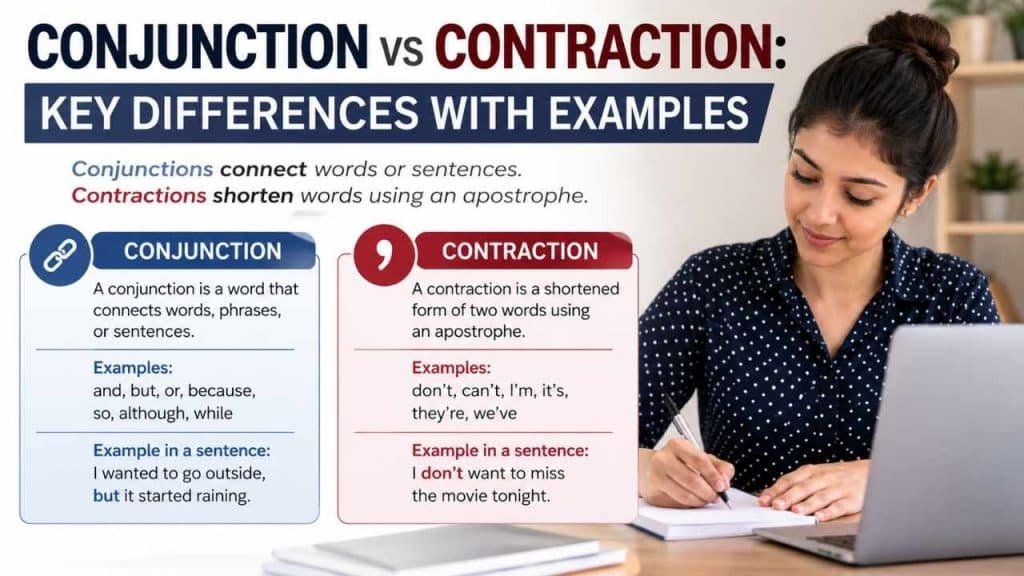
A conjunction is a word that helps connect words, phrases, or clauses, while a contraction is a shortened form of words created using an apostrophe, like don’t or I’m. Even though they may appear in the same sentences, their roles in English grammar are not related.
In this guide, you will learn the conjunction vs contraction difference with examples, simple rules, and easy explanations. This will help you avoid common grammar mistakes and improve your writing skills. Whether you are a student or a beginner in English, this topic will become very easy once you understand it step by step.
Quick answer
Conjunction vs Contraction is a common grammar confusion. A conjunction is a word that connects words, phrases, or sentences, such as and, but, or. A contraction is a shortened form of words using an apostrophe, like don’t or I’m. The difference between conjunction and contraction is function: one connects ideas, the other shortens words.
What Is a Conjunction?
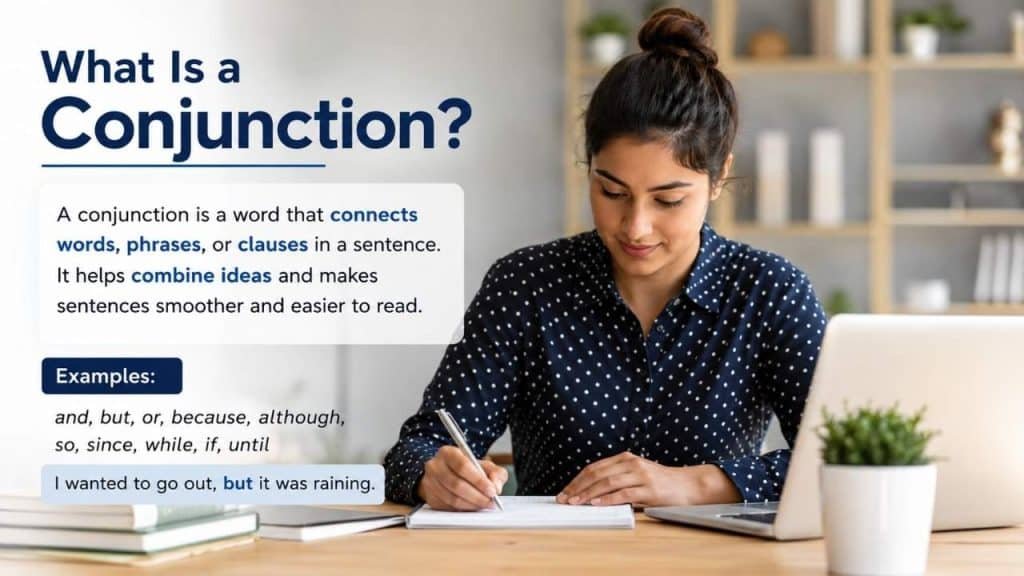
A conjunction is a word that connects words, phrases, or sentences in English grammar. It helps make sentences smoother and clearer by joining ideas together. Common conjunctions include and, but, or, because, although, and many more. For example, “I like tea and coffee” shows how a conjunction links two ideas.
Conjunctions are an important part of English grammar basics because they improve sentence flow and meaning. They also help avoid short, broken sentences. There are different types of conjunctions, such as coordinating, subordinating, and correlative conjunctions.
Understanding conjunctions helps you build better sentence structure and improves your writing skills. In short, conjunctions act as sentence connectors that join ideas in a meaningful way. They do not shorten words; instead, they focus on linking thoughts clearly and correctly in both spoken and written English.
What Is a Contraction?
A contraction is a shortened form of two words made by using an apostrophe (’). It helps make speech and writing more natural and less formal. For example, do not becomes don’t, I am becomes I’m, and they are becomes they’re.
Contractions are very common in everyday English, especially in speaking and informal writing. They make sentences shorter and easier to say. However, in formal writing like essays or exams, contractions are often avoided.
The main purpose of a contraction is to save time and make language more natural. It is important to remember that contractions are not joining words like conjunctions; instead, they are simply shortened word forms. Learning contractions helps improve fluency and understanding of real-life English conversations.
Conjunction vs Contraction: Key Differences
The difference between conjunction and contraction is very clear once you understand their roles. A conjunction connects words, phrases, or sentences, while a contraction shortens two words into one using an apostrophe.
Conjunctions help build sentence structure and link ideas smoothly. For example, I wanted to go, but it was raining. Here, but is a conjunction joining two ideas. On the other hand, contractions reduce word length, such as cannot → can’t or she is → she’s.
Another key difference is function. Conjunctions are used to show relationships between ideas, while contractions are used for convenience in speaking and informal writing. Conjunctions do not change word forms, but contractions change spelling.
In short, conjunctions connect sentences, while contractions shorten words. Understanding this conjunction vs contraction difference with examples helps improve grammar accuracy and writing clarity.
Side-by-Side Comparison Table
The conjunction vs contraction comparison makes it easier to understand their differences clearly. A conjunction is a grammar word that connects ideas, while a contraction is a shortened form of words using an apostrophe. Both are important in English, but they serve completely different purposes.
A conjunction works by linking words, phrases, or sentences. For example, I like apples and oranges. Here, “and” connects two ideas. A contraction, however, shortens words for easier speech, such as I am → I’m or do not → don’t.
Conjunctions belong to sentence structure rules, while contractions belong to word formation rules. Conjunctions are used in both formal and informal writing, but contractions are mostly used in casual communication.
This simple comparison helps learners quickly identify each one. If a word connects ideas, it is a conjunction. If it shortens words, it is a contraction. This table helps avoid confusion in everyday grammar use.
How to Identify Conjunctions and Contractions Quickly
You can easily identify conjunctions and contractions by checking their role in a sentence. A conjunction always connects words, phrases, or sentences. If a word is linking two ideas, it is most likely a conjunction. For example, in “She is smart and kind,” the word “and” connects two qualities.
A contraction, on the other hand, is always a shortened form of two words using an apostrophe. If you see an apostrophe (’), it often signals a contraction like don’t, isn’t, or we’re. This is a quick way to recognize them.
Another simple trick is to ask: does the word join ideas or shorten words? If it joins, it is a conjunction. If it shortens, it is a contraction.
Using this method helps you quickly understand the conjunction vs contraction difference without confusion. It also improves grammar accuracy in writing and speaking.
Common Mistakes Students Make
Many students confuse conjunctions and contractions because they look similar in sentences but serve different purposes. One common mistake is thinking that words like don’t or can’t are conjunctions. In reality, they are contractions, not joining words.
Another mistake is using contractions in formal writing, such as essays or exams. While contractions are fine in speaking, they are usually avoided in academic writing.
Students also mix up sentence roles. For example, they may not recognize that and, but, or are conjunctions that connect ideas, not shortened words.
Some learners also forget that contractions always include an apostrophe, while conjunctions never do. This simple rule helps avoid confusion.
By understanding these common errors, you can clearly master the difference between conjunction and contraction with examples. Practicing correct usage improves both writing clarity and grammar confidence.
Real Sentence Examples
Understanding conjunction vs contraction examples helps make grammar clearer. Conjunctions are used to connect ideas in sentences, while contractions are used to shorten words for easier communication.
For conjunctions, examples include:
- I wanted to go out but it started raining.
- She is smart and hardworking.
- You can have tea or coffee.
In these sentences, words like but, and, or connect different ideas smoothly.
For contractions, examples include:
- I am → I’m
- Do not → don’t
- They are → they’re
- It is → it’s
These contractions make sentences shorter and more natural in speech.
By studying these examples, you can easily understand the conjunction and contraction difference in English grammar. One connects ideas, while the other shortens words. Practicing examples regularly helps improve fluency and writing accuracy.
Can a Word Be Both a Conjunction and a Contraction?
A common question in grammar is whether a word can be both a conjunction and a contraction. The simple answer is no. A word cannot serve both roles because their functions are completely different in English grammar.
A conjunction is always used to connect words, phrases, or sentences. For example, and, but, or are always conjunctions because they link ideas together. They never shorten words or use apostrophes.
A contraction, on the other hand, is a shortened form of two words using an apostrophe, such as don’t, I’m, or we’re. These words do not connect ideas; they only make speech and writing shorter and easier.
This is why there is no overlap between the two categories. Understanding this helps reduce confusion in conjunction vs contraction grammar differences. If a word connects ideas, it is a conjunction. If it shortens words, it is a contraction.
Quick Memory Trick to Remember the Difference
You can easily remember the conjunction vs contraction difference with a simple trick. Think of conjunctions as “connectors” and contractions as “shorteners.” This small idea helps you quickly identify each one in sentences.
A conjunction connects words, phrases, or sentences. You can remember it with the word “join”—conjunctions join ideas together like and, but, or. If a word joins two ideas, it is a conjunction.
A contraction, however, is about shortening. You can remember it with the word “cut” because it cuts two words into one using an apostrophe, like don’t, I’m, they’re.
Another easy trick is: if you see an apostrophe (’), it is almost always a contraction. If there is no apostrophe and the word connects ideas, it is a conjunction.
This memory method makes grammar simple and helps you avoid confusion in everyday writing.
Mini Practice Quiz
Let’s test your understanding of conjunction vs contraction with a quick practice quiz. This will help you identify the difference between conjunction and contraction with examples more clearly.
Read each sentence and decide if the highlighted word is a conjunction or a contraction:
- I like tea and coffee.
- She don’t want to go outside.
- We can stay home or go out.
- It’s raining heavily today.
- He is tired but happy.
Answers:
- Conjunction
- Contraction
- Conjunction
- Contraction
- Conjunction
If you scored well, you clearly understand the basics of English grammar rules for conjunctions and contractions. If not, review the examples again. Practicing quizzes like this helps improve grammar skills and builds confidence in writing correct sentences.
FAQs
Many learners have questions about conjunction vs contraction, so here are simple answers to help clear confusion.
Is “don’t” a conjunction?
No, don’t is a contraction, not a conjunction. It is a shortened form of “do not.”
What is the easiest way to tell the difference?
If a word connects ideas, it is a conjunction. If it shortens words using an apostrophe, it is a contraction.
Why are contractions used in English?
Contractions are used to make speech and writing faster, easier, and more natural in informal communication.
What do conjunctions do in a sentence?
Conjunctions connect words, phrases, or sentences to improve flow and meaning.
Conclusion
Understanding conjunction vs contraction is simple once you learn their roles. A conjunction connects ideas in a sentence, while a contraction shortens words using an apostrophe. The difference between conjunction and contraction mainly lies in function, not appearance.
By learning examples, rules, and quick tricks, you can easily avoid confusion in writing. Practicing regularly helps you use both correctly in everyday English.